Govt Hikes MSP for All Rabi Crops, Incentivises Diversification
New Delhi: The Cabinet Committee on Economic Affairs (CCEA), chaired by Prime Minister Narendra Modi, today approved an increase in the Minimum Support Prices (MSP) for all mandated Rabi crops for the Marketing Season 2026-27.
The highest increase has been announced for safflower, with a rise of ₹600 per quintal, followed by lentil (Masur) at ₹300 per quintal. Other crops have also seen significant hikes: rapeseed & mustard by ₹250 per quintal, gram by ₹225 per quintal, barley by ₹170 per quintal, and wheat by ₹160 per quintal.
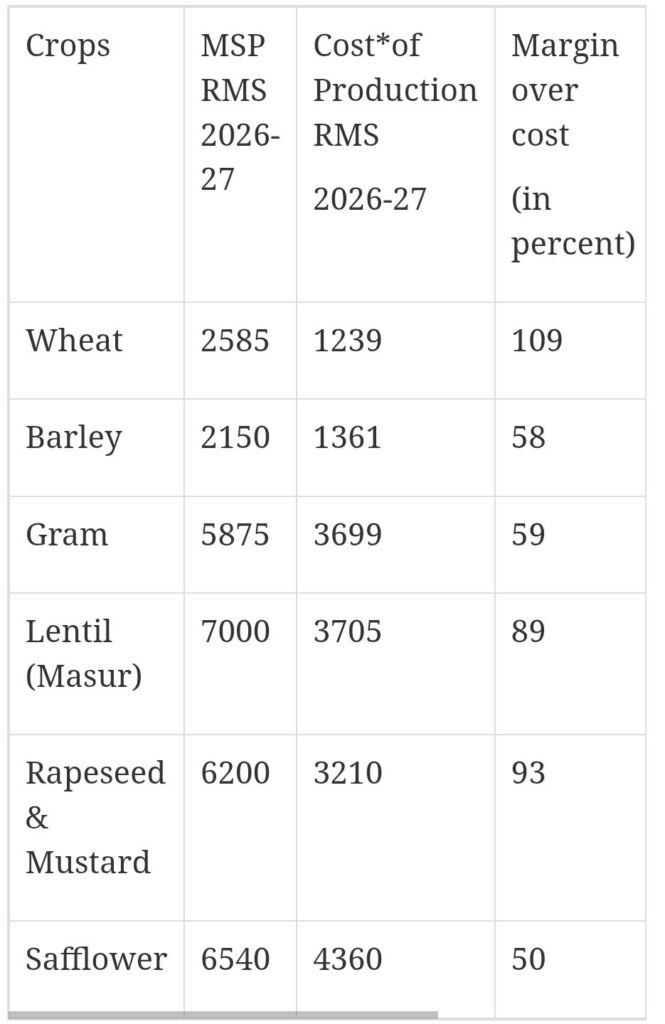
For comparison, the MSP for wheat in the previous season (2025-26) was ₹2,425 per quintal; barley ₹1,980; gram ₹5,650; lentil ₹6,700; rapeseed & mustard ₹5,950; and safflower ₹5,940. The revised MSPs for 2026-27 are ₹2,585 for wheat, ₹2,150 for barley, ₹5,875 for gram, ₹7,000 for lentil, ₹6,200 for rapeseed & mustard, and ₹6,540 for safflower.
The expected margins over the All-India weighted average cost of production for the upcoming marketing season are 109% for wheat, 58% for barley, 59% for gram, 89% for lentil, 93% for rapeseed & mustard, and 50% for safflower. The cost of production includes all paid-out costs such as hired labour, bullock or machine labour, rent for leased land, input materials like seeds and fertilisers, irrigation charges, depreciation on implements and farm buildings, interest on working capital, fuel and electricity for pump sets, miscellaneous expenses, and imputed value of family labour.
Minimum Support Prices for all Rabi crops for Marketing Season 2026-27
(Rs.per quintal)
The increase is expected to provide remunerative prices to growers and encourage crop diversification across the Rabi season. The government stated that the MSP hike aligns with the Union Budget 2018-19 announcement of setting MSP at a minimum of 1.5 times the All-India weighted average cost of production.
Officials emphasised that these MSP revisions are expected to encourage crop diversification in the Rabi season, providing farmers with incentives to explore alternative crops and reduce overdependence on a few staples. The government maintains that higher MSPs not only secure the livelihoods of farmers but also strengthen the food security of the nation by ensuring a stable supply of essential commodities.
– global bihari bureau