 By Nava Thakuria*
Guwahati High-Rise Blaze Mirrors Goa’s Lapses
Inferno Rekindles Fears of Urban Failures
Guwahati: The reverberations of the Goa fire disaster, still fresh in the public mind for its chilling demonstration of systemic failures, can be felt all the way in the Northeast as Guwahati grapples with its own unsettling reminder of how fragile urban safety really is. What happened in Goa — a supposedly upscale nightlife hub turning into a death trap because of illegal alterations, blocked exits and a regulatory apparatus that simply wasn’t paying attention — has become an uncomfortable backdrop to the slow-burning crisis now unfolding in the heart of Assam’s capital.
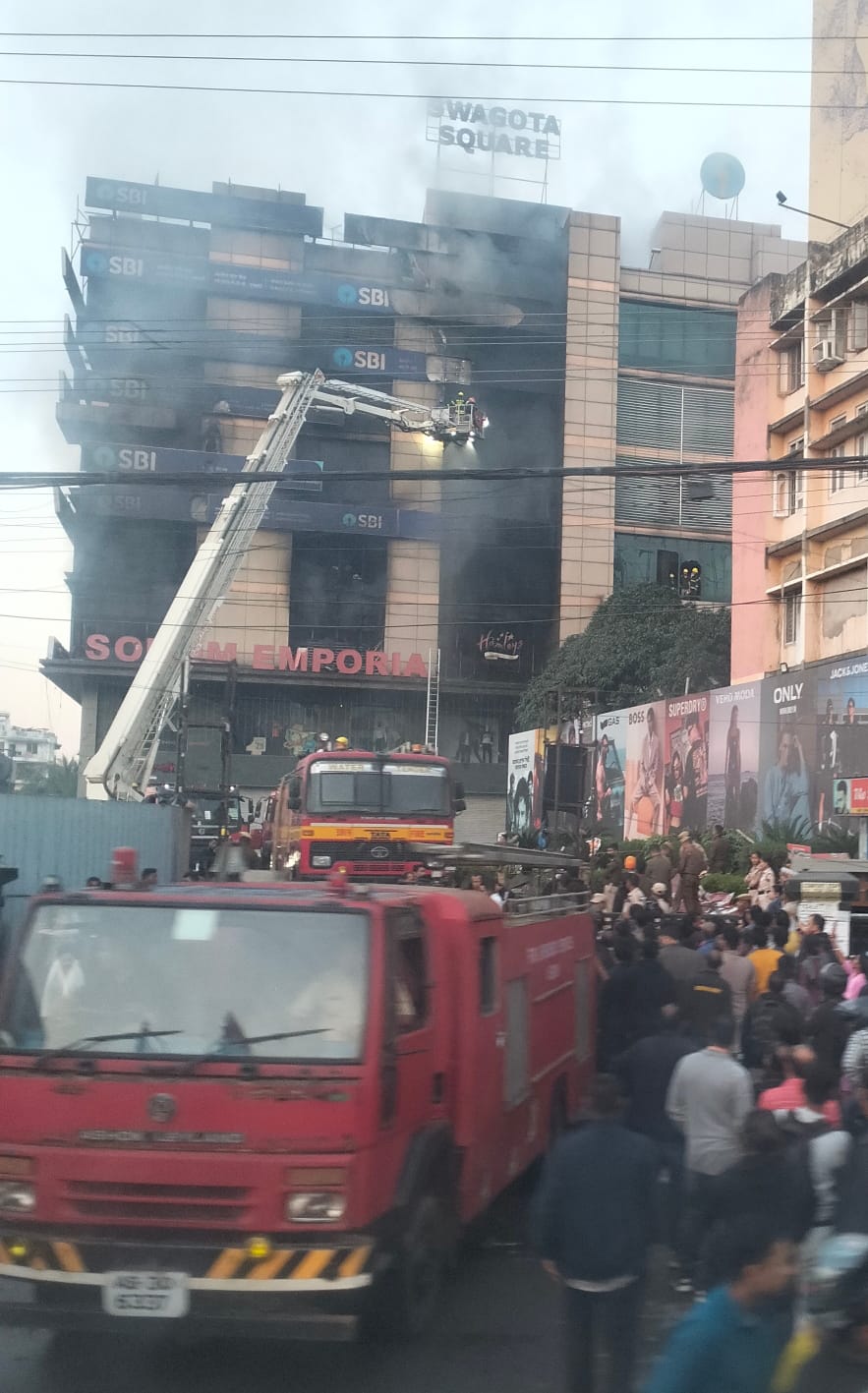
Here, a six-storey commercial complex at Christianbasti has been burning since the midnight of 9–10 December, its glass walls blown out, its interiors gutted, and its façade coughing out dense black smoke long after fire engines first arrived. The building, which houses the Sohum Emporia mall and offices of the State Bank of India, was supposed to have passed all necessary checks. On paper, it was compliant. On the ground, however, firefighters have been battling the blaze for days with limited visibility, depleted water reserves and obstructed access routes — a sequence of failures that mirrors the same complacency exposed in Goa.
No casualties have been reported, a rare sliver of relief in a disaster that otherwise lays bare a troubling truth: the city’s preparedness for high-rise emergencies remains dangerously inadequate. The All Assam Engineers’ Association (AAEA) has not minced words, calling the ongoing inferno a “collective breakdown” of the very agencies tasked with certifying such structures. Its leaders argue that the persistence of the blaze is itself evidence of deeper rot — buildings approved without rigorous scrutiny, safety systems installed only to satisfy paperwork, inspections reduced to rituals, and accountability scattered across departments that thrive on ambiguity.
The firefighters’ struggle points to serious infrastructural gaps. Water sources ran out early; access to the building’s rear was blocked; smoke was so dense that personnel often had to retreat; ladders could not reach critical points; and whatever fire-suppression systems the structure claimed to possess failed to make any meaningful difference. For a building of its size — always busy, always packed — these deficiencies were not hidden flaws but structural vulnerabilities waiting for ignition.
Authorities have said little about the state of the building’s internal fire-safety mechanisms. There is no clarity on whether sprinklers, alarms, hydrants, smoke detectors, refuge areas or evacuation plans existed in functional condition. What is known, however, is that the blaze originated in a second-floor godown and spread vertically — precisely the scenario modern fire-suppression systems are supposed to contain. The fact that it spread unchecked suggests a level of unpreparedness that borders on negligence.
Guwahati’s residents have drawn their own conclusions as they watch multiple agencies — the Assam Fire and Emergency Services, the National Disaster Response Force, IAF and Army teams — cycle through the same desperate efforts with uncertain progress. The sight evokes a broader anxiety: if a centrally located commercial complex equipped with declared safety compliance can burn for days, what faith can the public place in the city’s hundreds of rapidly constructed towers, many built in lanes where fire engines can barely pass?
The engineers’ forum has demanded strict action against officials who allowed the structure to rise and operate with apparent gaps. Their demand is not merely punitive; it raises a deeper question about the culture of approvals in rapidly expanding cities. If Goa’s nightclub disaster was a warning that India’s tourism hubs cannot rely on cosmetic compliance, Guwahati’s high-rise fire is a reminder that urban centres far from the national spotlight face the same rot — the same corner-cutting, the same bureaucratic evasions, the same illusion of safety.
Government response so far has been limited to firefighting rather than accountability. No detailed explanation has been offered about the building’s safety audit trail, the renewal of fire NOCs, or the role of civic inspectors. There has been no public release of inspection records, no identification of lapses, and no acknowledgement of systemic shortcomings. In a city prone to seismic activity and increasingly dense construction, the absence of transparent introspection is not just bureaucratic inertia — it is a risk multiplier.
As the smoke continues to rise over Christianbasti, the parallels with Goa become harder to ignore. One was a sudden, lethal catastrophe; the other is a slow, stubborn blaze. Yet both reveal the same underlying crisis: urban India is building upward far faster than it is building safely. Until systems of oversight shift from paperwork to real-world readiness, and until accountability is treated as an obligation rather than an afterthought, cities will keep learning the same lesson the hard way — sometimes through tragedy, sometimes through fire that simply refuses to go out.
*Senior journalist