
Addis Ababa: Global hunger rates have modestly declined for the second consecutive year, with an estimated 8.2 per cent of the world’s population — about 673 million people — experiencing hunger in 2024. This marks an improvement from 8.5 per cent in 2023 and 8.7 per cent in 2022. However, the overall progress masks widening disparities, as hunger has risen alarmingly across most subregions of Africa and Western Asia, according to the State of Food Security and Nutrition in the World (SOFI) 2025 report launched today in Addis Ababa during the Second United Nations Food Systems Summit Stocktake (UNFSS+4).
The report, jointly published by the Food and Agriculture Organization of the United Nations (FAO), International Fund for Agricultural Development (IFAD), United Nations Children’s Fund (UNICEF), World Food Programme (WFP), and the World Health Organization (WHO), estimates that between 638 and 720 million people faced hunger in 2024. Using the point estimate of 673 million, the data show a reduction of 15 million hungry people from 2023 and 22 million from 2022. Still, hunger levels remain significantly above pre-COVID-19 pandemic figures, due in large part to lingering effects of the health crisis and the high global food inflation observed over recent years.
Southern Asia and Latin America have seen marked improvement. In Asia, the prevalence of undernourishment fell to 6.7 per cent in 2024, or 323 million people, from 7.9 per cent in 2022. Latin America and the Caribbean also reported progress, with the rate of undernourishment dropping to 5.1 per cent or 34 million people in 2024, compared to 6.1 per cent in 2020. In contrast, the situation has worsened in Africa and Western Asia. Over 20 per cent of Africa’s population — about 307 million people — faced hunger in 2024, while in Western Asia, the proportion was 12.7 per cent, affecting more than 39 million people.
The report warns that if current trends persist, 512 million people could remain chronically undernourished by 2030, nearly 60 per cent of whom will be in Africa, posing a grave challenge to the achievement of Sustainable Development Goal 2 (Zero Hunger). FAO Director-General QU Dongyu emphasised the urgency of tailored global action, stating, “While it is encouraging to see a decrease in the global hunger rate, we must recognise that progress is uneven. SOFI 2025 serves as a critical reminder that we need to intensify efforts to ensure that everyone has access to sufficient, safe, and nutritious food.”
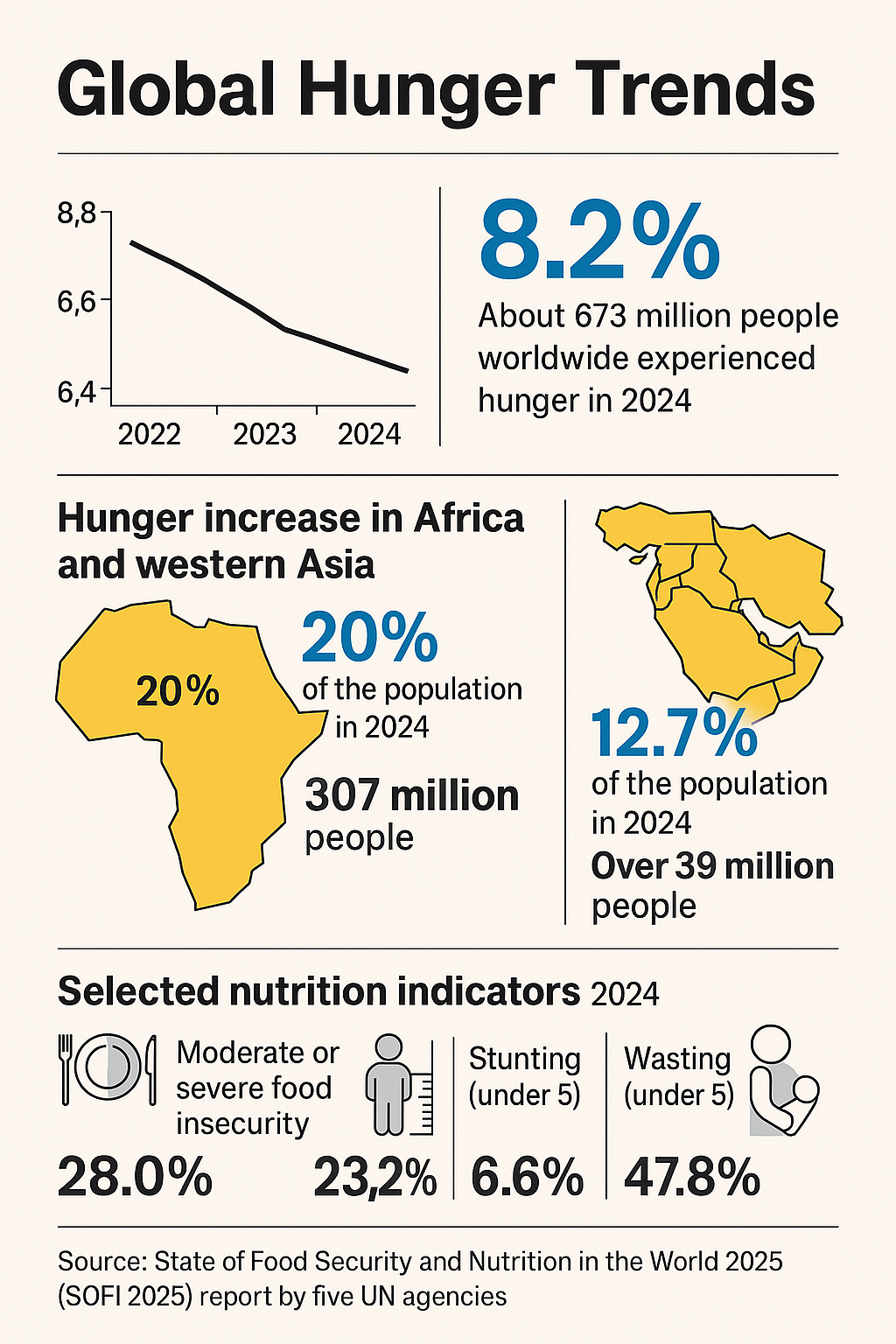
The report also tracks progress on key nutrition indicators. From 2023 to 2024, the global prevalence of moderate or severe food insecurity decreased marginally from 28.4 to 28.0 per cent, affecting 2.3 billion people — still 335 million more than in 2019 and 683 million more than in 2015. Childhood stunting declined to 23.2 per cent in 2024 from 26.4 per cent in 2012, indicating global progress. However, little change was observed in childhood overweight and wasting, while adult obesity rose sharply to 15.8 per cent in 2022 from 12.1 per cent in 2012. Exclusive breastfeeding rates for infants under six months improved significantly, from 37.0 per cent in 2012 to 47.8 per cent in 2023. Conversely, anaemia among women aged 15 to 49 rose to 30.7 per cent in 2023 from 27.6 per cent in 2012.
SOFI 2025 also explores the causes and consequences of the food price surge from 2021 to 2023. The report attributes inflationary pressures to the global policy responses to the COVID-19 pandemic — including massive fiscal and monetary stimulus — alongside the war in Ukraine and extreme weather events. Food price inflation has consistently outpaced headline inflation since 2020, peaking in January 2023 at 13.6 per cent, 5.1 percentage points higher than the general rate. This disparity was even more pronounced in low-income countries, where food inflation peaked at 30 per cent in May 2023.
Despite global price increases, the number of people unable to afford a healthy diet fell from 2.76 billion in 2019 to 2.60 billion in 2024. However, this decline was not universal. In low-income countries, where diet costs surged disproportionately, the number of people unable to afford healthy food rose from 464 million in 2019 to 545 million in 2024. In lower-middle-income countries excluding India, the figure grew from 791 million to 869 million during the same period.
To address the food inflation crisis, the report recommends a mix of policy interventions, including targeted and time-bound fiscal measures such as social protection schemes, credible and transparent monetary policies, and investments in agricultural research, infrastructure, and market systems to enhance productivity and resilience.
International Fund for Agricultural Development (IFAD) President Alvaro Lario stressed the urgency of action, stating, “In times of rising food prices and disrupted global value chains, we must step up our investments in rural and agricultural transformation.” United Nations Children’s Fund (UNICEF) Executive Director Catherine Russell emphasised the devastating impact of undernutrition on children, saying, “Every child deserves the chance to grow and thrive. The SOFI 2025 report underscores the need to act urgently for the world’s youngest and most vulnerable.” World Food Programme (WFP) Executive Director Cindy McCain warned that funding cuts are threatening aid delivery, noting, “This year, funding cuts of up to 40 per cent mean that tens of millions of people will lose the vital lifeline we provide.” World Health Organization (WHO) Director-General Dr. Tedros Adhanom Ghebreyesus added, “This report provides encouraging news, but also shows where the gaps are and who is being left behind.”
The SOFI 2025 report offers a mixed picture: hopeful signs of recovery in many parts of the world but worsening crises in others, especially in regions already grappling with conflict, climate shocks, and economic instability. The report makes clear that only sustained, coordinated action across multiple sectors can move the world closer to ending hunger and malnutrition for all.
– global bihari bureau