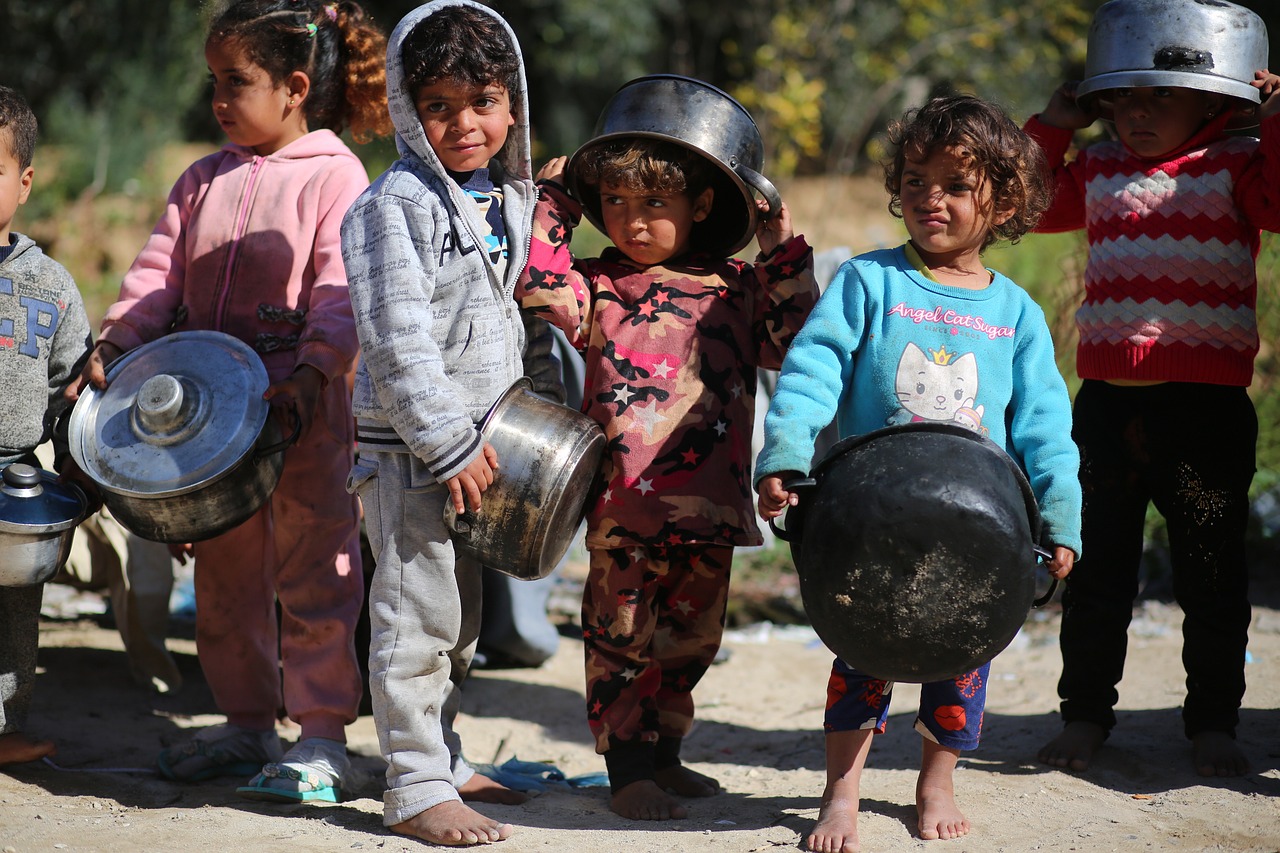
File photo of Gaza children
Rome: With famine looming, agriculture on the brink of total collapse, and the possible outbreak of deadly epidemics in Gaza, the Food and Agriculture Organization (FAO) today urgently called for the immediate restoration of humanitarian and commercial access and lifting of blockades. The latest Integrated Food Security Phase Classification (IPC) analysis, released today, warns that the entire population of the Gaza Strip—approximately 2.1 million people—faces a critical risk of famine due to 19 months of conflict, mass displacement, and severe restrictions on humanitarian aid and supplies.
From April 1 to May 10, 2025, 93% of the population (1.95 million people) were classified in Crisis or worse (IPC Phase 3 or above), including 244,000 (12%) in Catastrophe (IPC Phase 5) and 925,000 (44%) in Emergency (IPC Phase 4). The IPC projects that from May 11 to September 2025, the entire population will face Crisis or worse acute food insecurity. “The international community must act now. The immediate restoration of access to humanitarian and commercial supplies at scale is critical. Every delay deepens hunger and accelerates starvation, bringing us closer to famine,” said FAO Director-General QU Dongyu. “If we fail to act, we are failing to uphold the right to food, which is a basic human right and the legal protections that uphold it, undermining one of the core principles safeguarding civilian survival.”
Reestablishing immediate humanitarian and commercial access is critical to maintaining minimum local food production, particularly of livestock, which are the last accessible source of milk, eggs, and meat for many families, the FAO stated. A ban on all inputs has led to catastrophic losses, with livestock reduced to 36% for sheep, 39% for goats, 3.8% for cattle, 1.4% for layers and broilers, and 79.5% for working animals. An additional 20–30% are predicted to perish without aid. Commercial livestock production has largely ceased, with most operations now limited to household-level production for self-consumption. FAO has distributed over 2,100 tons of animal feed and veterinary kits to more than 4,800 herders, but supplies fall far short of needs. More veterinary kits, feed, and supplies are ready to be deployed by FAO and partners as soon as access is granted. Without these, herders lose critical food sources, and untreated animals pose serious public health risks, particularly for those working closely with animals, by becoming vectors for diseases that could trigger deadly epidemics. Preserving the remaining animals now is essential to prevent irreversible losses that could collapse livestock-dependent livelihoods entirely.
Gaza’s agriculture is on the brink of collapse. A geospatial assessment by FAO and UNOSAT (October–December 2024) reveals that 75% of fields used to grow crops and olive tree orchards have been damaged or destroyed. More than two-thirds of Gaza’s agricultural wells (1,531), which rely on groundwater for irrigation and agriculture, were no longer functional as of early 2025, severely debilitating irrigation efforts. An ongoing FAO-UNOSAT assessment indicates further reduction in usable agricultural land, leaving little space to preserve or restore livelihoods. Before October 2023, 42% of Gaza’s land (over 15,000 hectares) was used for crops, orchards, and livestock grazing, but ongoing hostilities have devastated this foundation, undermining food security and economic stability.
– global bihari bureau