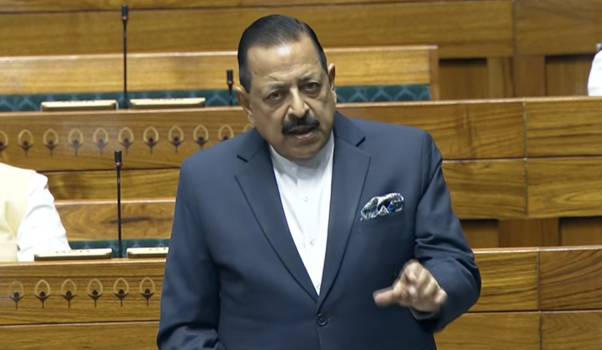
Dr Jitendra Singh in Lok Sabha today.
Gaganyaan parachute test and Bharatiya Antariksh Station plans signal India’s space leap
Govt: 2027 Crewed Mission Goal Strengthened by IMAT Milestone
New Delhi: India’s human space programme continues to take bold strides, with the successful Integrated Main Parachute Airdrop Test (IMAT) for the Gaganyaan Crew Module validating the country’s readiness for its first crewed mission, while long-term plans for the indigenous Bharatiya Antariksh Station (BAS) chart the next phase of sustained human presence in space. The parachute test, conducted on November 3, 2025, demonstrated the Crew Module’s ability to withstand extreme descent conditions, and Parliament was informed of progress on both immediate mission safety and future space infrastructure.
Union Minister of State for Science and Technology and Minister of State in the Prime Minister’s Office, Dr Jitendra Singh, told the Lok Sabha that the IMAT, conducted to test the Crew Module’s parachute-based deceleration system under extreme conditions, is a critical step toward the first crewed Gaganyaan launch, targeted in the first quarter of 2027. The test simulated a delayed disreefing between two main parachutes to evaluate performance under asymmetric loads, ensuring crew safety under worst-case descent scenarios. Outcomes from such trials are integrated into astronaut emergency training and system improvements.
Separately, ISRO’s November 11 press release provided technical details: the latest IMAT was carried out on November 3, 2025, at the Babina Field Firing Range (BFFR) in Jhansi, Uttar Pradesh. A simulated mass representing the Crew Module was dropped from 2.5 kilometres using the Indian Air Force’s IL-76 aircraft. The ten-parachute system—comprising apex cover separation, drogue, pilot, and main parachutes—deployed as planned, achieving a stable descent and soft landing. Built-in redundancy ensures that even with one main parachute inoperative, a safe landing is possible.
The main parachutes follow a reefed inflation sequence, partially opening first (reefing) and then fully inflating after a preset interval (disreefing), executed via pyro devices. The recent test successfully demonstrated performance under delayed disreefing between two main parachutes, validating load distribution and structural integrity under extreme conditions. The trial involved multiple organisations, including the Vikram Sarabhai Space Centre (VSSC), Aerial Delivery Research and Development Establishment (ADRDE), DRDO, the Indian Air Force, and the Indian Army, and is part of a series of progressively complex IMATs to qualify the system for human-rating.
Oversight of the parachute system and test results is carried out by independent panels such as the Design Review Team, the Independent Assessment Committee, and the National Advisory Panel for Human Rating and Certification. Major outcomes are shared periodically with the public. Astronaut training incorporates lessons from each qualification test, covering emergency drills, off-nominal landing procedures, survival kit operation, and psychological preparedness.
Alongside Gaganyaan, ISRO has also finalised the overall configuration for an indigenous space station, the Bharatiya Antariksh Station (BAS), comprising five modules. The first module, BAS-01, is targeted for development and launch by 2028, with the complete station expected to be operational by 2035. System engineering and technology development for BAS-01 are progressing, with the design reviewed by a National Level Review Committee and aligned with international standards to ensure interoperability with systems provided by other space agencies. Potential collaborations for technology development and use of niche test facilities are also being explored.
The budget for precursor missions, development, and launch of BAS-01 has been included in the revised scope of the Gaganyaan Programme, which received an enhanced allocation of ₹20,193 crore following Union Cabinet approval in September 2024. BAS is expected to enable sustained human spaceflight in India, supporting microgravity research, technology development, and future missions, including India’s planned lunar landing under Space Vision 2047.
Recently approved projects complementing this roadmap include Chandrayaan-4, Chandrayaan-5 ISRO–JAXA LuPex mission, Gaganyaan follow-on missions including Bharatiya Antariksh Station module-1, the Next Generation Launch Vehicle, and the Third Launch Pad.
– global bihari bureau