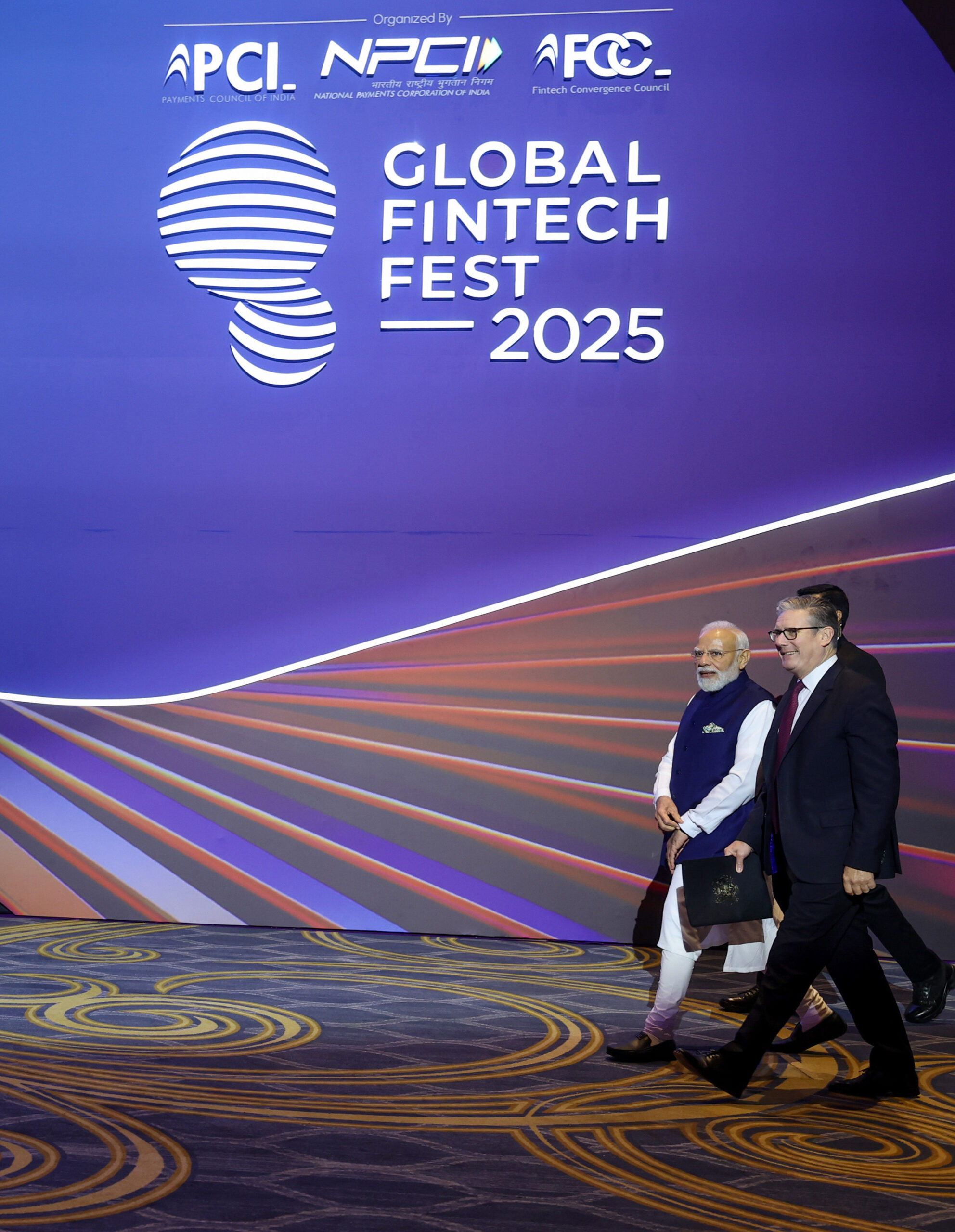
Prime Minister Narendra Modi of India and Keir Starmer of the United Kingdom participate in the Global Fintech Fest 2025, in Mumbai on October 09, 2025.
 By Deepak Parvatiyar*
Trade Wars to Quad Drills: India’s Strategic Shift
New Delhi: In a highly dynamic and unpredictable global scenario, India’s perceptible shift toward proactive resilience defines its 2025 policy framework, balancing economic autonomy with strategic assertiveness.
As global trade barriers rise and regional instabilities intensify, India’s 2025 policy landscape reveals a deliberate pivot toward economic diversification, defence interoperability, and multilateral diplomacy. This recalibration, rooted in developments through October 09, 2025, is not merely reactive but a calculated assertion of strategic autonomy—yet it grapples with implementation hurdles, domestic inequities, and the risk of overextension in a multipolar world.
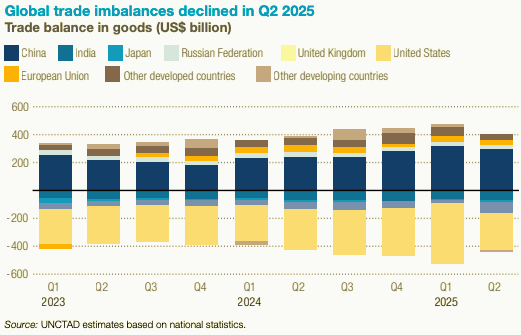
The United States (U.S.) tariffs, escalating to 50% on approximately $50 billion of Indian exports (textiles, gems, leather, and food products) effective August 27, exemplify these pressures: triggered by India’s continued purchases of discounted Russian oil, they threaten a slowdown in South Asia’s growth next year, with labour-intensive sectors facing job losses, per World Bank warnings. These measures, layered atop a 25% reciprocal tariff from April, expose vulnerabilities in U.S.-centric trade (20% of India’s export volume), but have accelerated longstanding diversification efforts, underscoring India’s capacity to adapt without capitulation. Critics, however, warn that short-term market disruptions could exacerbate rupee depreciation and inflation, potentially eroding gains if alternative corridors falter amid global slowdowns.
Central to this economic strategy is the acceleration of free trade agreements (FTAs), long in gestation but now propelled by tariff headwinds. The India-United Kingdom (UK) Comprehensive Economic and Trade Agreement (CETA), finalised in principle on May 6 and signed on July 24 during Prime Minister Narendra Modi’s London visit, predates the tariffs by months, evolving from 2021’s Enhanced Trade Partnership roadmap through 14 negotiation rounds. Operationalised via UK Prime Minister Keir Starmer’s October 9 Mumbai visit, it targets doubling bilateral trade to $112 billion by 2030, eliminating tariffs on 90-99% of goods (covering 92% of UK imports to India) and fostering synergies in advanced manufacturing (e.g., electric vehicles, aerospace), clean energy (offshore wind, green hydrogen), and financial technology (fintech) (Unified Payments Interface (UPI) integration). The relaunched Joint Economic and Trade Committee (JETCO) and inaugural Chief Executive Officer (CEO) Forum, attended by 125 UK executives, sealed 12 memoranda of understanding (MoUs) for semiconductors and green tech, while the £24 million Connectivity and Innovation Centre advances sixth-generation (6G), satellite connectivity, and cybersecurity standards. Nine UK universities, including Southampton’s operational Gurugram campus, aim to train thousands of Indian students annually by 2028 (aggregate projection from campus capacity plans), enhancing knowledge flows but facing scepticism over bureaucratic delays and uneven funding.
Also read: India-UK Seal Deals in Trade, Tech, Defence, Education
Proponents argue CETA buffers tariff-hit sectors, potentially adding $1.35 billion in UK textile exports, yet detractors highlight risks: without swift ratification (expected 2026), Indian Micro, Small, and Medium Enterprises (MSMEs) may struggle with compliance, and over-reliance on UK markets (projected 15% growth) could mirror U.S. dependencies if Brexit-era volatility recurs.
Parallel European Union (EU) FTA negotiations, relaunched in 2022, advanced significantly with the 14th round being held in Brussels from October 6-10, 2025, to close chapters on customs facilitation, intellectual property, and sanitary and phytosanitary (SPS) standards, eyeing a year-end conclusion for €124 billion in annual goods trade.
This could unlock EU market access for Indian services (information technology (IT), pharmaceuticals (pharma)) while addressing tariff asymmetries, but ~30% of Indian MSMEs lack EU compliance readiness, per exporter surveys (e.g., Global Trade Research Initiative (GTRI)), risking uneven benefits and heightened competition from low-tariff rivals like Vietnam.
Southeast Asian outreach, via Modi’s April 3-4 attendance at the 6th Bay of Bengal Initiative for Multi-Sectoral Technical and Economic Cooperation (BIMSTEC) Summit in Bangkok, secured ~$2 billion (estimated) in Thailand-linked port and rail projects—India’s fourth-largest Association of Southeast Asian Nations (ASEAN) partner—bolstering supply chains, yet ASEAN’s limited absorption (e.g., 10-15% offset for U.S. losses) underscores the challenge of rapid redirection.
Domestically, these external shocks demand internal fortification, where reforms like Goods and Services Tax (GST) 2.0 and Minimum Support Price (MSP) hikes aim to insulate growth but reveal fault lines. GST 2.0, effective September 22 post the 56th GST Council’s September 3 approval, consolidates primarily to two main slabs (5% and 18%), with 0% for essentials and 40% for demerit goods, axes 12% and 28% tiers, digitises compliance for Micro, Small, and Medium Enterprises (MSMEs), and corrects inverted duties—projecting 0.2-0.3% Gross Domestic Product (GDP) uplift via reduced litigation and festive-season spending boosts. Essentials like soaps, toothpaste, and electronics (air conditioners (ACs), televisions (TVs)) see rate cuts, enhancing affordability, but transitional 20% compliance cost spikes have ignited protests in Gujarat and Maharashtra, with small businesses decrying uneven digital access. October 1 MSP hikes for 2026-27 Rabi crops—wheat to ₹2,585/quintal (6.6% rise, 105% cost margin), barley at 7.03% to ₹1,980, mustard to ₹5,950 (5.31%, ~90% cost margin)—benefit 15 million farmers and incentivise diversification, aligning with 2018’s 1.5x cost pledge. Gram’s modest 3.86% to ₹5,650 draws union criticism for trailing 50% input inflation (e.g., fertilisers), potentially fueling rural discontent if procurement lags (26.6 million tonnes wheat bought in 2024-25). Optimists see these as resilience anchors, cushioning 0.9% GDP hits from tariffs, but pessimists foresee widened inequalities if urban-rural divides persist amid 6.4% International Monetary Fund (IMF) growth forecasts.

Defence policy, too, transitions from restraint to calibrated assertiveness, fortifying Indo-Pacific deterrence without alienating key partners. The inaugural India-Australia Defence Ministers’ Dialogue on October 9 in Canberra—attended by Rajnath Singh and Richard Marles—formalised mutual submarine rescue pacts, P-8I air refuelling, and Joint Staff Talks for cyber-space integration, amid Talisman Sabre 2025’s July debut (35,000 personnel) and Malabar’s November Quadrilateral Security Dialogue (Quad) phase, emphasising anti-submarine warfare. India’s peripheral Australia-United Kingdom-United States (AUKUS) engagement, tracking the UK-Australia SSN-AUKUS treaty (July 26, 12 UK subs over 50 years), explores Pillar 2 tech ties (artificial intelligence (AI), quantum, undersea) via informal talks since 2023, yet opposition flags costs (e.g., no tech transfers) and China escalation risks. Operation Sindoor’s May 7 strikes—targeting nine Jaish-e-Mohammed (JeM)/Lashkar-e-Taiba (LeT) sites in Pakistan-occupied Kashmir (PoK)/Punjab via drones/missiles post-April 22 Pahalgam attack (26 civilian deaths)—signals preemptive doctrine, but subsequent sporadic ceasefire violations highlight escalation perils, potentially straining U.S.-India ties if misperceived as adventurism. This posture deters China (South China Sea focus) but invites blowback if regional arms races intensify.
Regionally, India navigates volatility with pragmatic caution, balancing opportunity against influence erosion. Bangladesh’s Muhammad Yunus-led interim government, post-2024 unrest, faces May’s land transit suspension for ~$9.2 billion in annual textile/garment flows (contributing to a ~15% bilateral trade dip), straining ties amid cultural curtailments (e.g., scaled Durga Puja exchanges) and Yunus’s China pivot—yet Dhaka seeks dialogue, eyeing U.S. tariff wins (20% vs. India’s 25%). Nepal’s September youth protests—sparked by corruption/social media bans, killing 19 and forcing Prime Minister Khadga Prasad Sharma Oli’s resignation—alert India to Chinese infrastructure inroads (Belt and Road Initiative (BRI) projects), with Gen Z unrest (Kathmandu-centric) amid Oli’s meetings with Chinese President Xi Jinping; some analysts suggest potential external influences, though unverified—a monarchy revival could stabilise but complicate Delhi’s leverage. These dynamics affirm India’s stabilising role but risk ceding ground to Beijing if U.S.-China proxy frictions escalate.
Multilaterally, India attempts to master multipolarity, leveraging forums for leverage without subordination. India’s approach within the Brazil-Russia-India-China-South Africa (BRICS) grouping exemplifies this calibrated autonomy. At recent BRICS ministerials and the August 2025 Johannesburg+1 follow-up, India reaffirmed that de-dollarisation or a common BRICS currency is not part of its agenda, distancing itself from Chinese and Russian advocacy for alternative payment systems. Commerce Minister Piyush Goyal and External Affairs Minister S. Jaishankar have explicitly ruled out any shared currency framework, asserting India’s commitment to avoiding measures that could weaken the U.S. dollar. Instead, India promotes limited use of local currencies for trade settlements—a pragmatic hedge against volatility rather than an ideological shift. This stance enables India to engage constructively in BRICS economic cooperation while shielding itself from potential U.S. retaliation, as Washington has warned that BRICS efforts to challenge dollar dominance could trigger new tariff rounds.
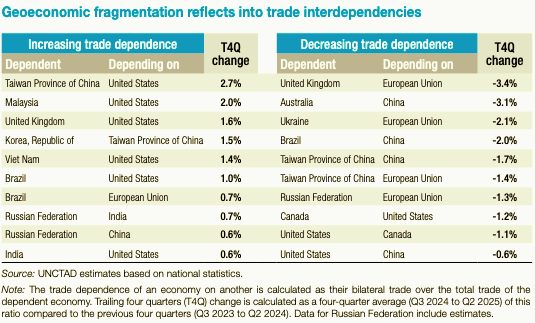
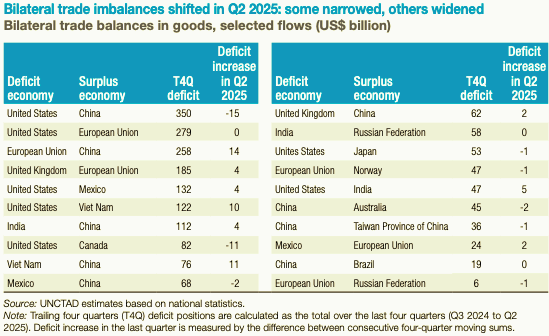
At the September 1 Shanghai Cooperation Organisation (SCO) Tianjin Summit (25th edition), Modi engaged Chinese President Xi Jinping and Russian President Vladimir Putin—reviving the Russia-India-China (RIC) trilateral—while advocating rules-based order and condemning the Pahalgam attack, signing 20 documents, including the 2026-2035 Strategy and granting Laos partner status. A pre-SCO August 30 Zelenskyy call coordinated Ukraine ceasefire support (Kyiv invite extended), with Modi reaffirming peace amid Trump’s funding critiques—positioning India as mediator, though neutrality frustrates Western allies. India’s October 9 endorsement of the Israel-Hamas phase-1 ceasefire (20-point, Qatar/Egypt/Turkey/U.S.-mediated)—committing to ongoing humanitarian assistance (e.g., recent 30-tonne tranches via United Nations Relief and Works Agency (UNRWA))—bolsters neutral broker status, but limited leverage questions efficacy if phase-2 (disarmament, withdrawal) stalls.
India’s 2025 strategy—trade buffers, defence synergies, fiscal stabilisers, and diplomatic agility—convincingly advances autonomy, mitigating tariff shocks (e.g., 6.4% growth intact) and projecting Indo-Pacific influence. Yet, a 360-degree lens reveals contingencies: if EU/BIMSTEC deals delay, U.S. duties could shave 0.9% GDP; regional unrest (Nepal/Bangladesh) might amplify Chinese sway; and multipolar tightropes risk alienating Quad partners. Success hinges on equitable execution—addressing MSME/farmer grievances and tech gaps—to transform pressures into enduring resilience, lest vulnerabilities undermine this ambitious arc.
*Senior journalist