

 By Deepak Parvatiyar*
Critical Minerals or Critical Damage?
Climate Crisis Meets Mining Rush as US Courts 54 Nations
What began as a ministerial on lithium, cobalt and rare earths has quietly revealed itself as something far larger: an attempt by the United States to redesign the political economy of the next industrial age.
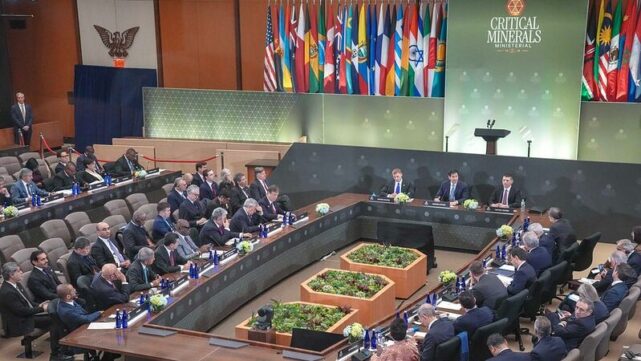
At the 2026 Critical Minerals Ministerial in Washington, attended by representatives from 54 countries from across Africa, Asia, the European Union, the Middle East and the Indo-Pacific on February 4, 2026, US officials presented an expansive strategy to restructure global supply chains for minerals that underpin artificial intelligence, robotics, batteries, defence systems and advanced manufacturing. Publicly framed as a diversification effort, the initiative also signals a shift toward a managed, alliance-based market architecture for resources now defined by Washington as strategic assets.
Net Zero, but at What Cost? US Leads Mining Bloc
Critical minerals matter right now in very concrete terms as demand for them is expected to multiply several times by 2030 due to electric vehicles, renewable energy storage, semiconductors and defence technologies. The Washington ministerial marks a decisive shift away from market-led mineral trade toward a security-driven architecture anchored in state financing, preferential agreements and managed pricing. While framed as diversification, the initiative effectively reorders global mineral flows along political lines. Financing, trade policy and diplomacy are now being fused into a single instrument of industrial strategy, echoing the logic of Cold War energy blocs rather than free commodity markets.
The meeting was called by President Donald Trump and hosted by Secretary of State Marco Rubio alongside Vice President JD Vance, Treasury Secretary Scott Bessent, Interior Secretary Doug Burgum, Energy Secretary Chris Wright and US Trade Representative Jamieson Greer. US officials argued that current critical minerals markets are dangerously concentrated and structurally fragile. They claimed that such concentration exposes supply chains to disruption and political leverage, compelling the creation of diversified and resilient systems spanning mining, processing, transport and manufacturing. They stressed that this vulnerability requires the construction of such diversified and resilient systems spanning mining. The objective, they said, is to secure end-to-end supply chains for technologies essential to economic transformation and national security. To that end, at the ministerial, Washington set forth a combination of diplomacy, finance and trade coordination, and along with its partners, announced a series of bilateral and multilateral measures.
In a single day, the U.S. signed eleven new bilateral critical minerals frameworks or memoranda of understanding with countries including Argentina, the Cook Islands, Ecuador, Guinea, Morocco, Paraguay, Peru, the Philippines, the United Arab Emirates and Uzbekistan. Ten similar agreements had been concluded in the previous five months, and negotiations were completed with seventeen additional countries. These frameworks are designed to structure cooperation across mining, refining, recycling and end-use applications.
Private sector participation was highlighted as central to the strategy. On February 3, government officials met with industry leaders to discuss supply chain risks and investment opportunities. Deputy Secretary of State Christopher Landau witnessed the signing of a memorandum of understanding between Glencore and the US-backed Orion Critical Mineral Consortium regarding a potential acquisition of assets in the Democratic Republic of the Congo. The agreement was described as aligned with the US-DRC Strategic Partnership Agreement, aimed at encouraging American investment in Congolese mining and ensuring secure and mutually beneficial flows of copper and cobalt. Following the ministerial, Landau and Under Secretary of State Jacob Helberg convened a task force of mining industry leaders to advance priority projects under the new framework.
For rare earth processing, mining technologies and battery materials, additional support has come through the Department of Energy’s Loan Programs Office and new funding initiatives. The US International Development Finance Corporation and the ‘Department of War’ (The U.S. Department of War was abolished in 1947, and its modern successor is the Department of Defense, but the official U.S. State Department release mentions Department of War, though the funding details correspond to DoD-related programmes) also reported equity and debt commitments across multiple countries. Trade policy is being integrated into the effort. The Office of the United States Trade Representative unveiled an action plan with Mexico and proposed joint frameworks with the European Commission and Japan. Washington unveiled government financing opportunities for strategic projects and formally launched a new multilateral platform called the Forum on Resource Geostrategic Engagement, or FORGE. The initiative replaces the earlier Minerals Security Partnership and will be chaired by the Republic of Korea through June. It is intended to coordinate policy and project-level cooperation among participating countries, aligning industrial policy with climate and security objectives while reducing exposure to supply concentration and market manipulation. US officials described it as a vehicle for collaboration on pricing challenges, market development, financing access and closing gaps in priority supply chains.
The financial scale of the initiative is unprecedented. The machinery to enforce this vision is formidable. The State Department said more than 30 billion dollars in letters of interest, loans and investments have been mobilised over six months, including a 10-billion-dollar Export-Import Bank direct loan – the largest in its history – for Project Vault, a national stockpile of critical minerals, which is a central component, announced by President Donald Trump on February 2, 2026, which aims to establish a domestic strategic reserve of critical minerals.
Over the past year, EXIM issued 14.8 billion dollars in letters of interest for critical minerals projects, including 455 million dollars for rare earth processing in the United States, 400 million dollars for lithium extraction in Arkansas, 350 million dollars for cobalt and nickel in Australia and 215 million dollars for tin extraction in the United Kingdom and Australia. Its authorised portfolio also includes 1.3 billion dollars for Pakistan’s Reko Diq copper and gold project and investments across Pennsylvania, Tennessee, New York and Virginia.
Through its Loan Programs Office, the Department of Energy has backed projects such as Lithium Americas’ Thacker Pass mine, Ioneer’s Rhyolite Ridge project, Glencore battery recycling, Syrah’s natural graphite processing facility and conditional commitments exceeding one billion dollars each for lithium hydroxide extraction, synthetic graphite processing and potash mining. New funding initiatives launched in 2025 include 134 million dollars for a rare earth demonstration facility, 355 million dollars for next-generation mining technologies and 500 million dollars for battery materials processing and recycling.
The ‘Department of War’, (the U.S. State Department used this term even as the said department as claimed by the US State reported equity and debt commitments to projects in Alaska, Western Australia, North Carolina, Indiana, the Republic of Korea, Tennessee, Jamaica and Louisiana, while the US International Development Finance Corporation said it is exploring more than one billion dollars in mineral exploration and supply chain projects in Ukraine, Brazil, Kazakhstan and Africa. These include a 600-million-dollar investment in the Orion Critical Minerals Consortium and 565 million dollars for rare earth extraction in Brazil.
Yet beyond the scale of announcements, the ministerial revealed a deeper strategic shift. The architecture being proposed would reorganise mineral flows along political lines rather than commercial ones. U.S. Vice President JD Vance made the logic explicit: markets, he said, are failing because prices collapse under strategic dumping, volatility and overproduction. He framed the initiative as a national security response. “This is not just a commercial problem. It is a national security problem,” he said, pointing to missile defence systems, energy infrastructure and advanced manufacturing as being hostage to supply chains that can “vanish in the blink of an eye.” He accused previous administrations of failing to map global supply vulnerabilities and said the Trump administration was responding with unprecedented public financing and industrial policy.
Vance’s solution was not market reform but price floors, tariffs and a preferential trade zone for critical minerals with reference prices fixed at each stage of production and enforced through adjustable tariffs. These price floors, he argued, would eliminate strategic dumping and make long-term investment viable. He invited allies and partners to join what he described as a trading bloc that would guarantee stable access in emergencies and protect domestic producers from being driven out of business by subsidised competition.
Secretary of State Marco Rubio echoed this logic, tracing American vulnerability to decades of neglect of upstream extraction and processing. He reinforced the link between mineral security and national security. He traced America’s vulnerability to decades of neglect of mining and processing, recalling how the Mountain Pass rare earth discovery once powered the jet age and the space age before being abandoned. He compared the present moment to the 1970s oil crisis that led to the creation of the International Energy Agency, arguing that a similar institutional response is now required for critical minerals. But the analogy reveals as much as it obscures. The International Energy Agency was designed to stabilise energy markets; the emerging mineral regime seeks to discipline them. Where oil once defined geopolitics, lithium and cobalt now become instruments of industrial statecraft.
Green Tech, Dirty Minerals: Washington’s Global Mining Push
This is not diversification in the classical sense. Even as the United States frames its move as “collaboration” for stability, and assumes power asymmetries will “institutionalise” exploitation, and despite the EU joint statement emphasising “mutually beneficial” partnerships, it distinctly appears cartelisation under a new banner. This fusion of diplomacy, capital and tariffs amounts to a new industrial order. Beyond its broad political commitments, the initiative leaves open key questions about how its principles will be translated into operational mechanisms. As with most ministerial declarations, FORGE currently exists more as a strategic framework than as a fully specified policy instrument. Beneath the rhetoric of cooperation lies a more radical shift. The proposed system replaces open commodity markets with managed trade in the name of security. Mineral flows would increasingly be governed by political alignment rather than price discovery. Mining, refining and manufacturing are no longer treated as commercial activities alone but as strategic assets embedded in geopolitical competition. As per the new American order, diversification would be achieved not through global openness but through structured blocs.
Billions for Lithium, Silence on Ecological Cost
Clearly beyond its broad political commitments, the initiative leaves open key questions about how its principles will be translated into operational mechanisms. Resource-rich countries in Africa and Latin America are being drawn into frameworks designed elsewhere, with little clarity on pricing power, labour standards or environmental safeguards. The language of “resilient and green supply chains” masks a revival of extractive politics under climate branding. Democratic Republic of the Congo, Latin American lithium producers (Argentina, Bolivia, Peru), and African participants (Guinea, Zambia, Sierra Leone, Kenya) are central to mining but so far absent from the narrative. Their silence leaves unanswered: Do they see FORGE as an opportunity or an extraction regime? Are they worried about price floors benefiting buyers over producers? How do they view environmental and labour standards?
Their absence makes the story look like a contest among consuming powers rather than producing states. This ambiguity is not accidental, but central to the project’s politics. It goes beyond saying that beneath the rhetoric of cooperation lie unresolved contradictions. It allows competing interpretations: cooperation for some, control for others. FORGE becomes a diplomatic umbrella under which power asymmetries can be quietly institutionalised. FORGE can be read simultaneously as multilateral cooperation and as the scaffolding of a new mineral order dominated by those who control capital, technology and rule-making power.
The language of “strategic dumping” and “market failure,” repeatedly invoked by US officials without naming specific countries, further suggests that the initiative is as much about disciplining rivals as stabilising supply.
The entire architecture seems clearly designed to counter China’s dominance in critical minerals. But the United States notably avoided naming Beijing, offered no record of China’s reaction, and provided no analysis of how these measures might redraw supply chains long centred on Chinese control. Just before the ministerial, China had warned that supply chains should not be turned into tools of political alignment and urged all countries to respect market economy principles, international trade rules, and constructive dialogue; Beijing cautioned that efforts to reorganise supply chains away from China through political partnerships risk fragmenting global markets and undermining the global economic recovery.
Also read: China Hits Back at US, EU Over Hutchison and Goldwind Cases
Managed pricing and preferential trade zones risk fragmenting the global mineral market into competing blocs, replicating in minerals the same geopolitical fault lines now visible in technology and energy.
Still, what remains unclear is who ultimately governs this new mineral order and whose interests it will serve. FORGE has no defined institutional authority, no binding enforcement mechanism and no articulated role for multilateral bodies such as the International Energy Agency or the World Bank, even as it proposes managed prices, preferential trade and coordinated tariffs that could sit uneasily with World Trade Organization (WTO) norms. Private corporations stand to benefit from public guarantees and price stability, while resource-rich states risk being confined once again to the role of upstream suppliers rather than full participants in refining and manufacturing chains. In the absence of firm commitments on value addition, labour standards and environmental protection, the initiative could entrench a new form of green extractivism—one that redistributes risk upward to governments and downward to communities, while consolidating strategic control in the hands of consuming powers.
Now, by fusing tariffs, price floors, public finance and diplomatic alignment into a single strategic framework, Washington is effectively transforming critical minerals from commodities into instruments of geopolitical management. This marks a departure from decades of market-driven resource trade toward a model in which political affiliation may increasingly determine access, pricing and investment flows.
Rare Earths, Rare Ethics: Climate Goals Clash with Extraction
Significantly, the environmental implications remain conspicuously under-specified. While FORGE is framed as promoting “resilient and green supply chains,” the sheer scale of new mining, refining and processing projects implied by the initiative risks accelerating extractive pressure across fragile ecosystems in Africa, Latin America and parts of Asia. Lithium, cobalt and rare earth extraction are already associated with water depletion, toxic waste and community displacement. A security-driven rush to diversify supply could reproduce old extractive hierarchies under a new strategic banner.
There is also a structural contradiction between climate transition and strategic stockpiling. Project Vault and similar initiatives treat minerals as assets to be accumulated and defended, echoing Cold War-era oil reserves. Yet the energy transition depends not only on secure access but on responsible extraction and equitable distribution. Without binding standards on labour, environment and community consent, resilience could become a synonym for accelerated extraction rather than sustainable development.
For resource-rich states, participation offers capital and infrastructure but also raises the prospect of reduced bargaining power over pricing and downstream value addition. The proposed price floors and managed trade regimes are designed primarily to stabilise investment for consuming nations rather than maximise revenues for producers. In this sense, the architecture resembles past commodity control regimes in which stability for industrial economies came at the cost of autonomy for mining states.
Global South Mines, Global North Profits: New Minerals Order
India’s insistence on de-risking rather than decoupling reflects this unease, although one may argue that no backlash has been reported from most Global South nations. Indian External Affairs Minister S. Jaishankar warned against bloc-building and argued for de-risking through diversification and structured international cooperation, suggesting concern that a rigid bloc could reproduce the very concentration it seeks to escape, merely under a different flag. New Delhi’s support for FORGE came with an insistence on strategic autonomy, reflecting unease about being locked into a pricing and tariff regime designed in Washington.
Also read:
- US Pushes Critical Minerals Bloc as India Urges De-Risking
- India’s Rare Earth Push Faces Reality Check
- Budget Push on Rare Earths Triggers Mountain Concerns
- Rare Earths Take Centre Stage in Budget 2026-27
The ministerial has therefore exposed a fundamental tension at the heart of critical minerals diplomacy: the U.S. strategy prioritises rapid industrial and geopolitical gains through managed alliances, investment, and domestic stockpiles, while partner nations such as India seek to safeguard autonomy, ensure environmental and labour standards, and preserve the option for diversified sourcing. The ministerial is not merely a technical discussion about lithium, cobalt, or rare earths; it is a contest over who controls the next industrial economy.
What is unfolding, therefore, is not merely coordination on supply chains but the early construction of a new mineral order. Control over lithium, cobalt and rare earths is being woven into national security doctrines, trade policy and industrial planning in ways that blur the boundary between cooperation and coercion. What is at stake is not merely mineral supply but governance of the future economy. Whoever controls lithium, cobalt and rare earths controls the infrastructure of artificial intelligence, clean energy and advanced manufacturing. The United States is attempting to move first, replacing market volatility with political management.
For Washington, the stakes are explicit: reindustrialisation, job creation and insulation from what it views as hostile supply manipulation. For resource-rich states in Africa and Latin America, participation offers investment but raises questions about pricing power and environmental and labour standards. For India and other emerging powers, the calculus lies between engagement and strategic autonomy.
The Washington ministerial thus leaves the world with a paradox. It seeks to escape vulnerability through diversification, yet risks creating a new system of dependence through managed blocs. It promises resilience, yet could accelerate ecological and political stress in the very regions supplying the minerals. And it frames cooperation as security, even as it redraws markets along geopolitical lines.
With a combination of financial firepower, bilateral agreements, new multilateral mechanisms, and private-sector engagement, the United States is signalling an unprecedented level of intervention in the global critical minerals space. Whether this intervention will stabilise markets or generate new geopolitical tensions remains an open question, but the ministerial has unmistakably placed Washington at the centre of the emerging political economy of critical minerals.
Delegations attended from Angola, Argentina, Armenia, Australia, Bahrain, Belgium, Bolivia, Brazil, Canada, the Cook Islands, the Czech Republic, the Democratic Republic of the Congo, the Dominican Republic, Ecuador, Estonia, Finland, France, Germany, Greece, Guinea, India, Israel, Italy, Japan, Jordan, Kazakhstan, Kenya, Lithuania, Malaysia, Mexico, Mongolia, Morocco, New Zealand, Norway, Oman, Pakistan, Paraguay, Peru, the Philippines, Poland, Qatar, the Republic of Korea, Romania, Saudi Arabia, Sierra Leone, Singapore, Sweden, Thailand, the Netherlands, Ukraine, the United Arab Emirates, the United Kingdom, Uzbekistan and Zambia, alongside the European Commission.
What emerges from the Washington ministerial is not merely a technical discussion of lithium or cobalt but a struggle over who will set the rules of the next industrial economy. If oil shaped the geopolitics of the twentieth century, critical minerals now threaten to define the conflicts and alliances of the twenty-first. The danger is that a transition meant to be green and inclusive could become another arena of strategic rivalry, where extraction intensifies, inequalities widen, and environmental costs are displaced onto weaker states.
*Senior journalist


Thanks for the indepth and further catching article
This is not just the end of “oil wars” but the beginning of mineral geopolitics 2.0—where climate ambition, industrial power and strategic rivalry collide.