

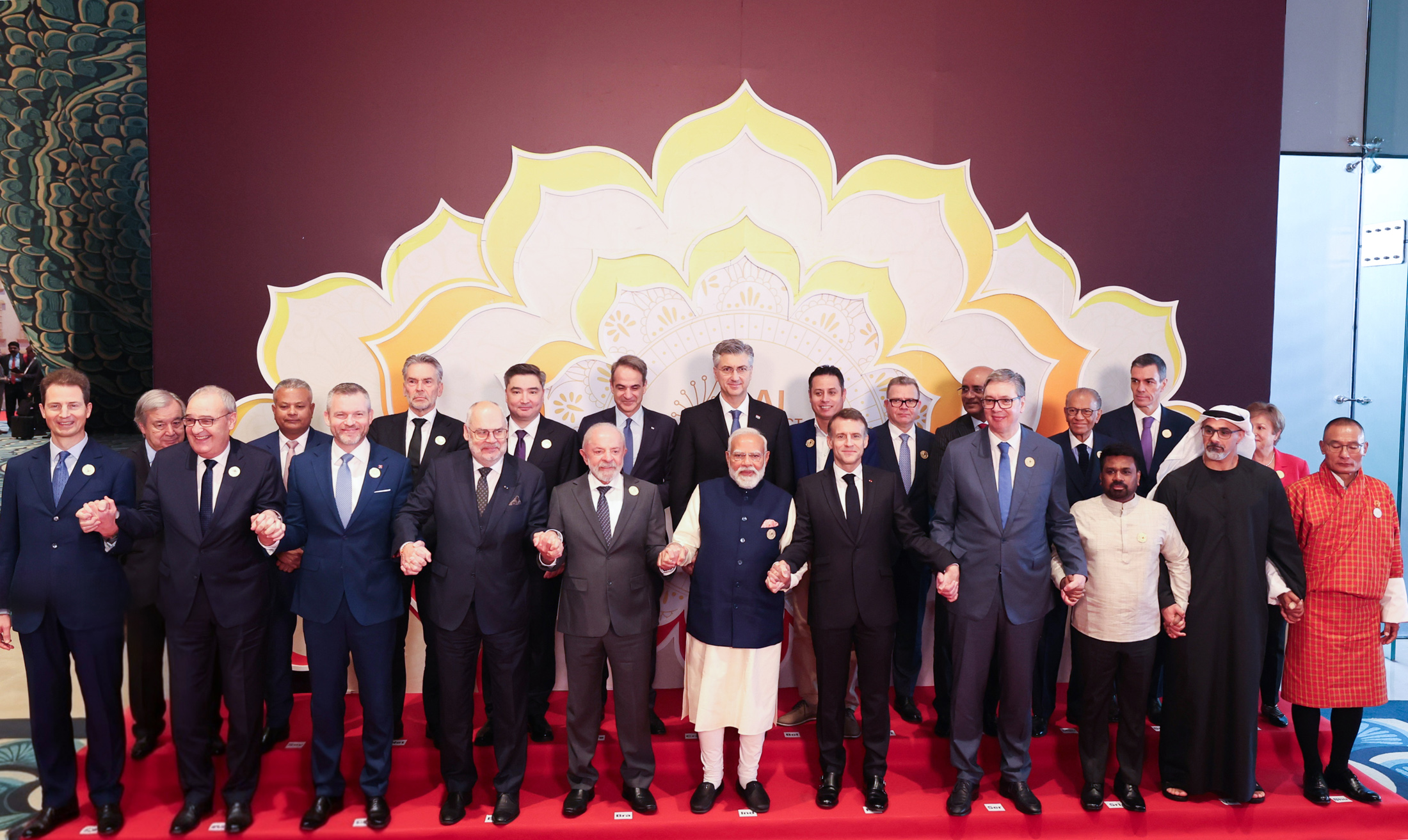
Prime Minister Narendra Modi with global world leaders at the Opening Ceremony of India AI Impact Summit 2026 at Bharat Mandapam, in New Delhi on February 19, 2026.
 By Deepak Parvatiyar*
AI Summit Moves From Vision to Global Governance Talks
Leaders Frame AI as Public Infrastructure and Policy Tool
New Delhi: The India AI Impact Summit shifted decisively from symbolism to substance on its fourth day, coinciding with the opening ceremony of the Summit, as world leaders, technology executives and multilateral institutions unveiled new commitments and cooperative frameworks here on February 19, placing artificial intelligence firmly within the domains of governance, diplomacy and public infrastructure. What began with pledges, exhibitions and civic mobilisation is now translating into policy conversations, bilateral engagements and industry coordination that seek to define how AI will be regulated, shared and deployed across borders. The summit’s trajectory so far signals a transformation from a showcase of technological ambition into an evolving forum where artificial intelligence is being negotiated as an instrument of international cooperation and strategic trust.
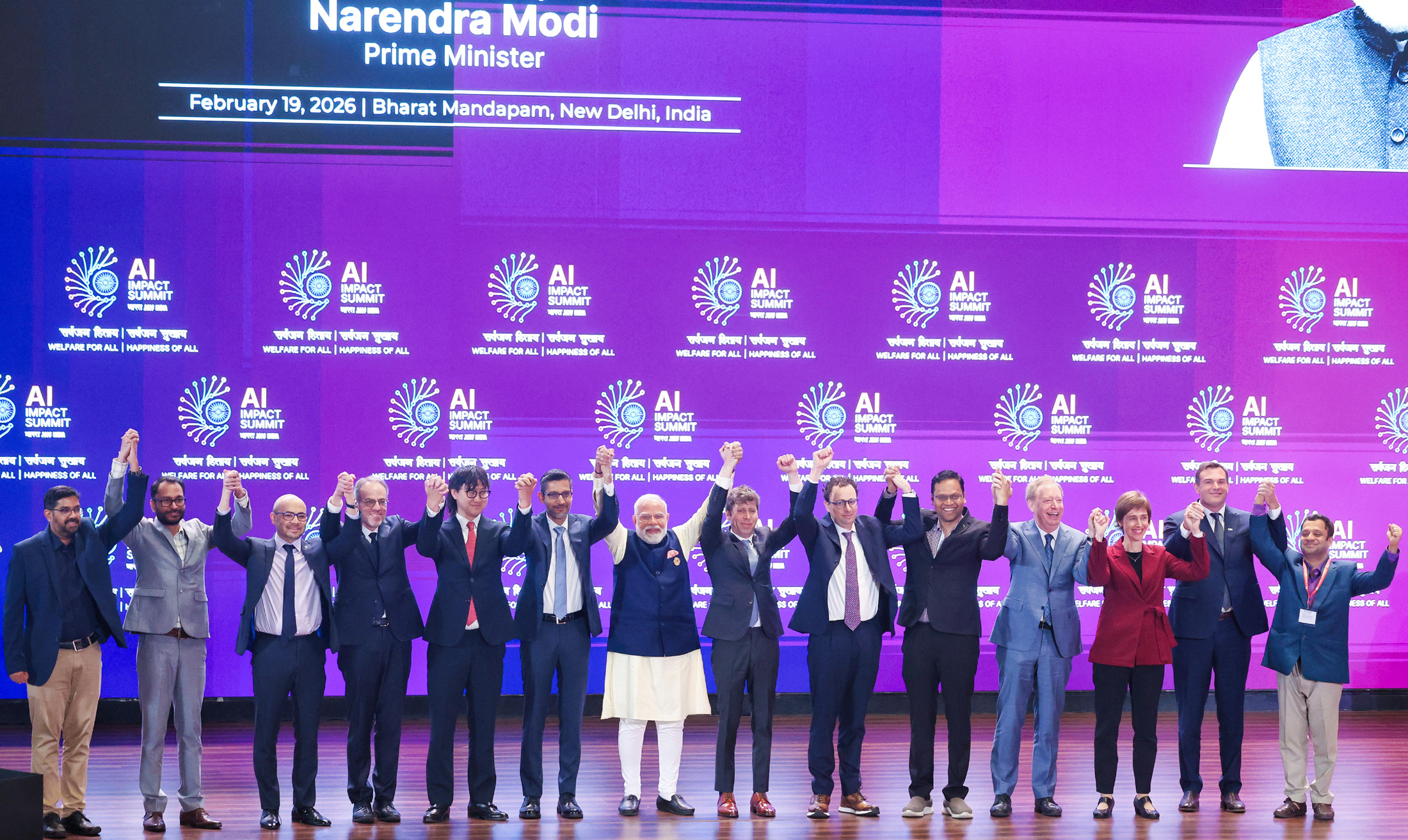
At the centre of the day’s proceedings was Prime Minister Narendra Modi, who addressed the Leaders’ Plenary and welcomed the outcomes of the Chief Executive Officers’ Roundtable involving industry figures such as Sundar Pichai, Sam Altman and senior executives from Europe and Asia. Modi described the discussions as focused on scaling artificial intelligence responsibly, strengthening global collaboration and unlocking opportunities for growth, while reiterating that AI must serve human progress and sustainable development. His address, delivered with real-time sign language translation enabled by artificial intelligence, projected accessibility not as a technical add-on but as a governing principle of digital public life.
The sustained presence of multiple heads of government—from France, Brazil, Serbia, Estonia, Greece, the Netherlands and Switzerland—has reinforced the summit’s identity as a diplomatic arena rather than a technology expo. Leaders, including Emmanuel Macron, Luiz Inácio Lula da Silva, Aleksandar Vučić, Alar Karis, Kyriakos Mitsotakis, and Dutch Prime Minister Dick Schoof, have framed artificial intelligence as a shared strategic concern rather than a competitive technology race. Their participation indicates that AI governance is entering the same category as climate negotiations and security dialogues, where consensus-building and norm-setting are as important as innovation.
Bilateral engagements unfolding alongside plenary sessions have further embedded artificial intelligence within broader foreign policy and trade architectures. India and the Netherlands have discussed cooperation in AI, quantum technologies and semiconductors while linking digital governance to partnerships in water management, agriculture, health and clean energy. Greece and India reviewed their strategic partnership with emphasis on connectivity initiatives under the India–Middle East–Europe Economic Corridor. Switzerland reaffirmed its collaboration in innovation-led growth and proposed hosting a future AI summit. These interactions illustrate that artificial intelligence is now inseparable from trade agreements, digital corridors and geopolitical alignments.
Yet the summit has also revealed a structural gap between principles and enforcement. While leaders continue to endorse responsible and inclusive AI, the frameworks under discussion remain largely voluntary. Unlike climate accords or arms-control treaties, there is as yet no binding verification or compliance mechanism for algorithmic governance. This raises a central analytical question: can ethical commitments endure in a fragmented international system where regulatory capacity differs sharply between states? The summit, in its current phase, has succeeded in building consensus but has not yet resolved how that consensus will be institutionalised.
Multilateral institutions occupy a critical but still evolving role. References to cooperation within the International Telecommunication Union and broader United Nations platforms suggest that India seeks to reposition itself as a rule-shaper in global digital governance. By convening presidents, prime ministers and corporate leaders simultaneously, New Delhi is attempting to convert diplomatic presence into normative influence. The underlying message is that global AI standards should not be authored solely in Washington, Brussels or Beijing.
Also read:
- India’s AI Impact Summit and the New Politics of Technology
- India AI Summit Turns Infrastructure Into Statecraft
- As India Hosts AI Meet, US Unveils $200m Plan
This positioning sends a strategic signal to both the United States and China. To Washington, the summit projects an alternative to a purely market-driven AI ecosystem by emphasising digital public infrastructure and subsidised compute access. To Beijing, it presents a model of technological sovereignty without centralised state control. India’s approach echoes its historical non-aligned diplomacy—now transposed into the realm of algorithms and data. The gathering thus functions as a declaration that the Global South intends to participate in shaping AI governance rather than merely adapting to it.
Economic and labour questions remain only partially articulated. While leaders and executives have highlighted opportunity, innovation and upskilling, detailed frameworks for managing job displacement and inequality are still emerging. In societies where informal labour dominates, automation risks are acute. The summit has acknowledged these concerns rhetorically but has yet to outline comprehensive social protection or education strategies at scale, exposing the tension between technological optimism and socio-economic preparedness.
Data governance and privacy have surfaced through discussions on misinformation, deepfakes and child protection, but concrete commitments on cross-border data regulation and algorithmic accountability remain limited. Without clarity on who controls data and how consent is enforced, claims of human-centric AI risk remain aspirational. The summit’s emphasis on safety highlights political awareness of these risks, but the institutional pathways to manage them are still under construction.
The Global South dimension, repeatedly invoked, is also being tested by practical constraints. India’s ambition to lead developing nations in AI governance depends on its ability to translate summit outcomes into affordable infrastructure, multilingual tools and technology transfer. Announcements on public compute access and accessibility initiatives point in that direction, but financing models and timelines are yet to be fully defined. The risk is that AI diplomacy remains symbolic unless it is accompanied by operational capacity.
Public legitimacy has been cultivated through civic participation, youth initiatives and responsibility pledges. These gestures convert ethics into collective ritual, but their long-term impact will depend on whether they mature into law, regulation and institutional practice. Symbolism has opened the conversation; governance will determine its durability.
Some high-profile absences have also shaped perceptions. Bill Gates did not attend his scheduled appearance amid international scrutiny unrelated to the summit’s agenda, while NVIDIA chief Jensen Huang was absent due to illness. These developments, though peripheral to policy outcomes, illustrate how credibility, optics and global media attention now intersect with technology diplomacy.
What the India AI Impact Summit is demonstrating, while still in progress, is that artificial intelligence has crossed a political threshold. It is no longer only a commercial frontier or scientific pursuit; it is now a subject of foreign policy, multilateral negotiation and moral authority. The convergence of heads of state and corporate leaders in New Delhi underlines that whoever governs AI will influence not just markets, but norms of power and trust.
The unresolved challenge is whether voluntary cooperation can evolve into an enforceable order. As the summit continues, its significance will lie not merely in the announcements made but in the institutions and standards that follow. The central question remains open: can geopolitics shape artificial intelligence before artificial intelligence reshapes geopolitics?
For now, the summit has made one reality unmistakably clear. The future of intelligence is being negotiated not only in laboratories and boardrooms, but in councils of state—and that negotiation is still unfolding.
*Senior journalist




👌👌