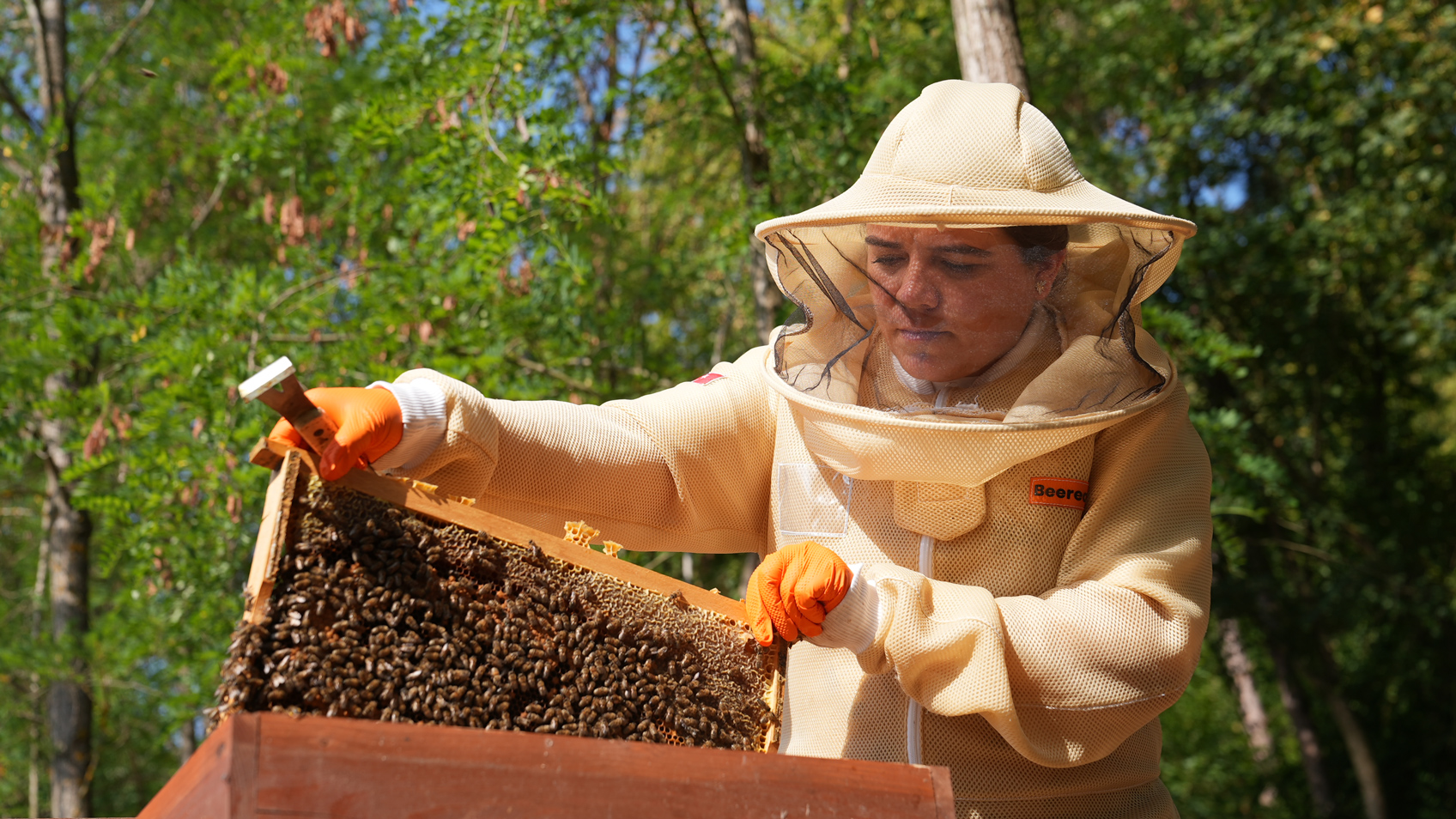
Nurcan Tekneci had a successful corporate career and used to live a hectic city life. After the pandemic, she decided to move to the countryside and take up beekeeping, a big decision that not everyone approved of. ©FAO/ Turuhan Alkır
Finding Purpose Among Bees in Northwestern Türkiye
How a Turkish Mother Rebuilt Life Around Bees
On the quiet green outskirts of Düzce, in northwestern Türkiye, the scent of chestnut trees mingles with the steady hum of bees. Nurcan Tekneci adjusts her beekeeper’s veil, lifts the lid of a hive and watches as the colony rises in a soft, coordinated wave—busy, disciplined and tireless. She smiles, at ease in a world that once seemed unimaginable.
Just a few years ago, the woman now known locally as a beekeeper, trainer, entrepreneur and community role model was living a life defined by deadlines rather than seasons.
Nurcan, 36, grew up in Izmir, studied Latin Languages and Literature in Istanbul, earned a master’s degree and built a successful corporate career. She managed departments, earned a comfortable salary and followed the relentless rhythm of city life—long workdays, crowded commutes and constant urgency. “Almost ten years passed like that,” she recalls. “I didn’t even realise how little time I spent with my son.”
The turning point came during the global pandemic. Confined at home for 45 uninterrupted days, Nurcan experienced something she had long missed. Her son was two years old at the time. “I bonded with him in a way I never had before,” she says. “I realised we could live with less, and that consumption, chaos and stress weren’t the only way.”
One morning over breakfast, her husband, Lokman, repeated a suggestion he had made many times before: “Let’s move to the village.” This time, she agreed.
Leaving the city was not easy, and resistance came quickly. “My father was the first to object,” she says, laughing. “From his perspective, I had two university degrees, a good job and a high salary. Beekeeping? He thought I had gone mad.”
Friends were sceptical too. Some joked, “Are you going to watch flies now?” Her answer never changed. “Not flies,” she would reply. “Bees.”
What began as a change of address soon became a deeper transformation. Working with bees gave Nurcan a renewed sense of purpose, especially after her father later died of lung cancer. His illness reinforced her determination to build a life grounded in clean air, natural production, food safety and healthy living—values she wanted to pass on to her child.
“I had one goal,” she says. “I shut my ears to everything else.”
Beekeeping demanded commitment and discipline, and Nurcan approached it with the same seriousness she once brought to the corporate world. She studied scientific methods, apprenticed with experienced beekeepers and completed vocational training. She and her husband worked side by side. Their son, now eight, was initially indifferent, but gradually became involved. Eventually, they gave him a hive of his own.
“We wanted him to grow up connected to nature,” Nurcan says. “That makes me very happy, because one day he will go to university, and having an extra ‘golden bracelet’—as we say in Turkish, a valuable skill—is a wonderful thing.”
Evenings often stretch long at the apiary. The family brings tea, snacks and camping chairs, lingering until sunset. “We stay here until late,” she says. “It’s peaceful. This is where we feel happiest.”
As their experience deepened, Nurcan began to think beyond honey. She established her own brand and explored new products. Beeswax candles marked a turning point. “I learned that beeswax releases negative ions that help clean the air,” she explains. “After my father’s illness, this knowledge became very meaningful to me.”
Season by season, her production expanded—from beeswax to royal jelly and then propolis—each addition supported by scientific research and expert supervision.
In 2025, Nurcan joined a series of beekeeping trainings supported by the Food and Agriculture Organization of the United Nations (FAO), aimed at strengthening local production, sustainability and rural livelihoods. Despite years of hands-on experience, she says the programme reshaped her approach.
“These trainings helped me understand where I was making mistakes,” she says. “With more detailed and more careful work, I can increase my capacity and produce higher-quality, more sustainable products. FAO gave me a roadmap.”
The sessions covered hive management, seasonal care, disease control, product diversification and sustainable practices. Just as importantly, they connected her with a wider network of beekeepers facing similar challenges.
One summer afternoon, another visitor arrived at Nurcan’s apiary: Dilara Koçak, one of Türkiye’s most prominent nutrition experts and a long-time FAO supporter who works to raise awareness about agrifood systems, sustainability and healthy living.
Standing amid thousands of softly buzzing bees in Düzce, Dilara said she had encountered something remarkable. “We are on the farm of miraculous creatures that provide nutrition,” she said. “Bees are essential to the sustainability of agrifood systems, to pollination and to biodiversity.”
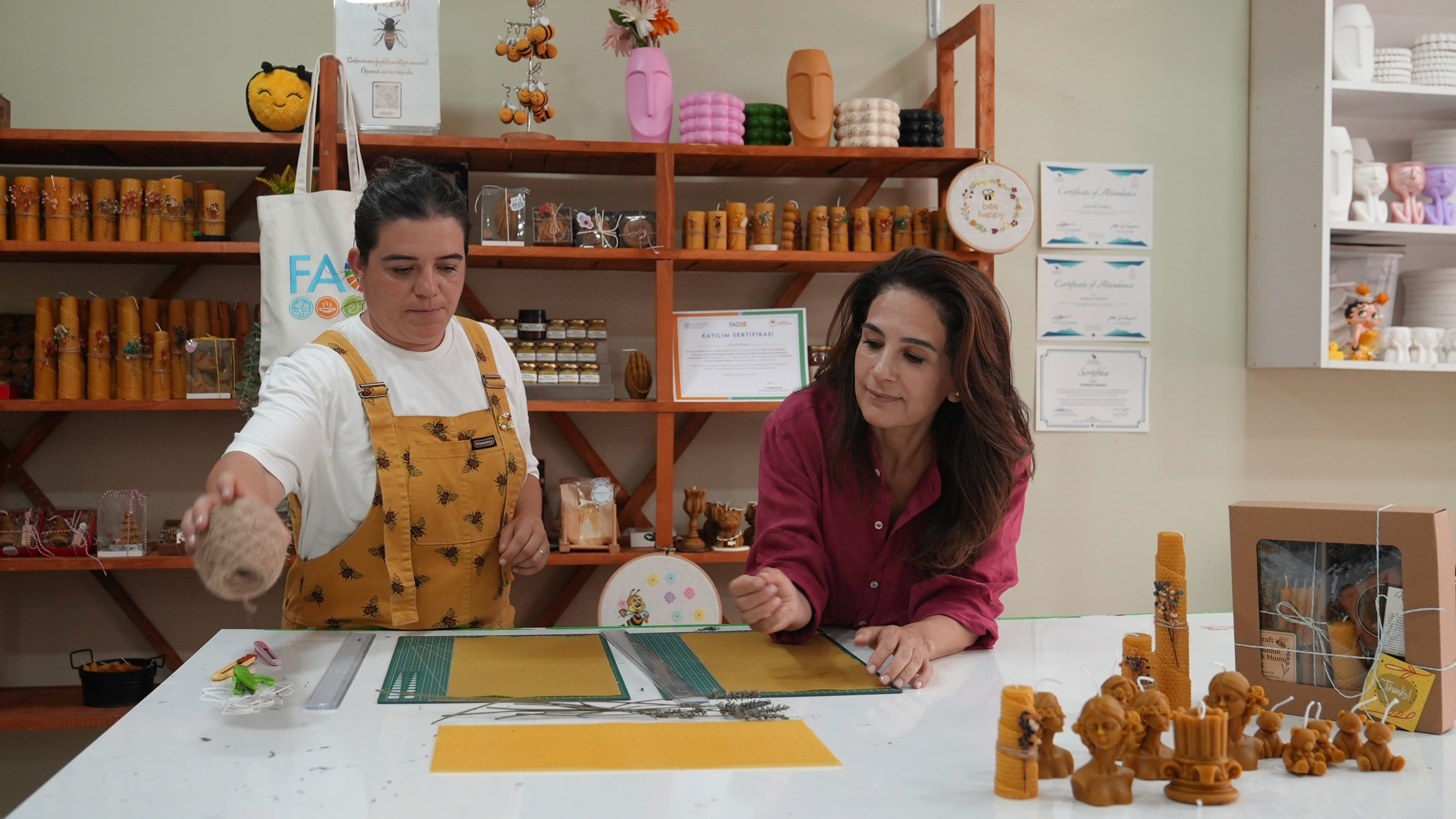
During her visit, the two women made beeswax candles together, allowing Dilara to experience the craft Nurcan has mastered. The candles—symbols of light, labour and nature—became a quiet metaphor for their shared commitment to sustainability and women’s empowerment.
“There is a woman leader here,” Dilara said. “She inspires women, inspires young people and does everything she can to ensure the survival of bees. Witnessing this is very special.”
Today, Nurcan manages around 70 hives and harvested 200 kilograms of honey this year alone. Yet she says her ambitions extend well beyond numbers.
“I want to establish a bee farm,” she says. “A place where children, women, young people—even white-collar workers exhausted by city life—can come, learn about bees and produce their own honey.”
She imagines workshops, training programmes and a honey harvest festival where families leave with honey they have seen produced themselves. At the heart of the idea is education. “My goal is to improve food literacy,” she says. “I want people to know exactly what they are eating.”
Nurcan says she never truly left her professional life behind. Instead, she reimagined it. The skills she developed in corporate offices—organisation, quality control and communication—now shape her rural enterprise.
With continued FAO-supported training and a growing vision, she moves steadily forward. Among the hives of Düzce, surrounded by her family and the constant hum of wings, Nurcan Tekneci has found not only a livelihood, but a sense of home and purpose.
This story is part of a global series celebrating women farmers, including producers, fishers, pastoralists, traders, agricultural scientists and rural entrepreneurs. The International Year of the Woman Farmer 2026 recognises their essential contributions to food security, economic prosperity, nutrition and livelihoods, despite heavier workloads, precarious working conditions and unequal access to resources. It calls for collective action and investment to empower women, in all their diversity, and to build a fairer, more inclusive and sustainable agrifood system for all.
Source: The FAO News And Media Office, Rome
– global bihari bureau