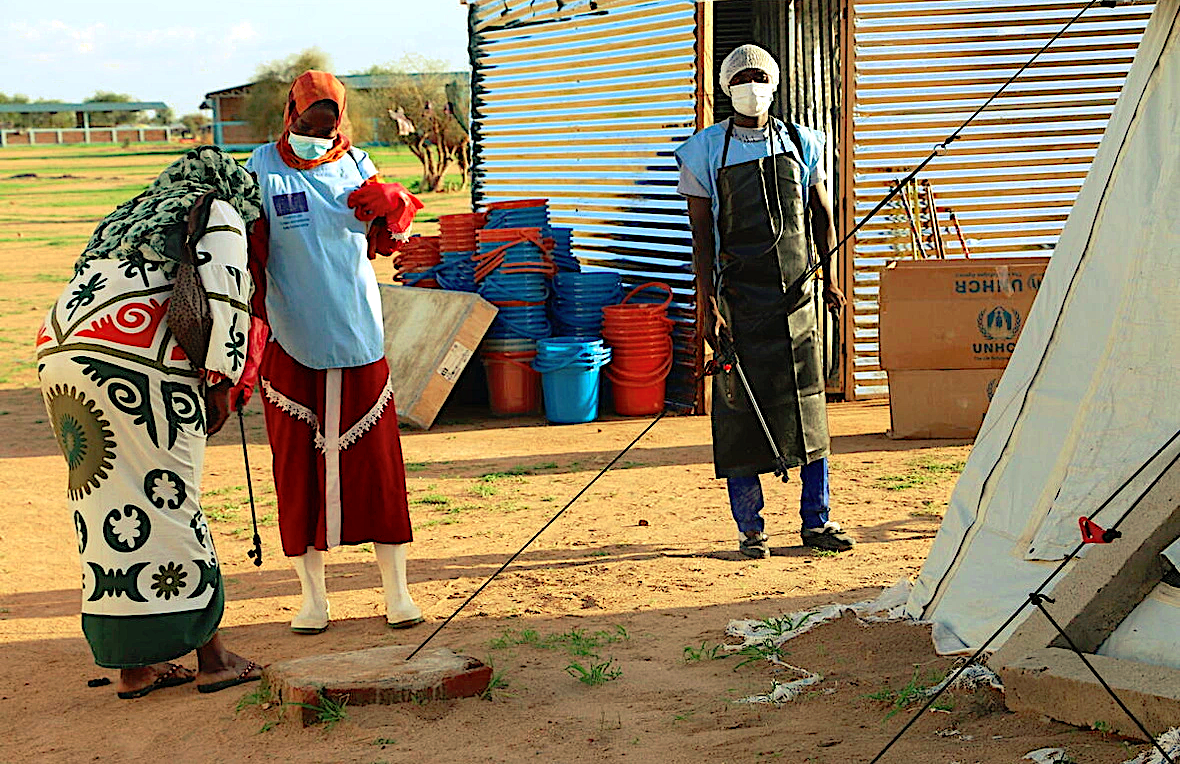
Health workers in Dougui refugee settlement in eastern Chad disinfect premises and handwashing kit facilities to limit the chain of cholera contamination. © UNHCR/Bockarie Kallon
Geneva/Khartoum: In Sudan, terrified families flee bullets only to face a deadly cholera outbreak and hidden explosives, as the country’s brutal civil war leaves millions hungry and homeless. UN agencies warned on Friday that without urgent aid, the spiralling crisis—marked by violence, disease, and desperation—could claim countless more lives. The UN Refugee Agency (UNHCR), World Health Organization (WHO), and UN Mine Action Service (UNMAS) are sounding the alarm as Sudan’s conflict, now in its third year, devastates communities and overwhelms humanitarian efforts.
Jocelyn Elizabeth Knight, a UNHCR Protection Officer, shared chilling accounts from civilians escaping violence in Sudan’s Zamzam displacement camp. “People told me multiple times that when they were fleeing from Zamzam, armed people would threaten them while they were in flight, saying, ‘Flee, go to that place, run here, run there, we will follow you, we will find you,’” Knight said during a Geneva briefing. She recounted a young boy’s fear in a UNHCR shelter: “A tiny boy told me, ‘You know, during the day things are okay here, but I’m afraid to go to sleep at night in case the place where we’re living is attacked again.’”
The conflict between the Sudanese Armed Forces (SAF) and Rapid Support Forces (RSF), which began in April 2023, has fueled a public health emergency. Dr. Ilham Nour, WHO Senior Emergency Officer, reported, “Cholera has swept across Sudan, with all states reporting outbreaks.” Since July 2024, nearly 100,000 cases have been recorded. In eastern Chad, hosting over 873,000 Sudanese refugees, the Dougui settlement reported 264 cases and 12 deaths by early August. Suspected cases have also emerged in Treguine settlement and surrounding villages, with border areas like Adre—home to over 235,000 refugees—facing severe risks.
Dossou Patrice Ahouansou, UNHCR’s Principal Situation Coordinator for Eastern Chad, stressed the need for immediate action: “We still have more than 230,000 refugees at the border in very difficult situations. Without urgent action, including enhancing access to medical treatment, clean water, sanitation, hygiene, and most importantly, relocation from the border, many more lives are on the line.” UNHCR has paused refugee relocations from border points to curb cholera’s spread, prioritising health interventions.
Unexploded ordnance from the conflict adds a lethal threat, especially in urban areas. Mohammad Sediq Rashid, Chief of UNMAS Sudan, said, “The sad reality of this ongoing conflict is it is not happening in rural areas, it’s mainly happening in urban areas, in highly populated regions.” Last week, six minefields were confirmed in Khartoum, three containing anti-personnel landmines—a first in this conflict. “Contamination is on the roads, in homes, in schools, airstrips, medical facilities, humanitarian bases,” Rashid said. “This is a population largely unaware of the dangers that are waiting for them… this problem is only growing every day.”
WHO Director-General Dr. Tedros Adhanom Ghebreyesus yesterday highlighted the dire situation: “In Sudan, unrelenting violence has led to widespread hunger, disease, and suffering. There are reports from the city of El Fasher that people are eating animal feed to survive.” Famine conditions have been confirmed in parts of Sudan, with 770,000 children under five expected to suffer severe acute malnutrition this year. WHO-supported nutrition centres treated over 17,000 severely malnourished children with medical complications in the first half of 2025, but many remain unreachable. Recent floods have worsened the crisis, driving outbreaks of cholera, malaria, dengue, and other diseases. WHO has prepositioned medicines, trained rapid response teams, and strengthened disease surveillance, but Dr. Tedros warned, “Our efforts are held back by limited access and a lack of funding. WHO has received less than one-third of the money we need to provide urgent health assistance in Sudan.”
UNHCR is appealing for $130 million to aid 800,000 people in Darfur, including relocating 239,000 refugees from the Chad-Sudan border to safer settlements with better services. However, global funding shortages are crippling these efforts. The UN’s $4.2 billion appeal for Sudan and $1.8 billion Regional Refugee Response Plan for 2025 are severely underfunded, with only 23% and 10% of the required funds received, respectively. Without immediate support, critical services like clean water, healthcare, and shelter face collapse.
The UN agencies urged an end to the violence and unrestricted humanitarian access. Dr. Tedros concluded, “As long as the violence continues in Sudan and other conflict zones, we can expect to see more hunger, more displacement, and more disease. In each place, and everywhere, the best medicine is peace.”
– global bihari bureau