Rajnath Singh Commissions India’s Largest Indigenous Coast Guard Ship
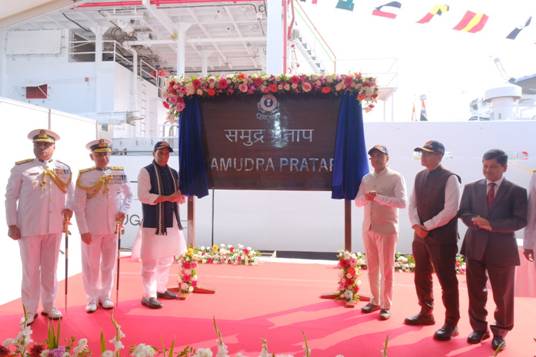
Panaji: Marking a landmark step in India’s pursuit of self-reliance in shipbuilding and maritime capabilities, Defence Minister Rajnath Singh commissioned the Indian Coast Guard Ship (ICGS) Samudra Pratap, the first of two Pollution Control Vessels built by Goa Shipyard Limited (GSL), in Goa on January 5, 2026. With over 60% indigenous content, ICGS Samudra Pratap is India’s first indigenously designed pollution control vessel and the largest ship in the Coast Guard fleet, significantly enhancing India’s operational capabilities across pollution control, fire-fighting, coastal patrol, maritime safety, and environmental protection.
Describing the vessel as an embodiment of India’s mature defence industrial ecosystem, Rajnath Singh highlighted GSL’s modern approach in integrating multiple capabilities into a single platform. “ICGS Samudra Pratap has been specially designed for pollution control, but its role is not limited to this alone. As multiple capabilities have been integrated, the ship will prove effective in coastal patrol and maritime safety, while sending a clear signal to any adversary that misadventures against India’s maritime borders will be met with a bold and befitting response,” he said.
The ship features advanced pollution detection systems, dedicated pollution response boats, side-sweeping arms, floating booms, high-capacity skimmers, portable barges, and a fully equipped pollution control laboratory, enabling rapid containment and mitigation of environmental hazards. Its Fi-Fi Class 1 External Fire-Fighting System and modern fire-control systems further strengthen emergency response capability. A helicopter hangar and aviation support facilities extend operational reach, allowing sustained operations even in rough sea conditions. Powered by two 7,500 kW diesel engines driving indigenously developed controllable pitch propellers and gearboxes, the vessel achieves speeds exceeding 22 knots with a 6,000-nautical-mile endurance, combining manoeuvrability, flexibility, and operational resilience.
Rajnath Singh underscored the broader environmental and economic implications of the vessel. “Marine environment protection is both a strategic necessity and a moral responsibility. Through its quick detection, precise station-keeping, and efficient recovery systems, ICGS Samudra Pratap will ensure that pollution incidents are controlled in a timely manner, safeguarding coral reefs, mangroves, fisheries, marine biodiversity, and the sustainability of coastal communities and the blue economy,” he said. Emphasizing that safe seas guarantee safe trade, lives, and environment, he framed the commissioning within India’s Grand Maritime Vision, stressing that marine resources are “a shared heritage of humanity” and that India stands for peace, stability, and environmental responsibility in the Indo-Pacific.
Reflecting the government’s commitment to inclusion, the vessel will also host two women officers in frontline roles. Rajnath Singh highlighted that these officers will serve as pilots, observers, air traffic controllers, logistics officers, law officers, and hovercraft operators, embodying a gender-neutral work environment and setting a precedent for the future. “Today, women are not only playing support roles; they are serving the nation as frontline warriors. They are role models for future generations, and the ICG will continue to provide opportunities and development for all,” he added.
The Defence Minister also stressed the importance of transitioning the Coast Guard from a platform-centric to an intelligence-driven, integration-centric force, with specialised career streams in maritime law enforcement, environmental protection, and maritime cybersecurity. He emphasised India’s role as a regional standard-setter and a future global leader in maritime governance, highlighting efforts to shape norms, strengthen capacity-building initiatives, and promote cooperative frameworks across the Indo-Pacific.
ICGS Samudra Pratap, meaning “Majesty of the Seas,” will be based at Kochi under the operational control of the Commander, Coast Guard Region (West) through Coast Guard District Headquarters No. 4 (Kerala & Mahe). The commissioning ceremony was attended by Goa Chief Minister Dr Pramod Sawant, Defence Secretary Rajesh Kumar Singh, Director General of ICG Paramesh Sivamani, GSL Chairman & Managing Director Brajesh Kumar Upadhyay, and other senior officials from central and state governments.
With a displacement of 4,170 tons and a length of 114.5 meters, the ship integrates Dynamic Positioning, Integrated Bridge System, Integrated Platform Management System, and Automated Power Management System, ensuring high automation and mission efficiency. Its armament includes a 30 mm CRN-91 gun and two 12.7 mm Stabilised Remote-Controlled Guns, providing credible defensive capability.
Through ICGS Samudra Pratap, India demonstrates a comprehensive approach: deterring maritime misadventures, safeguarding the marine environment, ensuring coastal security, and contributing to a stable and responsible Indo-Pacific. Rajnath Singh concluded that this commissioning signifies a significant leap in indigenous maritime capability, reinforcing India’s status as a Responsible Maritime Power ready to face 21st-century multi-dimensional challenges.
– global bihari bureau