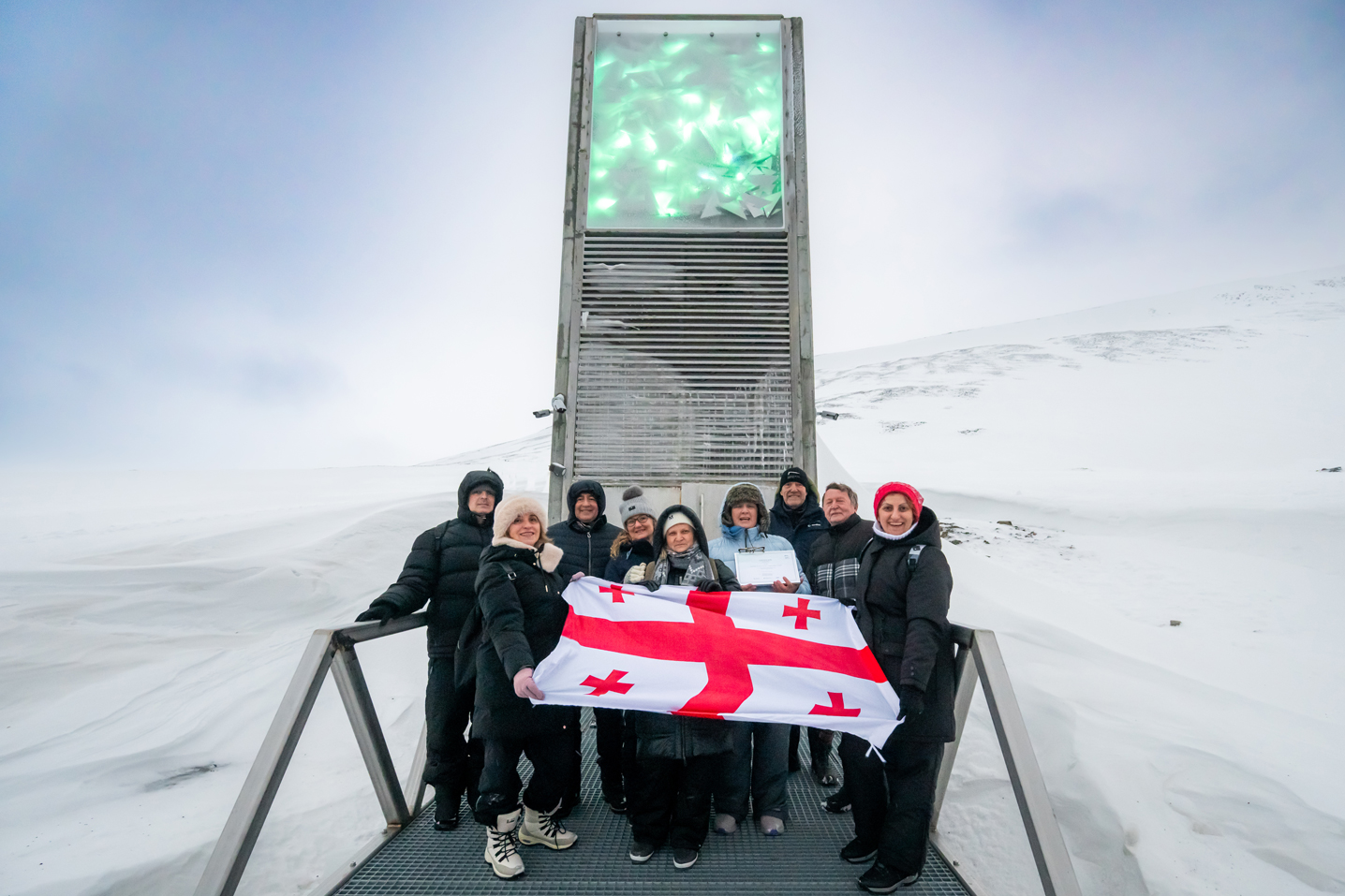
By linking on-farm and gene bank conservation—including storage in the Svalbard Global Seed Vault— farmers and scientists, supported by the BSF project in Georgia, help ensure that local seeds remain available for future generations. ©Crop Trust/Michael Major
Ancient Seeds Secure Future in Svalbard Vault
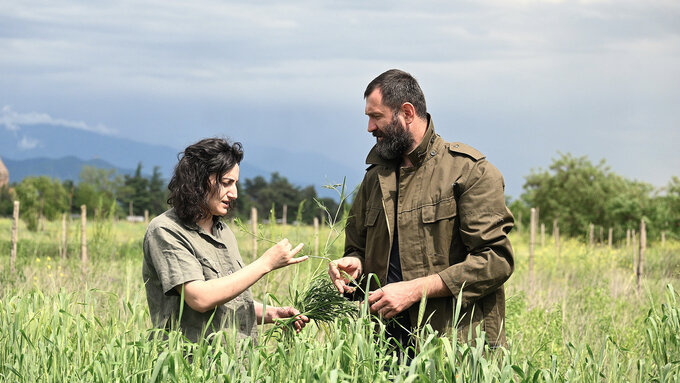
In the rugged embrace of Georgia’s Caucasus mountains, where the air hums with the pulse of ancient traditions, Natia Matcharashvili moves through her fields in Zemo Alvani, a village tucked in the north of the country. Her hands, steady and deliberate, handpick the ripest wheat grains, each one a testament to her pride as a first-generation farmer. For Natia, every harvest is a ritual, a promise that these grains will soon be milled into flour, carrying the essence of her land into every loaf.
Natia and her husband, Shota, left the bustle of Tbilisi, Georgia’s capital, to return to their village, driven by a longing to root their children closer to nature. For Shota, the call was deeper—a pull to honour his grandfather’s legacy as a farmer and to revive native wheat varieties that were fading from Georgian fields. “It’s our responsibility to protect these traditional wheat varieties that have adapted to our soil and climate over generations,” Natia says, her voice warm with conviction. “We wanted to share our traditions and live in harmony with nature,” she adds, explaining their return to Zemo Alvani.
In their bakery, where the aroma of fresh bread and cookies fills the air, Natia and Shota transform these traditional wheat varieties into more than sustenance—they share their heritage with every customer. “What started as a simple desire became our livelihood,” Natia reflects. “Now we’ve grown a few [native varieties] and tasted them, and we want to keep going, discovering more of these forgotten Georgian varieties and bringing them back to life.”
Georgia, a cradle of remarkable wheat diversity, cradles fourteen wheat species, five of which were born on its soil. Yet, this living heritage teeters on the edge of extinction, as modern varieties, bred for efficiency, have overtaken fields once tended by generations of small-scale farmers. Decades of Soviet-era centralised agriculture replaced family farms with sprawling state cooperatives, leaving native wheat varieties to wither.
Enter Tamriko Jinjikhadze, an agricultural scientist at Georgia’s Scientific Research Centre of Agriculture (SRCA), who saw the quiet disappearance of her country’s most important crop varieties and refused to let them vanish. “Some of our country’s most important crop varieties are quietly disappearing,” Tamriko explains, her words carrying the weight of urgency. To stem this loss, she turned to the Benefit-sharing Fund (BSF) of the International Treaty on Plant Genetic Resources for Food and Agriculture, housed within the Food and Agriculture Organization of the United Nations (FAO). The BSF fuels projects like Tamriko’s, which develop, safeguard, and facilitate the exchange of plant genetic resources.
With this support, Tamriko’s team embarked on seed-collecting missions to remote Georgian villages, seeking out local varieties still nurtured by small-scale farmers. It was on one such mission that she met Natia and Shota. The couple knew they were growing a local wheat variety, but its name and story were mysteries to them. Tamriko’s team gathered seeds from their fields, taking them to the SRCA for identification. These local varieties, Tamriko explains, are vital because they thrive in their native conditions, shaped by generations of cultivation. Georgian wheats, with their higher resistance to fungal diseases and superior productivity, are genetic treasures. “They serve as initial breeding material to develop resilient wheat varieties that can survive climate change and new pests and diseases,” she says.
But the journey of these seeds stretches far beyond Georgia’s borders. Over 200 samples of traditional varieties, including Lagoedkhis Gdzeltavtava and Dolis Puri from Natia and Shota’s fields, embarked on an extraordinary voyage. From the sun-warmed slopes of Georgia’s mountains, they travelled to the frozen heart of the Arctic Circle, to the Svalbard Global Seed Vault in northernmost Norway, 2,000 kilometres north of Oslo. Here, in a fortress of ice where temperatures hold steady at -18°C, the Vault safeguards duplicates of seeds from across the globe, securing the world’s future food supply.
“It’s very comforting to know that our local varieties are safely preserved in Svalbard,” Shota says, his voice steady with hope. “This makes me feel confident about the future.” As climate change and environmental challenges erode genetic diversity, this security is vital. The Svalbard Global Seed Vault, alongside gene banks, stands as a bulwark against the loss of crops that have sustained humanity for centuries.
Tamriko underscores the human thread in this mission: “The journey of these seeds begins in the hands of farmers—their knowledge is as vital as the seeds themselves. We, as scientists, are here to support them—not just to conserve seeds, but to ensure they can be used for livelihoods.” For Natia, this work is a bridge between past and future. “By growing these local wheat varieties, we’re ensuring both their survival and the transmission of our knowledge,” she concludes.
When customers sink their teeth into the fresh bread at Natia and Shota’s bakery, they taste more than flour and water. They taste ancient seeds, recovered by scientists, duplicated in the icy vaults of Svalbard, and tended by farmers in Georgia’s fields. Each bite is a story of resilience, a promise that the past will continue to nourish the future, one seed at a time.
Source: The FAO News And Media Office, Rome
– global bihari bureau