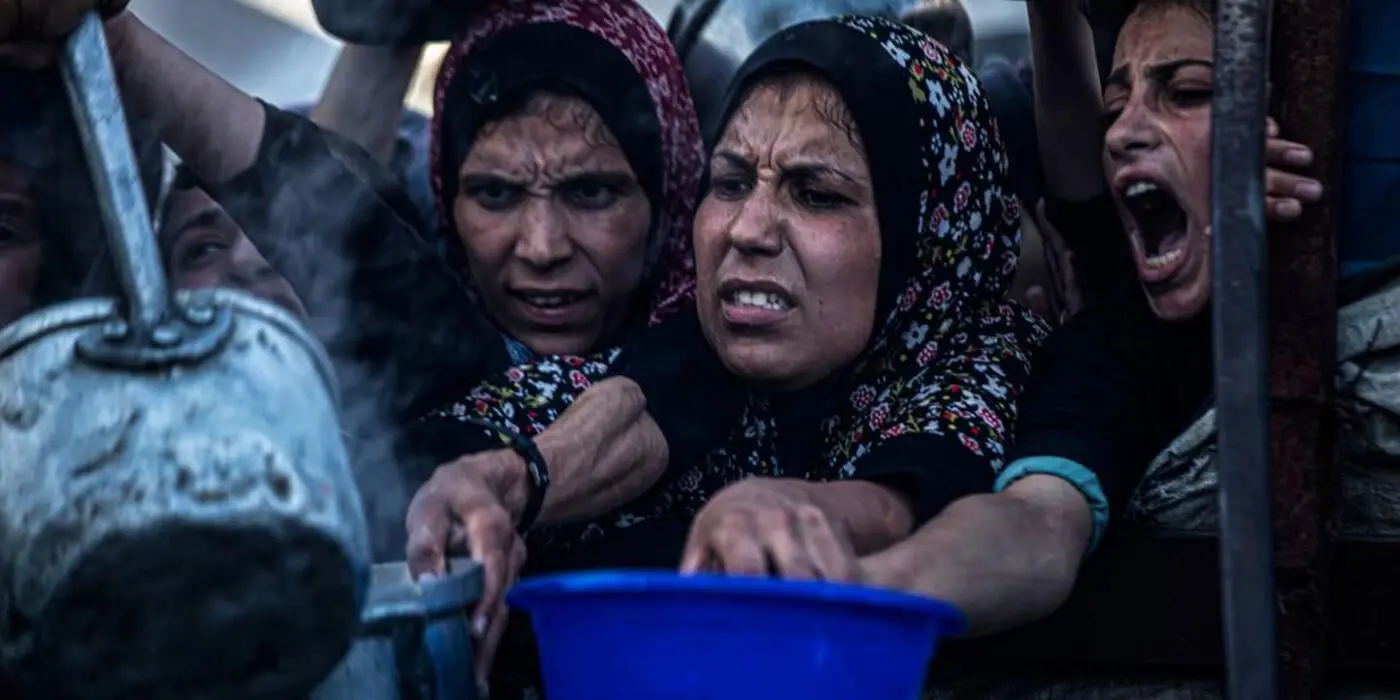
People in Gaza desperately seek food. Photo: UNICEF/Mohammed Nateel
Famine Ravages Gaza Amid Global Pleas: Half a Million Starve in Man-Made Crisis
Gaza: In the shadow of relentless conflict, the United Nations has declared famine in Gaza Governorate, a historic first for the Middle East, where over 640,000 people now confront catastrophic food insecurity, a crisis poised to engulf Deir Al-Balah and Khan Younis by September’s end without swift intervention.
The Integrated Food Security Phase Classification (IPC) report, backed by 21 agencies, confirms that thresholds of extreme deprivation, acute malnutrition, and starvation deaths have been breached in Gaza City, painting a picture of despair where families scrape by on scant rations amid destroyed farmlands and blocked aid routes.
United Nations relief chief Tom Fletcher, speaking from Geneva, labelled this a man-made disaster, with food piling at borders due to obstructions, mere hundreds of meters from starving populations in once-fertile lands. He evoked the cruelty underpinning the crisis, urging an end to what he described as retribution sustained by indifference and complicity, a call echoed by United Nations Secretary-General António Guterres, who demanded an immediate ceasefire, hostage releases, and unrestricted humanitarian access to stem the tide of this preventable horror.
Gaza Famine: Survivors’ Heartbreaking Tales
Amid these stark assessments, the voices of those enduring the famine rise like whispers from the rubble, revealing the raw human toll. Hamada Shoo, a food blogger from Gaza, shared his daily torment: “I have lost so much weight. I eat bread only twice a week, not because I am on a diet but because it is simply not available. And when it is, the prices are unbearable. Flour has almost disappeared. There is no cash in the market, and to get your own money, you have to pay high interest. Starvation is real, and the struggle is daily.”
Nour Jamaan, a father of six daughters, described survival on the edge: “We’re still alive, but barely surviving. No gas to cook, no flour for basic food, vegetables are too expensive, and meat’s been gone for 3 months. We still have no proper shelter.” These accounts underscore a reality where 39 per cent of households report enduring days without food, adults forgoing meals to nourish children, and the destruction of 98 per cent of cropland compounding the scarcity.
Hunger’s Grip: Gaza’s Unfolding Tragedy
The health ramifications unfold in hospitals strained beyond capacity, where Dr. Rik Peeperkorn of the World Health Organization (WHO) detailed an exponential rise in child malnutrition, with over 12,000 cases identified in July alone—a sixfold increase since January. He recounted scenes of five-year-olds resembling toddlers, their bodies ravaged, and health workers collapsing from exhaustion. “Teams have witnessed people starving,” he said, highlighting how weakened immune systems amplify diseases and hinder recovery from war injuries. Dr. Ahmed al-Farra, leading paediatrics at Nasser Hospital, admitted his own plight: “There is no one in Gaza now outside the scope of famine, not even myself. I am speaking to you as a health official, but I, too, am searching for flour to feed my family.” A Palestinian medical student in Gaza City confided in a voice message: “It’s been over a week since the famine began. And honestly, I haven’t felt full even once. I’m constantly hungry, all day, every day. I fall asleep every day with hunger. I feel too weak to move.”
Elderly residents bear the weight of vulnerability, as testified in Amnesty International reports. Abu Alaa, a 62-year-old displaced from Jabalia, endured one meal of lentil soup daily: “I can tolerate the hunger, but children cannot.” Nahed, 66, witnessed aid sites devolve into chaos: “I saw with my own eyes people carrying bags of flour stained with the blood of those who had just been shot. The experience of hunger and war has changed Gaza completely; it has changed our values.” Aziza, 75, felt burdensome: “I always feel like these young children, they are the ones who deserve to live, my grandchildren. I feel like I’m a burden on them, on my son.” Moataz from Gaza lamented: “I can’t remember the last time I ate a full meal. There isn’t even flour in the tents. We live in darkness, without food, without hope. I hear the sound of hunger rising inside me every night, and no one hears me.”
Gaza’s Starvation: Voices from the Brink
United Nations Human Rights Office (OHCHR) spokesperson Jeremy Laurence attributed the famine to actions destroying infrastructure, agriculture, and restricting aid, deeming starvation as a method of warfare a war crime. World Food Programme (WFP) Director of Food Security and Nutrition Analysis Jean-Martin Bauer affirmed the Integrated Food Security Phase Classification’s gold-standard methodology, noting simultaneous famines in Sudan and Gaza for the first time in two decades. Projections warn of 43,400 children and 55,000 pregnant or breastfeeding women at severe malnutrition risk by mid-2026, tripling earlier estimates.
Joint appeals from the Food and Agriculture Organization of the United Nations (FAO), United Nations Children’s Fund (UNICEF), World Food Programme, and World Health Organization demand a ceasefire to enable massive aid influx, restore health systems, and revive local production. Food and Agriculture Organization Director-General QU Dongyu asserted: “Access to food is not a privilege—it is a basic human right.” World Food Programme Executive Director Cindy McCain pressed for safer distribution: “Famine warnings have been clear for months.” United Nations Children’s Fund Executive Director Catherine Russell highlighted children’s peril: “Without an immediate ceasefire and full humanitarian access, famine will spread, and more children will die.” World Health Organization Director-General Dr. Tedros Adhanom Ghebreyesus implored: “The world has waited too long, watching tragic and unnecessary deaths mount.”
Dr. Ezzideen Shehab, a Gaza doctor, captured the creeping inevitability: “The famine no longer approaches; it is here. It is written across faces like a curse: sunken cheeks, cracked lips, eyes too tired to hold sorrow.” Ahmed Kamal Junina, a linguistics professor, reflected amid pain: “Famine is no longer a threat—it is here. Some days, my stomach cramps as I try to revise a single paragraph. Hunger is loud.” Rida Hijjeh spoke of her daughter’s decline: “Because of the famine and the siege, this is what happened to her. She lost weight. There is simply nothing for the child to eat.” Tom Fletcher’s plea resonates: “It is too late for far too many, but not for everyone. For humanity’s sake, let us in.”
– global bihari bureau