First BrahMos missiles from Lucknow facility flagged off
Lucknow: Defence Minister Rajnath Singh and Uttar Pradesh Chief Minister Yogi Adityanath today flagged off the first batch of BrahMos supersonic cruise missiles manufactured at the BrahMos Integration and Testing Facility Centre in Lucknow. The facility, part of the UP Defence Industrial Corridor, produced its first missile batch within just five months of its virtual inauguration in May 2025, highlighting India’s growing ability to design, assemble, and test critical defence systems domestically. The 200-acre facility, built at a cost of ₹380 crore, is equipped to produce approximately 100 missile systems annually and is projected to achieve an annual turnover of ₹3,000 crore, generating around ₹500 crore in GST revenue, directly contributing to the state’s economy.
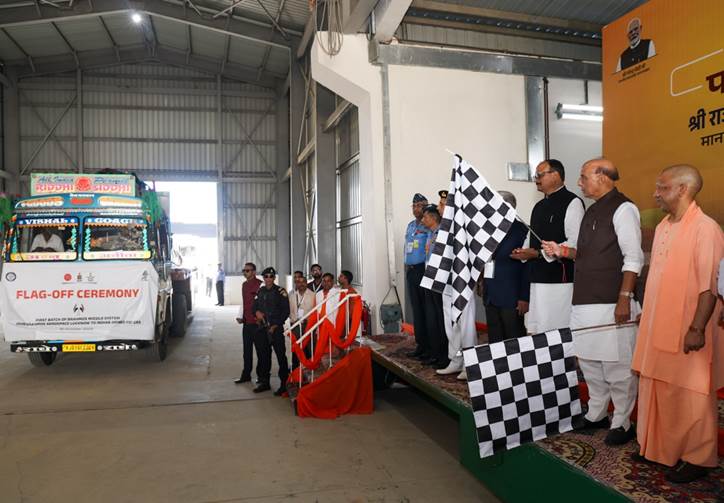
Rajnath Singh described BrahMos as not merely a missile but a symbol of India’s indigenous strength and technological capability. With a traditional warhead, an advanced guided system, and supersonic speed, the missile combines range, precision, and impact. “It has become the backbone of our Armed Forces,” he said, emphasising its operational reliability.
Highlighting its operational role in Operation Sindoor, the Defence Minister stated that BrahMos has proven its effectiveness in practice. “Every inch of Pakistan’s territory is now within the reach of BrahMos. Operation Sindoor shows that victory has become a habit. This operation was just a trailer. It has made Pakistan realise what might follow,” he added.
Rajnath Singh also stressed India’s position as a credible global partner in defence technology. “Made-in-India is no longer a slogan but a global brand. Whether through the export of BrahMos to the Philippines or future cooperation with other countries, India is now a giver, not just a taker. This is the true identity of an Aatmanirbhar Bharat,” he said. In the past month alone, the BrahMos team has signed contracts worth around ₹4,000 crore with two foreign countries, underlining the system’s international demand and India’s growing role in global defence exports.
Built to handle the entire production lifecycle, the Lucknow facility carries out assembly, integration, and testing to the highest technical standards. The Defence Minister said the project not only strengthens national security but also creates significant employment opportunities and drives regional economic growth. The UP Defence Industrial Corridor has already employed over 15,000 youth, and the BrahMos centre is expected to attract international experts, making Lucknow a hub for defence knowledge, innovation, and training.
Rajnath Singh underscored the importance of a resilient domestic supply chain. “If a foreign supplier refuses a critical component, production halts. We must strengthen small industries that manufacture thousands of components for major weapon systems to ensure the supply chain remains entirely within India. Be it advanced seekers or ramjet engines, we must develop all technologies domestically,” he said. He called for a roadmap to integrate small and medium enterprises alongside large corporations, asserting that the success of the Uttar Pradesh Defence Industrial Corridor depends on the parallel growth of smaller industries.
The Defence Minister also highlighted the broader economic significance of the facility. With each missile contributing to GST revenue, the government can fund schools, hospitals, and welfare schemes, showing how defence production supports both security and development.
Chief Minister Yogi Adityanath described BrahMos as a missile of Aatmanirbharta, fulfilling India’s defence requirements while ensuring the safety and prosperity of citizens. He thanked Prime Minister Narendra Modi and the Defence Minister for making Lucknow a key node in India’s self-reliance movement in defence production.
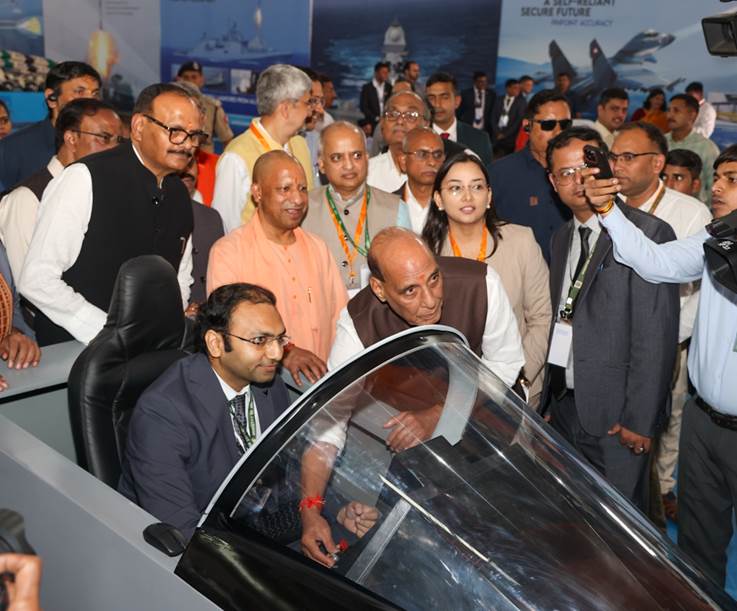
During the event, the Minister and Chief Minister inaugurated the Booster Building, observed a live demonstration of the booster docking process, and reviewed the Airframe and Avionics, Pre-Dispatch Inspection, and Warhead Buildings, along with simulator equipment. They also saw a display of a mobile autonomous launcher.
Director General of BrahMos, Dr Jaytirth R. Joshi, handed over a GST bill and a cheque of approximately ₹40 crore to the Chief Minister, highlighting the tangible revenue generation for the state. Deputy Chief Minister Brajesh Pathak, DRDO Chairman and Secretary, Department of Defence R&D Dr Samir V. Kamat, and other dignitaries were also present.
The Lucknow facility, as the first in the corridor to manage the complete manufacturing and testing process indigenously, reinforces both strategic autonomy and industrial growth, while advancing India’s “Make in India, Make for the World” initiative. With its production capacity, turnover, revenue contribution, and employment potential fully integrated into the narrative, the BrahMos Integration and Testing Facility exemplifies how defence manufacturing can simultaneously strengthen national security and economic development.
– global bihari bureau