

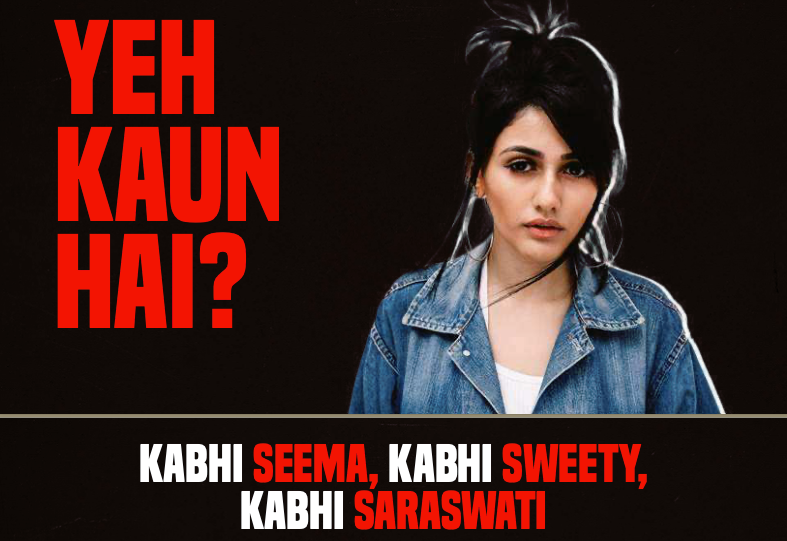
Congress MP and Leader of the Opposition in the Lok Sabha Rahul Gandhi today claimed the person in the photo was a Brazilian model and "an example of 25 lakh vote thefts in Haryana".
Rahul Flags Haryana Roll Irregularities Before Bihar Votes
BJP Calls Rahul’s Claims a Diversion Strategy
New Delhi: On the eve of the first phase of voting in Bihar, Congress leader Rahul Gandhi brought the question of electoral roll integrity into the heart of the national political conversation by releasing a dossier of documents that he termed the “Haryana Files,” alleging large-scale manipulation of voter lists in the 2024 Haryana Assembly election. He presented the material at a press conference in New Delhi on Wednesday, only hours before campaigning formally closed for the first segment of voting in Bihar. The timing was in itself politically consequential. It meant that the claims would circulate directly among voters, party workers, polling agents, district officials and media networks just as they entered the psychological threshold between campaign rhetoric and electoral decision-making.
Haryana had voted on October 5, 2024. The Bharatiya Janata Party won 48 seats, the Congress won 37, and the remainder went to other parties and independents. The Congress had come into that election convinced that it would secure a narrow lead, an expectation that Gandhi referenced in his remarks, noting that several exit polls had forecast a Congress advantage. He argued that the discrepancy between the party’s expectations and the final result could be explained not by post-campaign shifts or silent voter effects, but by what he termed “systematic tampering of the voter rolls.” He described the process as “Vote Chori” and visually extended this into “Sarkar Chori,” indicating that the question, in his view, was about the legitimacy of the governing mandate.
The document circulated by the Congress lists 5,21,619 voter entries it identifies as duplicated, 19,26,351 names it classifies as “bulk registrations” assigned to the same house number or address cluster, and 93,174 names it lists under what it describes as invalid or unverifiable addresses, including a quantity registered under “House No. 0.” The dossier also includes instances in which the same photograph appears under multiple voter identities, sometimes in different polling booths and in different parts of a constituency. One of the illustrative examples the Congress highlighted was from the Rai constituency, in which an image apparently drawn from a publicly circulating online model photograph appears multiple times under different names. These figures and examples are drawn from the Congress’s internal analysis of publicly available electoral roll PDFs and registration entries.
The party compared these alleged anomalies to the combined victory margin of 22,779 votes across the eight closest BJP–Congress contests in the 2024 Haryana election, arguing that the alleged irregularities exceed, by several scales, the number of votes required to determine control of the state legislature. The Congress did not file an election petition challenging the Haryana result at the time, nor did the party formally petition the Election Commission on the alleged anomalies in the months following the election. This gap—between internal suspicion and delayed public articulation—now forms part of the political interpretation of the event. Gandhi stated that the material was being publicly released now because, in his words, “the same pattern is appearing in Bihar.”
Bihar will vote in two phases, on 6 and 11 November, with counting on 14 November. At Wednesday’s briefing, however, Gandhi did not provide a separate dataset for Bihar. He claimed that the Special Intensive Revision process underway in the state shows, in his view, “the same signs” that the Congress claims to have identified in Haryana: bulk additions, duplicate entries and targeted deletions among certain voter groups. Yet no formal complaint or legal challenge has so far been filed by the Congress party with the Election Commission of India concerning Bihar’s voter rolls. The absence of such a filing means that, at present, the allegation remains politically asserted but not yet tested through statutory procedure.
The timing ensured that the matter would not remain procedural. The Bharatiya Janata Party responded within hours. Union Minister Kiren Rijiju addressed the press in New Delhi and dismissed Gandhi’s allegations, arguing that they were intended to influence the Bihar campaign environment. “Today, ahead of voting in Bihar, Rahul Gandhi narrated a story from Haryana. Having nothing left in Bihar, he has brought up Haryana to divert attention,” he said. Rijiju noted that senior Congress leaders in Haryana had publicly pointed to internal disunity and organisational weakness as causes of the party’s performance there. He also stated that exit polls are not evidence, recalling that exit polls in 2004 predicted a BJP victory before the Congress ultimately formed the government. “We did not accuse the Election Commission,” Rijiju said, adding that if the Congress believed irregularities had occurred, it could pursue remedies through the Commission or courts rather than through press presentations.
On the campaign trail in Bihar, BJP national president Jagat Prakash Nadda addressed public rallies in Madhuban and Narkatiaganj. While he did not directly mention the Haryana dossier, he spoke critically of Rahul Gandhi’s political approach, saying that Gandhi’s opposition to Prime Minister Narendra Modi, in his view, had extended into statements questioning or diminishing national institutions, the armed forces and India’s international standing. He criticised Rashtriya Janata Dal leader Tejashwi Yadav for not objecting to such remarks and described the Congress-RJD partnership as a formation aimed at electoral advantage rather than public purpose. Nadda said that the BJP’s approach was grounded in governance stability and the interests of society at large.
The Election Commission of India has not yet issued a detailed response to the Haryana material presented on Wednesday. The Commission’s most recent public clarification on similar allegations came in September 2025, when Gandhi accused officials of targeted deletions in the Aland constituency in Karnataka. At that time, the Commission publicly described the claims as “incorrect and baseless,” stating that deletions cannot legally occur without notice, verification and an opportunity for appeal. The Commission emphasised that statutory mechanisms exist for raising objections during roll revision and that disputes should be pursued through those channels and, if necessary, through election petitions. That position remains part of the Commission’s published record. The Commission has indicated that it will examine the Haryana dossier before offering further clarification.
The present dispute places the Election Commission at the centre of institutional attention, not because either side has yet proven its position, but because the electoral roll is the foundational instrument through which democratic participation is enacted. The roll determines who may vote. It forms the basis upon which turnout, booth-level patterns and aggregate results are evaluated. It also shapes the public’s perception of whether elections are substantively fair even before the first ballot is cast. If the data presented by the Congress eventually proves accurate through verification, it would indicate vulnerability in the administrative processes that govern voter list compilation, correction and maintenance. If the data do not withstand independent scrutiny, the episode would illustrate the capacity of allegations alone to influence electoral atmospheres when introduced immediately before voting.
The stakes, therefore, extend beyond Haryana or Bihar. They concern the public’s confidence in the principle of one person, one vote, and in the neutrality of the mechanisms that protect it. In India, the electoral roll is maintained through coordinated work between the Election Commission, state electoral officers, district administrations and booth-level officers, with data entry and verification occurring in cycles that vary in intensity between revision periods and election years. The process depends on administrative discipline, local accuracy, verification capacity and the presence of party-appointed booth agents who play a statutory role in objecting to or confirming entries. When any of these layers weakens, errors may occur; when allegations suggest coordination rather than isolated error, the question shifts from administrative error to structural bias. That is the axis on which the present dispute turns.
What remains unresolved is how the dispute will move from the level of public allegation to the level of institutional response. For the matter to acquire legal and procedural form, the Congress would need to file either a formal complaint regarding the Haryana rolls or an election petition in the appropriate jurisdiction. If the party intends to pursue the claim in Bihar, it would need to file objections during the ongoing revision cycle or after the results through an election petition. The Election Commission’s response, when issued, will shape whether the public understands the matter as a technical question addressed through procedure or a political conflict in which procedural resolution does not occur. For now, the allegations remain asserted, the rebuttals remain political, and the institutional position remains pending.
The immediate effects, if any, will become visible only after Bihar has voted. If turnout rises in areas where the allegations circulated actively, it may indicate mobilisation through distrust or vigilance. If turnout remains unaffected, the dispute may remain contained within party messaging. Either way, the issue now sits within the domain of public attention rather than administrative quiet. The question of electoral roll integrity has moved from the background to the centre of the democratic stage. The next movement will depend not on speeches or rallies, but on whether statutory verification, documented evidence and institutional response meet in the same frame.
– global bihari bureau


Impartial coverage of Bihar situation
🗳️🔥 Just before Bihar votes, Rahul Gandhi drops “Haryana Files” alleging fake voters & vote tampering 😮 BJP calls it a distraction tactic! Political drama peaking right before polls 🎭🇮🇳
🇮🇳🪖 Rajnath Singh hits back at Rahul Gandhi — says “Don’t drag the Army into politics!” 💥 Reminds all that soldiers follow only one religion: Sainya Dharma 🙏🔥