Photo source: @TheNaveena|X
Railing collapse triggers fatal stampede in Andhra temple
PM, Vice President, condole deaths in Srikakulam stampede
Kasibugga: At least nine people were killed and dozens injured in a stampede at the Sri Venkateswara Swamy Temple, in Kasibugga (also spelt Kashibugga), Palasa mandal, Srikakulam district, Andhra Pradesh, today due to a major crowd rush — a blood-soaked indictment of callous, serial negligence that treats human lives as collateral in the name of devotion.
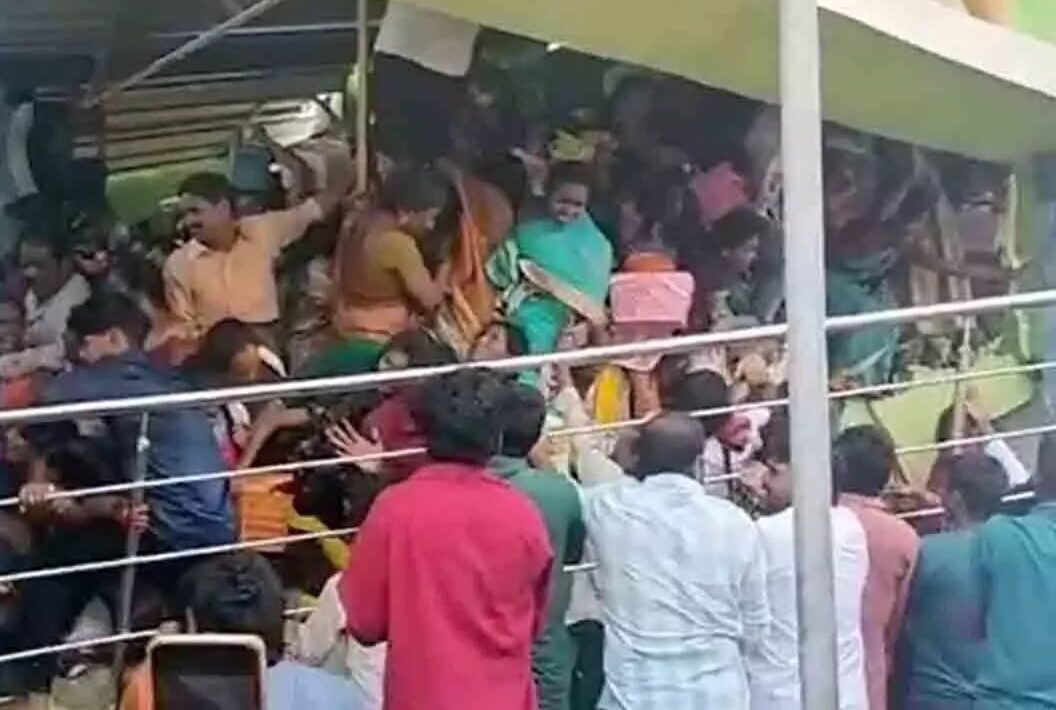
Officials said the tragedy occurred when a large number of devotees gathered at the temple on the occasion of Karthika Ekadashi, leading to overcrowding at one of the narrow approach corridors. The initial trigger, according to district authorities, appeared to be the collapse of a railing near the main queue line, causing panic and a cascading fall of people in the densely packed area.
The temple premises were reportedly filled far beyond their safe capacity. Preliminary estimates suggest that while the temple can hold around 2,000 to 3,000 devotees at a time, several times that number had converged since early morning for darshan and offerings. With the same route being used for both entry and exit, movement stalled, and people began pushing from the rear as news spread of a fall in the front portion of the queue.
Rescue teams, police personnel and local administration units rushed to the site. The injured were taken to nearby government and private hospitals. Medical officials confirmed that at least nine people had died, including eight women and a 13-year-old boy. Some victims are reported to be in critical condition. Eyewitnesses described scenes of panic and chaos as devotees fell over one another in the narrow passage. “It happened within seconds. People were trying to move forward, and suddenly the railing gave way. Those in front fell and were crushed,” said a local devotee who escaped with minor injuries.
The Sri Venkateswara Swamy Temple, locally dubbed Chinna Tirupati, is a private outfit built in 2018 by 94-year-old landlord Hari Mukunda Panda after he was reportedly denied darshan at Tirumala on age grounds. It operates outside the state Endowments Department, and organisers neither sought permission for the mass gathering nor alerted district authorities to any crowd-control measures. The absence of proper barricading, inadequate staff and lack of separate entry and exit routes are being cited as contributing factors.
Karthika Ekadashi, observed on the eleventh day of the bright fortnight in the Hindu lunar month of Karthika, involves fasting, lamp vigils, and worship of Lord Vishnu. It forms part of the month-long Karthika Masam observances and draws large crowds to Vishnu temples in Andhra Pradesh and Telangana. Devotees worship Lord Vishnu as Damodara or Sri Venkateswara on this day for moksha. Scriptures promise liberation. Instead, today, nine families received body bags. The temple owner now faces charges under Bharatiya Nyaya Sanhita sections for culpable homicide not amounting to murder.
Prime Minister Narendra Modi expressed deep grief over the loss of lives. “Pained by the stampede in Venkateswara Swamy Temple in Srikakulam, Andhra Pradesh. My thoughts are with those who have lost their near and dear ones. I pray that the injured recover soon,” he wrote on X (formerly Twitter). The Prime Minister announced an ex-gratia payment of ₹2 lakh each from the Prime Minister’s National Relief Fund to the next of kin of those who lost their lives and ₹50,000 each for the injured.
Vice-President of India, C. P. Radhakrishnan, also conveyed his anguish, describing the incident as “extremely distressing.” He offered condolences to the bereaved families and wished a speedy recovery to the injured. The state government has ordered a detailed inquiry into the circumstances leading to the stampede. A senior district official said that investigators will examine structural factors such as railing strength and queue-line layout, and whether standard safety protocols were followed.
Ekadashi carnage—another ignored warning
Crowd disasters of this kind have been recurring in India’s places of worship and public gatherings. Between 2005 and 2024, official records show over a dozen fatal stampedes in temples and religious congregations, including incidents at Sabarimala (Kerala), Naina Devi (Himachal Pradesh), Datia (Madhya Pradesh), and Vaishno Devi (Jammu and Kashmir). Government committees formed after such tragedies have consistently cited similar causes — overcrowding, inadequate crowd flow design, lack of real-time monitoring, and the absence of coordination between temple managements and local authorities.
The question arises that when will the state decide that devotion deserves protection, not platitudes?
Guidelines from the National Disaster Management Authority recommend separate entry and exit routes, capacity-based crowd regulation, deployment of trained marshals, and advance coordination between police, health and fire services. However, follow-up implementation often remains uneven, especially in smaller or privately managed shrines. Experts note that while large temples such as Tirumala or Vaishno Devi now employ digital queue systems, closed-circuit cameras, and emergency corridors, many local temples continue to rely on informal management practices that cannot cope with sudden surges in attendance.
In the case of Kasibugga, officials said that the crowd volume had far exceeded estimates for the festival day, and that inadequate infrastructure and a collapsed railing together created a fatal chain reaction. As investigations continue, authorities are expected to review safety compliance mechanisms across temples in the region to prevent recurrence.
The tragedy has reignited concern over the broader issue of public safety in religious congregations where deep faith and tradition often outpace institutional preparedness. But while faith is sacred, negligence is sacrilege!