Borrowed Time: Environment’s Economic Toll
The Collapse of Nature Is Rewriting the Global Economy
 Nairobi: The global economy is teetering on borrowed environmental credit, its very foundations crumbling as unchecked degradation gnaws away at productivity and stability. Climate upheaval, plummeting biodiversity, ravaged landscapes, and insidious pollution have fused into a relentless economic undertow, siphoning off trillions annually while redrawing the maps of global power and progress.
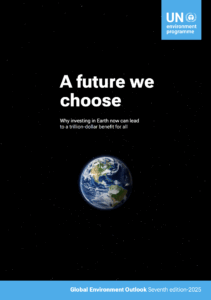
These aren’t distant eco-fables anymore; they’re hard numbers etched into balance sheets and human lives, according to The Global Environment Outlook, Seventh Edition: A Future We Choose (GEO-7), released during the seventh session of the United Nations Environment Assembly in Nairobi, today. This is the product of 287 multi-disciplinary scientists from 82 countries.
Air pollution alone reaps a grim harvest of nine million premature deaths each year, with a staggering price tag of US$8.1 trillion in 2019—equivalent to about 6.1 per cent of the world’s GDP, a figure that dwarfs many nations’ entire economies and exposes the folly of treating clean air as an optional luxury. Extreme weather fueled by climate shifts devours US$143 billion yearly in destruction, turning once-reliable infrastructure into liabilities and insurance premiums into corporate nightmares.
Vast swaths of the planet—between one-fifth and two-fifths of all land—are now degraded, imperilling the livelihoods of over three billion people who depend on soil that’s turning to dust under the weight of overuse and erratic weather.
And in the silent catastrophe of biodiversity collapse, one million species teeter on the brink of extinction, unravelling ecosystems that underpin everything from pharmaceuticals to pollination, services valued in the trillions but rarely accounted for in boardroom ledgers.

These aren’t mere anomalies in an otherwise thriving market; they’re the brutal realities defining trade, investment, and survival in our interconnected world. The fallout is measurable, inexorable, and accelerating, as detailed in the freshly unveiled seventh edition of the GEO-7.
Temperatures are on track to breach 1.5°C above pre-industrial levels by the early 2030s and 2°C by the 2040s, ushering in an era of chronic heatwaves that could cripple labour in tropical hubs of manufacturing and agriculture, where sweatshop economies already strain under rising mercury.
Food availability per person might dip by 3.4 per cent by mid-century, exacerbating hunger in regions least equipped to adapt, while fertile land vanishes at rates akin to erasing a Colombia or Ethiopia from the map annually—a loss that amplifies food insecurity and migration pressures.
The toxic legacy of plastics and chemicals piles higher, with 8,000 million tonnes of waste already fouling oceans and soils, inflicting US$1.5 trillion in annual health damages from exposures that seep into bloodstreams and supply chains alike.
Without a course correction, GEO-7 projects a 4 per cent shave off global GDP by 2050, ballooning to 20 per cent by century’s end, numbers that make recessions look like minor blips and underscore how environmental neglect is morphing into the ultimate market disruptor.
This dire tableau didn’t materialise from thin air; it’s the predictable offspring of a growth paradigm hooked on cheap fossil fuels, disposable resources, and subsidies that reward ruin. Political horizons, tethered to election cycles and shareholder impatience, favour kicking the can down a road that’s rapidly eroding, even as the deferred bills mount into existential threats.
GEO-7 paints this as no accident but a systemic flaw: our economic, financial, and governance frameworks are woefully mismatched to the challenges, prizing short-term extraction over long-term endurance.
Yet, in a twist that might raise eyebrows among the perpetually sceptical, the report dangles a lucrative alternative—pivot hard toward sustainability, and reap annual macroeconomic windfalls of US$20 trillion by 2070, surging beyond US$100 trillion by 2100. This isn’t pie-in-the-sky altruism; it’s crunching numbers from suites of models shared with bodies like the Intergovernmental Panel on Climate Change (IPCC) and the Intergovernmental Science-Policy Platform on Biodiversity and Ecosystem Services (IPBES), suggesting that decarbonising energy, embracing circular materials, reforming food production, restoring ecosystems, and realigning finance could not only halt the slide but turbocharge prosperity. By 2050, such shifts might avert nine million pollution-related deaths, lift 200 million from hunger, and pull over 100 million from extreme poverty, all while curbing biodiversity haemorrhage and expanding natural lands.
The blueprint demands nothing short of a full-spectrum overhaul across five interlocking systems, where half-measures risk merely shifting problems from one silo to another. In finance and economics, it’s about dethroning GDP as the sole deity, incorporating “inclusive wealth” metrics that value human and natural capital, pricing in externalities like carbon emissions, and axing subsidies that fuel deforestation or fossil dependency—think the US$7 trillion annually propping up harmful practices worldwide. Materials and waste cry out for circularity: redesign products for reuse, track components transparently, and nudge consumers toward less stuff through cultural nudges, potentially slashing the 2 billion tonnes of solid waste we churn out yearly, projected to hit 3.8 billion by 2050.
Energy’s path is clear but thorny—decarbonise supplies via renewables, amp up efficiency, and ensure mineral chains for batteries don’t spawn new social ills or energy poverty. Food systems, responsible for a third of emissions, need a diet makeover: promote sustainable eats, cut waste (a third of production rots uneaten), and boost efficiency to free up land for nature. Finally, the environment itself requires aggressive conservation, nature-based adaptations like mangrove buffers against storms, and mitigation strategies that lean on Indigenous and local knowledge for equitable transitions—wisdom that’s sustained ecosystems for millennia but often sidelined in technocratic fixes.
But here’s where the cynicism creeps in: GEO-7′s optimism hinges on “unprecedented action” in a world where emissions have climbed 1.5 per cent yearly since 1990, hitting records in 2024 despite Paris pacts and biodiversity frameworks. The report’s scenarios—blending behavioural restraint on consumption with tech efficiencies—admit trade-offs, like bioenergy’s potential clash with food security, and call for US$8 trillion yearly investments through 2050 to hit net-zero and biodiversity goals. Inaction’s tab? Far steeper, yet politically palatable in the near term. Early buzz on platforms like X reflects this divide: one reviewer hailed their contribution to the sustainability roadmap, while another critiqued its economy-centric lens, arguing it risks commodifying nature further.
Media coverage echoes the urgency—Health Policy Watch notes emissions must peak by 2025 and plummet 40 per cent by 2030 to cling to 1.5°C, a tall order amid UNEA-7’s deliberations from December 8-12. Circular Online laments the millions killed and trillions lost, framing GEO-7 as the most exhaustive planetary checkup yet.
Regionally, the report tailors its prescriptions, recognising that one-size-fits-all flops in a diverse world. In Africa, priorities skew toward bolstering food systems against desertification and integrating Indigenous practices in land restoration, while Asia-Pacific grapples with pollution hotspots through circular waste innovations. Europe might lead on energy transitions, phasing out fossils amid mineral supply tensions, whereas Latin America focuses on biodiversity safeguards in deforestation-prone zones. North America’s challenge lies in overhauling consumption-driven economies, and the Middle East in decoupling growth from oil. These pathways demand whole-of-society buy-in, from governments to Indigenous communities, yet history whispers caution—past GEO editions influenced policies unevenly, often diluted by vested interests.
UNEP’s Inger Andersen, in her launch statement, framed it starkly: continue the devastating path or seize progress in renewables and protections for a thriving future. But as delegates mingle in Nairobi, one can’t ignore the irony: amid calls for trillions in green investments, developing nations decry adaptation funding shortfalls that widen global rifts. GEO-7 quantifies the fork in the road—transformation as inevitable, the timing as the trillion-dollar question. Will boardrooms and ballots align before systemic failure forces their hand? In a world where delay has long been the default, the report’s trillion-dollar lure might just be the cynic’s last hope, or another echo in the chamber of unheeded warnings.
– global bihari bureau