New Delhi: The Election Commission of India (ECI) announced the schedule for bye-elections to fill vacant seats in five assembly constituencies across Gujarat, Kerala, Punjab, and West Bengal, with polling set for June 19, 2025, and vote counting scheduled for June 23, 2025. The bye-elections aim to address vacancies caused by the deaths of three sitting MLAs and the resignations of two others, marking a critical step in ensuring continued representation in these constituencies. The gazette notification for the elections will be issued on May 26, 2025, with nominations due by June 2, scrutiny on June 3, and the last date for withdrawal of candidatures on June 5. The electoral process is expected to be completed by June 25, 2025.
The outcomes of these polls are expected to have significant political implications, particularly in Kerala, where the shift of PV Anvar to the Trinamool Congress could influence local dynamics, and in Gujarat, where the ruling Bharatiya Janata Party faces the challenge of retaining its stronghold in Kadi and Visavadar.
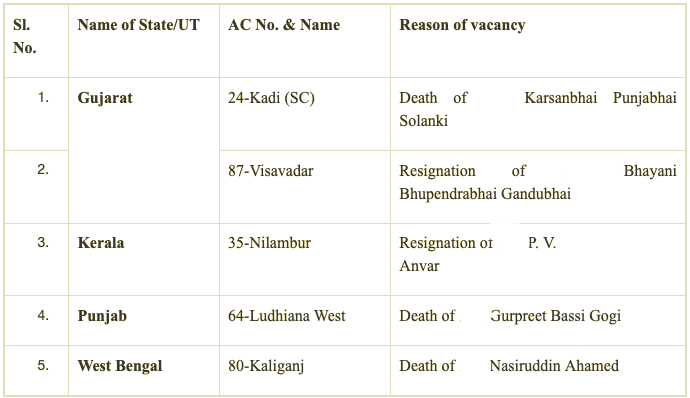
In Gujarat, bye-elections will be held in the Kadi (SC) and Visavadar constituencies to fill vacancies arising from the death of Karsanbhai Punjabhai Solanki in February 2025 and the resignation of Bhayani Bhupendrabhai Gandubhai, respectively. Kerala’s Nilambur constituency will see a bye-election following the resignation of PV Anvar, a former Left Democratic Front-backed MLA who stepped down in January 2025 after being appointed convenor of the Kerala unit of the Trinamool Congress. In Punjab, the Ludhiana West constituency will go to the polls due to the demise of Gurpreet Bassi Gogi in January 2025. West Bengal’s Kaliganj constituency faces a bye-election following the death of Nasiruddin Ahamed due to a cardiac arrest in February 2025.
The Model Code of Conduct for the bye-elections has been enforced immediately in the districts covering these constituencies, as per ECI guidelines issued on January 2, 2024. Additionally, the commission said it has introduced voter-friendly measures, including mobile deposit facilities outside polling stations to address challenges faced by senior citizens, women, and persons with disabilities. Mobile phones will be permitted within 100 meters of polling stations but must remain switched off and deposited in designated pigeonhole boxes or jute bags at the entrance, except in cases exempted by the Returning Officer. Electioneering is prohibited within a 100-meter radius of polling stations on polling day to maintain order and fairness.
Candidates with criminal antecedents are required to disclose their backgrounds in newspapers and on television channels on three occasions during the campaign period, spread across three blocks: within the first four days after withdrawal (June 6–9), the next four days (June 10–13), and from the ninth day until the second day before the poll (June 14–17). Political parties must also publish details of such candidates on their websites and social media platforms within 48 hours of selection, in line with Supreme Court judgments aimed at enhancing transparency. The ECI’s “Know Your Candidate” app will provide voters with access to this information, empowering them to make informed choices.
The ECI has further streamlined processes for candidates by facilitating “No Dues Certificates” for those who have occupied government accommodation in the past decade, covering rent, electricity, water, and telephone charges. This directive, issued on May 3, 2024, aims to expedite candidacy formalities. Under the leadership of Chief Election Commissioner Gyanesh Kumar and Election Commissioners Sukhbir Singh Sandhu and Vivek Joshi, the ECI reiterated its commitment to conducting transparent and voter-centric elections while adhering to legal frameworks and introducing innovations to enhance the voting experience.
To ensure a free, fair, and credible electoral process, the ECI has emphasised the use of updated electoral rolls, following the Special Summary Revision completed on May 5, 2025, with reference to April 1, 2025, as the qualifying date. Continuous updates to the rolls will be permitted until 10 days before the last date for filing nominations, allowing eligible citizens to register as voters. The commission has also mandated the use of Electronic Voting Machines (EVMs) and Voter Verifiable Paper Audit Trails (VVPATs) across all polling stations, with sufficient machines allocated to ensure smooth operations. Voter identification will primarily rely on the Electoral Photo Identity Card (EPIC), though alternative documents such as Aadhar cards, driving licenses, and Indian passports will also be accepted.
– global bihari bureau