New Delhi: The Election Commission of India (ECI) has released a list of approximately 65 lakh voters removed from Bihar’s draft electoral rolls, adhering to a Supreme Court directive issued on August 14, 2025.
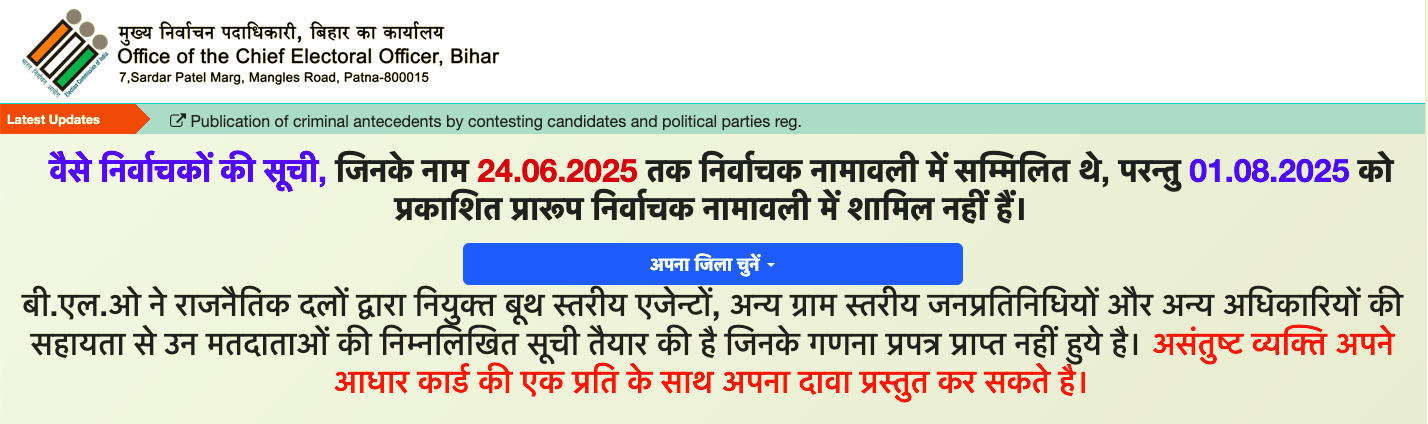
The list, accessible on the Chief Electoral Officer, Bihar’s website and at district election offices, specifies reasons for deletions: 22 lakh due to deaths, 36 lakh for permanent migration or untraceable voters, and 7 lakh for duplicate registrations. Searchable by Electoral Photo Identity Card (EPIC) numbers, it is also displayed at polling stations, panchayat offices, and booth-level officer stations, with widespread publicity through newspapers, radio, and television.
The Supreme Court, led by Justices Surya Kant and Joymalya Bagchi, mandated this transparency to safeguard voting rights, allowing affected voters to file claims or objections until September 1 using Aadhaar or EPIC for re-inclusion. The draft roll, published on August 1, now lists 7.24 crore voters, down from 7.89 crore.
The ECI, led by Chief Election Commissioner Gyanesh Kumar, defends the Special Intensive Revision (SIR), initiated on June 24, as a necessary update after nearly two decades, conducted with political party involvement and due process, including notices and hearings. Opposition parties, including Congress and Rashtriya Janata Dal (RJD), allege potential errors, claiming wrongful deletions risk voter suppression ahead of Bihar’s Assembly elections.
Also read: Voter Rolls Crisis: Trust at Stake
The ECI counters that booth-level lists were shared with parties, and no deletions occurred without scrutiny. A compliance report is due to the Supreme Court by August 22, as the court monitors fairness in the electoral process.
The SIR process, the first comprehensive revision in Bihar since 2005, was prompted by complaints from political parties about inaccuracies in the electoral rolls, such as outdated entries and duplicate registrations. The ECI emphasised that the exercise involved door-to-door verification by Booth Level Officers (BLOs) and coordination with Electoral Registration Officers (EROs) to ensure accuracy. Political parties were provided draft lists at each stage, and the ECI claims that no voter was removed without prior notice and an opportunity to respond. The commission’s affidavit to the Supreme Court detailed the procedural safeguards, including the use of Form 7 for objections and Form 8 for corrections, ensuring compliance with the Representation of the People Act, 1950.
Opposition leaders have voiced significant concerns, with Congress leader Rahul Gandhi publicly alleging “vote theft” and sharing photographs of voters purportedly wrongly removed. The Rashtriya Janata Dal and other allies in the Mahagathbandhan coalition in Bihar have echoed these claims, suggesting that the deletions disproportionately affect marginalised communities, potentially skewing the electoral outcome.
The ECI has strongly refuted these allegations, labelling them as misleading and demanding evidence or a public apology from Gandhi within seven days. The commission clarified that the SIR addressed long-standing issues, such as voters who migrated to other states or countries, and that the process was transparent, with all parties having access to booth-level data.
The Supreme Court’s intervention underscores the importance of an inclusive electoral process, particularly in a state like Bihar with a history of complex voter dynamics. The court’s order to accept Aadhaar and EPIC as proof for re-inclusion aims to simplify the process for affected voters, many of whom may lack access to other documentation. The ECI has set up help desks at district and block levels to assist voters in checking their status and filing claims. Additionally, the commission has extended the window for corrections until September 1, with the final electoral roll expected by late September, well before the anticipated Assembly election schedule.
Public response to the list’s release has been mixed, with some voters expressing relief at the ability to verify their status, while others report confusion over navigating the online portal or accessing physical lists. Civil society groups have called for more robust awareness campaigns to ensure rural and less tech-savvy voters can engage with the process. The ECI claimed it has responded by intensifying outreach efforts, including mobile vans and local language announcements, to reach remote areas. The commission has also assured that no eligible voter will be excluded from the final roll if they follow the prescribed re-inclusion process.
The controversy surrounding the deletions highlights broader challenges in maintaining accurate electoral rolls in a state with significant migration and demographic shifts. Bihar’s large population and history of electoral disputes make the SIR a critical exercise, but also a contentious one.
As the Supreme Court continues to oversee the process, the ECI faces the dual task of ensuring transparency while addressing political and public concerns. The outcome of this revision, and the handling of claims and objections, will likely shape trust in the electoral system as Bihar heads toward its Assembly elections.
– global bihari bureau