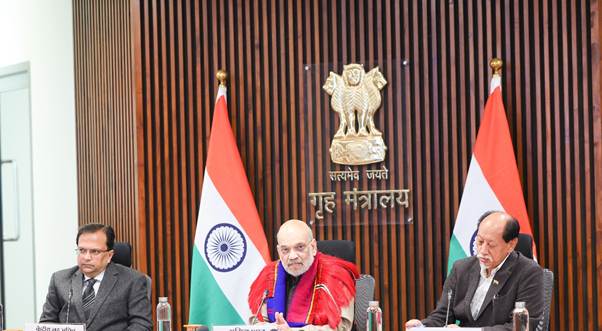
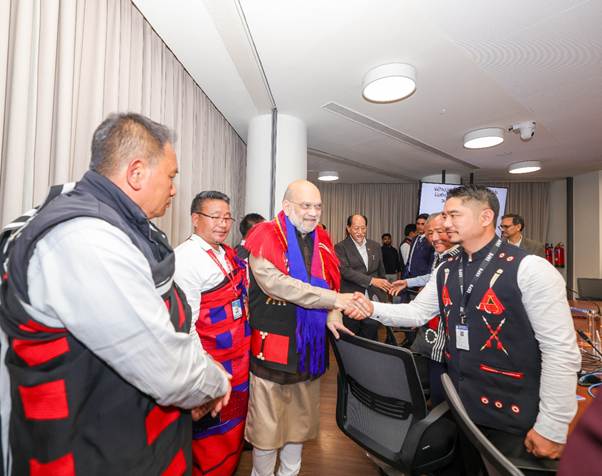
Union Home Minister Amit Shah (Centre) during the meeting with the ENPO representatives in New Delhi, today.
Centre, Nagaland ink pact on Frontier Nagaland Authority
New Delhi: A tripartite agreement signed in the national capital today between the Government of India, the Government of Nagaland and representatives of the Eastern Nagaland Peoples’ Organisation (ENPO) has been projected by the Centre as a historic breakthrough toward peace and development in the Northeast.
The accord, announced by the Union Ministry of Home Affairs, seeks to operationalise a long-pending demand of ENPO, an apex body representing eight recognised Naga tribes across six eastern districts of Nagaland. These districts are Tuensang, Mon, Kiphire, Longleng, Noklak and Shamator. Together, they will now come under a newly created administrative arrangement called the Frontier Nagaland Territorial Authority (FNTA).
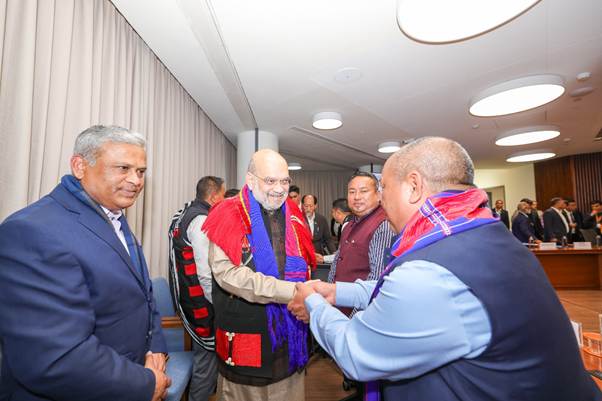
The agreement was signed in the presence of Union Home Minister and Minister of Cooperation Amit Shah and Nagaland Chief Minister Neiphiu Rio. According to official claims, the FNTA will receive devolved powers over 46 subjects, a scale of decentralisation that the government says will remove obstacles in the path of Eastern Nagaland’s development and fulfil the “genuine aspirations” of its people.
Addressing the event, Shah framed the pact as part of Prime Minister Narendra Modi’s broader vision of a Northeast free from insurgency, violence and disputes. He said that eleven years ago, the region was marked by armed groups, inter-state conflicts and fragmentation, conditions that disturbed peace and hindered development. The agreement, he argued, represented another step toward what he called a “dispute-free Northeast.”
The Home Minister reiterated that the government is committed to resolving every dispute and cited the signing of 12 major agreements in the region since 2019 as evidence of that approach. In a pointed political comparison, he said that previous governments had signed agreements but failed to implement them, while the present government intended to carry them out “in letter and spirit.”
Financial assurances formed a key part of the announcement. Shah told ENPO representatives that the Government of India would assist in the development of Eastern Nagaland and shoulder its responsibility. A fixed amount will be allocated every year for the region, and the Union Ministry of Home Affairs will also bear the initial expenditure required for establishing the FNTA.
Recalling earlier engagements, Shah said that during 2021–22, he had urged ENPO leaders to keep faith in the democratic process, assuring them that they would receive both justice and respect. He credited prolonged mediation by officers of the Ministry of Home Affairs, who worked as a bridge between ENPO and the Nagaland government, for bringing the talks to a conclusion.
The Home Minister acknowledged the strategic importance of the ENPO region and noted that, since the creation of Nagaland, citizens of Eastern Nagaland had felt they were denied justice and fair development. He said that Chief Minister Neiphiu Rio had agreed to listen to ENPO’s demands with an open mind and accept them after discussion. Shah publicly thanked Rio, his cabinet colleagues and the two Members of Parliament from the state for what he described as their magnanimity in carrying negotiations to their “logical conclusion.”
Calling the settlement a “happy conclusion” to a long-standing dispute, Shah congratulated the people and organisations of Eastern Nagaland and asserted that there would now be no obstacle in the path of the region’s development. He said both the Government of India and the Government of Nagaland would jointly carry forward the development agenda for Eastern Nagaland.
The agreement lays out an administrative structure for the new authority. It provides for a mini-secretariat for the FNTA, headed by an Additional Chief Secretary or Principal Secretary. Development outlay for Eastern Nagaland will be shared in proportion to population and area. The government has emphasised that the arrangement does not affect Article 371(A) of the Constitution of India, which grants special provisions and safeguards to Nagaland.
The framework is described as a unique model aimed at overall development through financial autonomy and enhanced decision-making. The official language speaks of accelerated infrastructure growth, economic empowerment and optimum utilisation of resources. The pact is also presented as proof of the government’s commitment to resolving contentious issues through dialogue rather than violence or armed conflict, reinforcing what it calls the basic tenet of democracy based on mutual respect and negotiation.
Deputy Chief Minister of Nagaland Yanthungo Patton, other cabinet colleagues, senior officials from the Union Ministry of Home Affairs and the Government of Nagaland, and several dignitaries were present at the signing ceremony.
While the Centre has portrayed the agreement as a milestone in its Northeast policy, its success will ultimately rest on whether the promised annual funding, devolved powers over 46 subjects and administrative autonomy translate into tangible change on the ground. Past accords in the region have often been celebrated at signing and questioned during execution. The FNTA experiment now enters that familiar phase where intent meets governance, and where development claims will be tested against realities in some of Nagaland’s most remote districts.
– global bihari bureau