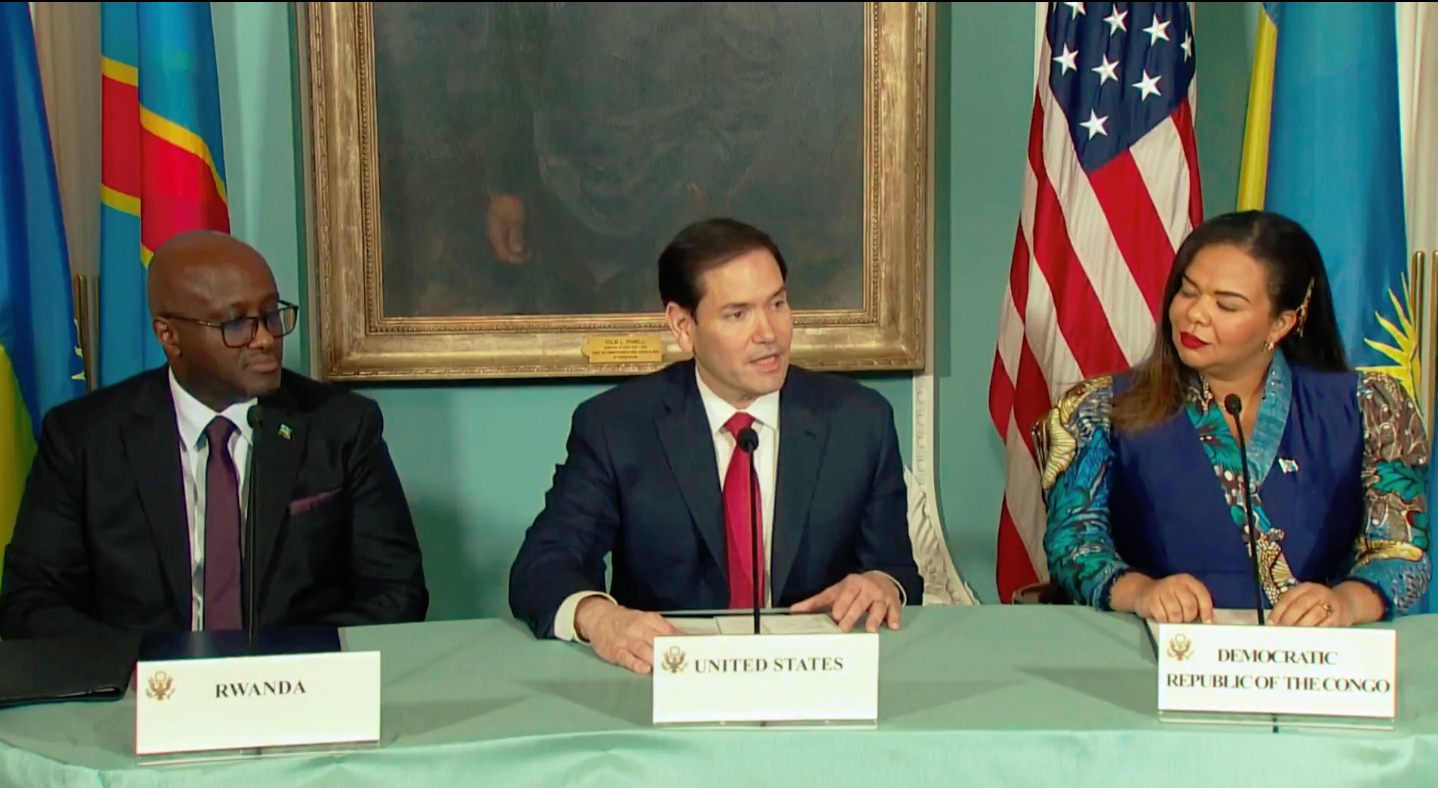
US Secretary of State Marco Rubio at the signing of the Democratic Republic of Congo-Rwanda Peace Agreement.
Washington: A peace agreement signed between the Democratic Republic of the Congo (DRC) and the Republic of Rwanda aims to end a conflict that has destabilised the Great Lakes region of Africa for over 30 years, claiming thousands of lives, displacing hundreds of thousands, and fueling illegal mineral trading costing the Democratic Republic of the Congo $1 billion annually.
The accord, formalised by Democratic Republic of the Congo Foreign Minister Thérèse Kayikwamba Wagner and Republic of Rwanda Foreign Minister Olivier Nduhungirehe, with United States Secretary of State Marco Rubio as a witness, seeks to halt hostilities, neutralize armed groups, and unlock $24 trillion in untapped mineral resources, including cobalt, copper, and lithium, in eastern Democratic Republic of the Congo.
Signed on June 27, 2025, in the Colin L. Powell Treaty Room at the United States Department of State in Washington, D.C., the agreement builds on the Declaration of Principles signed on April 25, 2025, and reflects months of negotiations led by the United States, with contributions from the State of Qatar, the African Union, and the Republic of Angola, observed by African Union Chairperson Mahmoud Ali Youssouf, Republic of Togo Foreign Minister Robert Dussey, and State of Qatar Minister of State Mohammed bin Abdulaziz Al-Khulaifi.
The agreement, effective immediately, addresses a conflict rooted in mutual accusations: the Democratic Republic of the Congo’s claims of Rwandan support for the M23 rebel group, which captured cities like Goma and Bukavu in early 2025, and Rwanda’s allegations of Democratic Republic of the Congo backing for the Democratic Forces for the Liberation of Rwanda (FDLR), a militia linked to the 1994 Rwandan genocide that killed a million people.
The agreement’s provisions, as detailed by the United States Department of State, include respect for territorial integrity, a prohibition on hostilities, and a joint security coordination mechanism to neutralise groups like the Democratic Forces for the Liberation of Rwanda, with the Republic of Rwanda committing to lift defensive measures.
“The heart of this peace agreement is the decision to establish a standing joint security coordination mechanism between DRC and Rwanda,” said Foreign Minister Nduhungirehe, emphasizing that neutralizing the FDLR, “the remnant of the forces which committed the genocide against the Tutsi in 1994,” is “the bedrock of peace and security in our region.”
A harmonised plan, agreed under the Luanda Process facilitated by Republic of Angola President João Lourenço on October 31, 2024, and adopted by foreign ministers on November 25, 2024, outlines Democratic Forces for the Liberation of Rwanda neutralisation and force disengagement.
The accord also supports disengagement and conditional integration of non-state armed groups, ensures humanitarian access, reaffirms the mandate of the United Nations Organization Stabilization Mission in the Democratic Republic of the Congo (MONUSCO), and facilitates the return of refugees and internally displaced persons with support from the United Nations High Commissioner for Refugees (UNHCR). These measures aim to restore safety and dignity to communities in eastern Democratic Republic of the Congo, where, as Foreign Minister Wagner noted, women’s organizations in Kinshasa demanded a peace that is “real, lived, shared, and built with us” during a meeting a few days prior to the signing, reflecting expectations of those facing displacement and hardship, according to Democratic Republic of the Congo government estimates of $1 billion annual losses from illegal mineral trading.
Negotiations began with a March 2025 meeting between Democratic Republic of the Congo President Félix Antoine Tshisekedi Tshilombo and Republic of Rwanda leadership, convened by State of Qatar’s emir, His Highness Sheikh Tamim bin Hamad Al Thani, followed by United States-led technical talks in Washington from June 18, 2025, guided by United States Senior Advisor for African Affairs Massad Boulos and United States Under Secretary for Political Affairs Allison Hooker.
“This was not easy. And there’s still work to be done, obviously, in terms of implementation,” said Secretary Rubio, acknowledging the United States team’s role and praising Boulos, who “jumped all over this and really worked it hard.” Boulos, appointed ten weeks prior, and the United States team facilitated compromise, with support from the African Union (AU), led by Republic of Togo President Faure Gnassingbé as facilitator, and the State of Qatar, which is mediating a parallel agreement between the Democratic Republic of the Congo and the M23-led Alliance Fleuve Congo (AFC) in Doha.
Foreign Minister Nduhungirehe emphasised neutralising the Democratic Forces for the Liberation of Rwanda, described as a remnant of the 1994 genocide forces, and the Republic of Rwanda’s commitment to peace and economic cooperation, including with American investors. Foreign Minister Wagner called peace a responsibility rooted in international law, urging action to deliver justice, stating, “Peace is a choice but also a responsibility to respect international law, to uphold human rights, and to protect the sovereignty of states.”
The agreement establishes a regional economic integration framework to be launched within 90 days, to attract United States and Western investment, fostering growth in a region where past agreements since 2021 have faltered, as noted by Congolese activist Daniel Kubelwa, who cites colonial-era border disputes and post-genocide tensions.
United States Secretary of State Rubio credited United States President Donald Trump’s focus on global peace, stating, “President Trump is a president of peace. He really does want peace. He prioritises it above all else,” referencing United States interventions in India-Pakistan and Israel-Iran conflicts. Rubio noted the agreement enables “family reunification” and “economic opportunity,” adding, “It’s about allowing people to now have dreams and hopes for a better life, for prosperity.” He thanked United States Senators Mike Rounds and Jim Risch, present at the ceremony, and United States Senators Chris Coons and Cory Booker for their support, emphasizing their interest in regional stability.
The United States Department of State, through Rubio, acknowledged implementation challenges, particularly as the Alliance Fleuve Congo has not committed to disarmament, with the State of Qatar continuing mediation. “What we have signed is only as strong as our will to implement it,” Wagner cautioned, emphasising that “those who have suffered the most are watching.”
A White House summit with the Democratic Republic of the Congo and the Republic of Rwanda heads of state is planned to finalise protocols, building on the Luanda Process and African Union-led initiatives.
The ceremony concluded with a call for sustained political will and international support to translate the agreement into action, ensuring communities in Goma, Bukavu, and beyond experience a peace that heals decades of scars and fosters prosperity.
– global bihari bureau