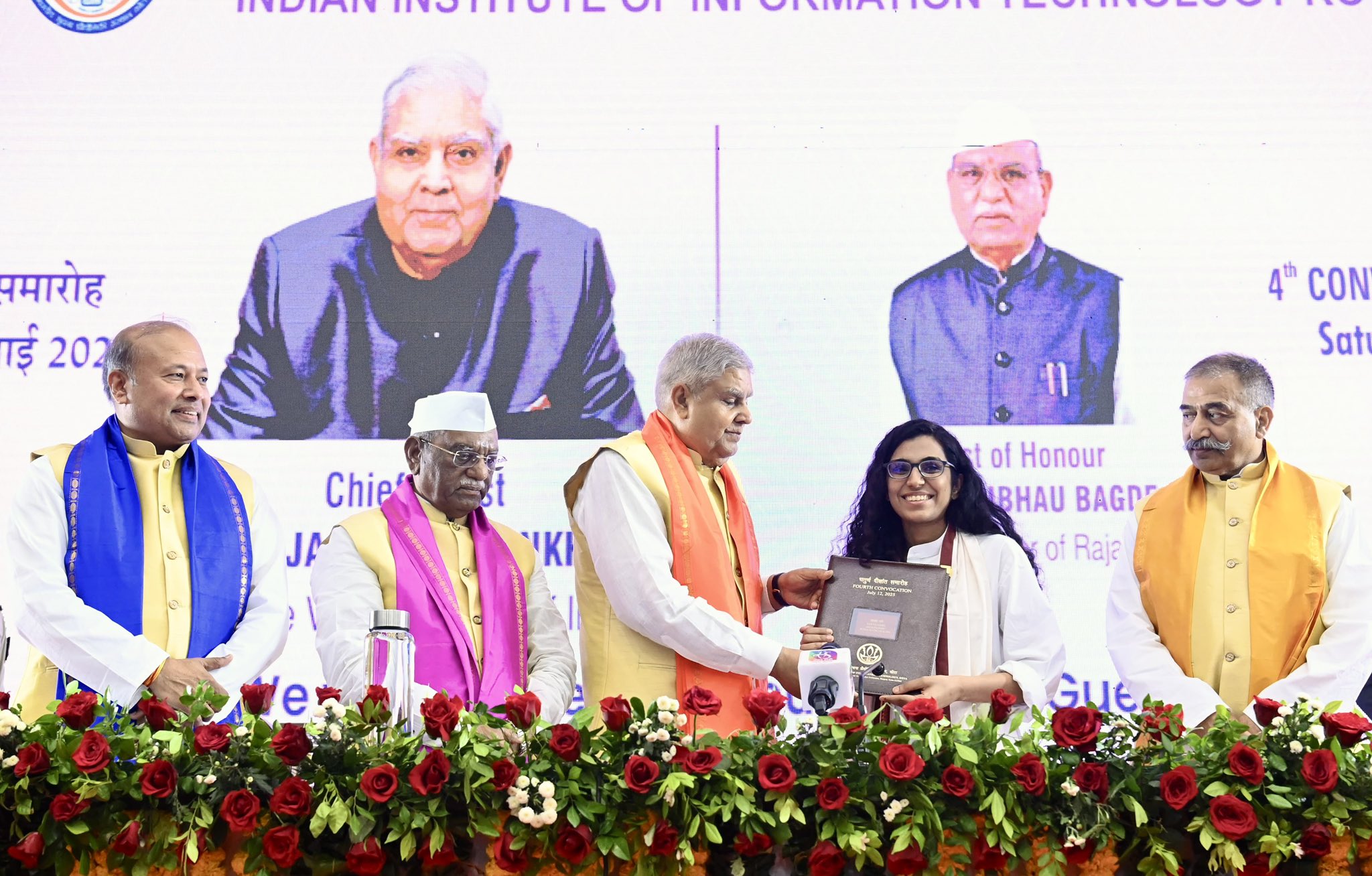
Vice-President Jagdeep Dhankhar presided as Chief Guest over the 4th Convocation of Indian Institute of Information Technology (IIIT) Kota, Rajasthan today.
Vice President Urges Skill Shift Over Coaching
Kota: Vice President Jagdeep Dhankhar today compared coaching centres with poaching centres, calling them black holes for talent in regimented silos during the 4th Convocation Ceremony of the Indian Institute of Information Technology (IIIT), Kota in Rajasthan, where he spoke as the Chief Guest. He warned, “Coaching centres have turned out to be poaching centres. They have become black holes for talent in regimented silos. Coaching centres are mushrooming. This is menacing for our youth, who are our future. We must address this malice that is worrisomely concerning. We cannot allow our education to be so smeared and tarnished.”
Dhankhar’s comparison of coaching centres to poaching centres in Kota holds particular significance given the city’s reputation as a hub for competitive exam preparation, attracting students nationwide for exams like the Joint Entrance Examination (JEE) and the National Eligibility cum Entrance Test (NEET). His remarks, made during the IIIT Kota convocation, were likely influenced by the alarming rise in student suicides linked to the intense pressure of coaching culture. Official records indicate that 27 students died by suicide in Kota in 2023, 16 in 2024, and 14 cases have been reported so far in 2025, as of the latest updates, reflecting a persistent mental health crisis.
This backdrop of tragedy, coupled with the robotic, marks-driven environment Dhankhar criticised, underscores his call to transform these centres into skill-focused institutions to safeguard the youth’s well-being and future. The Vice President urged a transformation, saying, “Coaching centres must use their infrastructure to transform into skill centres. I urge civil society and public representatives before me and outside, to appreciate the urgency of this disease. They must converge to restore sanity in education. We need coaching for skills.”
The Vice-President also cautioned that this trend is against the flow of the National Education Policy, creating unnecessary hiccups and impediments in growth and progress, and criticized the assembly-line culture in education as dangerous, noting how money poured into billboards and advertisements—funded by loans or hard-earned savings—misuses resources and clashes with civilisational ethos.
Dhankhar raised concerns over the obsession with perfect grades and standardised scores, which he said have compromised curiosity, an inalienable facet of human intelligence. “The obsession with perfect grades and standardised scores has compromised curiosity. The seats are limited, but coaching centres are all over the country. They prepare the minds of students for years together and robotise them. Their thinking has absolutely stymied. A lot of psychological problems can arise out of it,” he explained. He encouraged students to look beyond marks, stating, “Your marksheets and grades will not define you. When you take a leap into the competitive world, your knowledge and thinking mind will define you.” He further critiqued the cramming culture, saying, “We are facing the crisis of cramming culture, which has transformed vibrant minds into mechanical repositories of temporary information. There is no absorption. There is no understanding. It is creating intellectual zombies rather than creative thinkers. Cramming creates memory without meaning. Cramming creates memory without meaning and adds degrees without depth.”
Turning to the digital realm, the Vice-President emphasised technological leadership as the new frontier of patriotism. “We are getting into a new era, an era of new Nationalism. Technological leadership is the new frontier of Patriotism. We have to be world leaders in technological leadership,” he declared. He warned that sovereignty will not be lost through invasions, but through dependence on foreign digital infrastructure, noting, “Nations will no longer be compromised or colonised by armies as armies have now been replaced by algorithms. Sovereignty will not be lost through invasions, but through dependence on foreign digital infrastructure.” He highlighted import dependence in critical sectors like defence, saying, “If we get technology-driven equipment from outside, especially in sectors such as defence, that country has the power to bring us to a standstill.” Explaining the shift in global power dynamics, he added, “The battleground of the 21st century is no longer land or sea. Gone are the days of conventional warfare. Our prowess, our power has to be determined by code, cloud and cyber.”
Dhankhar called for India to rise as architects of its own digital destiny, urging, “We must rise as architects of our own digital destiny and also influence the destiny of other nations. Our coders, data scientists, blockchain innovators, and AI engineers are the modern-day nation builders. India, once a global leader, cannot afford to be at rest just being a passive user nation of borrowed technologies. Earlier, we used to wait for technology. The gap was decades. It has narrowed down to weeks now. We should actually be exporting technology.”
He emphasised building inclusive solutions, saying, “A smart app that doesn’t work in rural India is not smart enough. An AI model that doesn’t understand regional languages is incomplete. A digital tool that excludes the disabled is unjust.” He encouraged the youth to become conscious keepers of the tech world, stating, “Youth of Bharat must be conscious keepers of the tech world. We need to build Bharatiya systems for Bharatiya users and globalise them.”
The event saw the presence of Haribhau Kisanrao Bagde, Governor of Rajasthan, Lt. Gen. (Retd.) A.K. Bhatt, Chairperson, Board of Governors, IIIT, Professor N.P. Padhy, Director, and other dignitaries
– global bihari bureau