Jagdeep Dhankar
New Delhi: In a surprise political development, Vice President Jagdeep Dhankhar resigned from his post today, citing health reasons. His resignation, tendered to President Droupadi Murmu under Article 67(a) of the Constitution, took effect immediately. This is the first time in India’s history that a Vice President has resigned mid-term on health grounds. Earlier, V.V. Giri had quit his post to successfully contest the President’s elections. R. Venkataraman and Bhairon Singh Shekhawat, too, had resigned as Vice President, respectively, after winning and after losing their Presidential contests.
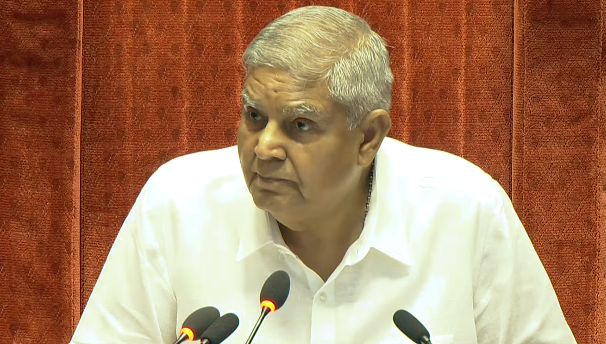
The announcement came shortly after Dhankhar presided over the proceedings of the Rajya Sabha on the opening day of the Monsoon Session of Parliament. He was present in the Chair through the morning and early afternoon sittings, conducting business as usual. He administered the oath of office to five newly elected Rajya Sabha members and accepted a resignation from another MP—duties that are part of the regular Chairperson’s responsibilities. During the session, Dhankhar addressed the House, urging members to maintain mutual respect and reduce political acrimony, saying, “A thriving democracy cannot sustain constant acrimony.” He also guided the House through procedural matters, including the rejection of 18 notices under Rule 267 from Opposition members seeking to suspend the day’s agenda. Instead, he admitted a government-backed notice under Rule 167 for a short-duration discussion on ‘Operation Sindoor’. His conduct was reported to be routine and without any visible signs of discomfort, and credible parliamentary sources confirmed that the proceedings under his chairmanship were in accordance with established norms.
Later in the afternoon, Dhankhar submitted his resignation, citing personal health concerns. In his brief official letter addressed to the President, he wrote, “To prioritise health care and abide by medical advice, I hereby resign as the Vice President of India, effective immediately.” The resignation was made public through his office and social media channels. Dhankhar, 74, had taken office as the 14th Vice President of India in August 2022 after serving as the Governor of West Bengal from 2019 to 2022. A senior advocate by training, he had held multiple public offices during his career, including as a Union minister and legislator in Rajasthan.
Earlier today, his office had informed that he was scheduled to visit Jaipur for a day on July 23, where he was to interact with the newly elected committee members of Confederation of Real Estate Developers’ Association of India (CREDAI) Rajasthan at Rambagh Palace, Jaipur.
Dhankhar’s tenure as Chairman of the Rajya Sabha was marked by both institutional initiatives and deep political contention. He introduced procedural reforms such as promoting a paperless Secretariat and reconstituting the panel of vice-chairpersons to include an equal number of women and men, a move seen as a significant step toward gender parity in parliamentary functioning. He was also known for using the Chair to raise policy issues, including the need for structured debate around populist welfare spending and electoral freebies. However, his style drew sharp criticism from the Opposition, which accused him of acting in a partisan manner and undermining the neutrality of the office. In December 2024, the Congress-led INDIA bloc submitted a no-confidence motion against him—the first of its kind against a Rajya Sabha Chairman since Independence. They alleged that he routinely denied the Opposition the opportunity to express its views and accused him of acting like a “headmaster” or a government spokesperson rather than a neutral constitutional authority.
There were several instances of high-profile confrontations in the House during his tenure. In one session, his sharp exchange with Samajwadi Party MP Jaya Bachchan led to an Opposition walkout. At other times, he openly rebuked senior leaders like Mallikarjun Kharge for entering the well of the House, calling it a disgrace to parliamentary decorum. He also did not shy away from critiquing other branches of government, notably in his inaugural speech, where he described the Supreme Court’s quashing of the National Judicial Appointments Commission as a breach of parliamentary sovereignty.
While Dhankhar’s resignation was sudden, it was presented as entirely motivated by health considerations, and no additional factors were mentioned in the official communication. With the Rajya Sabha now without a Chairperson, the constitutional process for electing a new Vice President is expected to begin soon, even as Parliament proceeds with its Monsoon Session. The unexpected vacancy at one of the highest constitutional offices has added a note of uncertainty to the legislative calendar.
– global bihari bureau