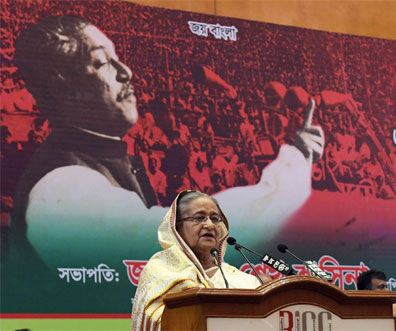
Sheikh Hasina. The background poster is that of her father late Sheikh Mujibur Rahman, the first President of Bangladesh.
 By Nava Thakuria*
Dhaka: Over a year after a mass uprising in Bangladesh toppled Prime Minister Sheikh Hasina, forcing her to seek refuge in India, the interim government in Dhaka has accused New Delhi of allowing leaders of the banned Awami League to establish political offices in Delhi and Kolkata.
Hasina, the daughter of Bangladesh’s founding leader, Sheikh Mujibur Rahman, and former head of the Awami League, fled to India in August 2024 following a popular revolt. The Indian government has not officially acknowledged granting her asylum, but her prolonged stay has become a flashpoint in bilateral relations. The Muhammad Yunus-led caretaker government in Bangladesh has revoked Hasina’s passport, limiting her movements, and is pressing for her extradition to face trials stemming from hundreds of police complaints lodged against her and numerous associates.
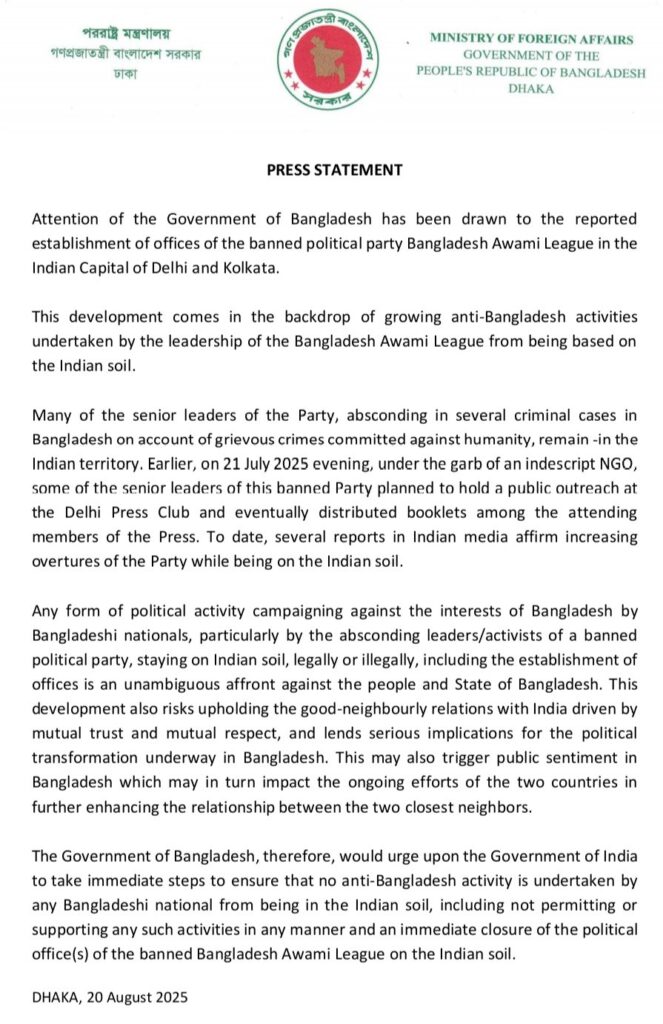
In a statement issued on August 20, 2025, Bangladesh’s Ministry of Foreign Affairs expressed alarm over reports that the banned Awami League has set up offices in Delhi and Kolkata, alleging that senior party leaders are using these hubs to orchestrate anti-Bangladesh activities. The statement claimed that many of these leaders, wanted in criminal cases, are taking shelter in India and engaging in political campaigning, including plans for public outreach events. Dhaka described such activities by Bangladeshi nationals, particularly absconding members of a banned political party, as an unambiguous affront to the people and state of Bangladesh. The ministry warned that these developments threaten the mutual trust and respect underpinning good-neighbourly relations between the two countries and called on India to take immediate action to halt any anti-Bangladesh activities and close any Awami League offices operating on its soil, whether legally or illegally.
 India’s Ministry of External Affairs quickly dismissed the allegations as misplaced. Addressing the media in Delhi, a Ministry spokesperson stated that the New Delhi government was unaware of any anti-Bangladesh activities by purported Awami League members or any actions that contravened Indian law. The spokesperson underscored India’s policy of not allowing its territory to be used for political activities targeting other nations and expressed hope that Bangladesh would conduct free, fair, and inclusive elections at the earliest to reflect the will of its citizens.
The controversy was amplified by Bangladeshi media outlets, which cited a BBC Bangla report claiming that over 2,000 Awami League figures, including former ministers, retired bureaucrats, army and police officers, law practitioners, and others, are residing in India on extended medical and tourist visas. These individuals are said to be renting accommodations in Delhi and Kolkata to hold regular meetings, strategise politically, and connect digitally with leaders elsewhere in the world. On at least one occasion, Hasina reportedly addressed a small gathering remotely, further intensifying Dhaka’s concerns.
The interim government in Bangladesh has taken a hard line against Hasina’s public statements, accusing her of making false and inflammatory claims. In December 2024, the International Crimes Tribunal in Dhaka issued an order preventing Hasina from delivering hate speeches. Additionally, the caretaker administration has warned Bangladeshi media outlets against airing or broadcasting any messages from the former prime minister, threatening swift legal action for non-compliance. These measures reflect the government’s efforts to maintain stability as it prepares for general elections scheduled for the first week of February 2026, as announced by Bangladesh’s chief election commissioner. Chief Adviser Muhammad Yunus has committed to enabling all eligible citizens, including those abroad, to vote in a festive atmosphere to elect representatives for the 300-member Jatiya Sansad. Yunus has also declared that he will not seek any elected or appointed position after the polls, though speculation persists that he could be a unanimous choice for the presidency once the current head of state, Mohammed Shahabuddin, completes his term in two years.
In India, the issue of Bangladeshi nationals has gained traction beyond the Awami League controversy. In his Independence Day speech on August 15, Prime Minister Narendra Modi highlighted concerns about illegal infiltration from Bangladesh and demographic changes in India’s bordering states due to a growing Muslim population. Modi announced the formation of a high-powered mission to address these issues, amid estimates that approximately 20 million undocumented Bangladeshi migrants are living in India. Asaduddin Owaisi, a prominent parliamentarian from Hyderabad and leader of the All India Majlis-e-Ittehadul Muslimeen, questioned India’s decision to shelter Hasina, arguing that her continued presence and provocative statements are creating diplomatic problems. Owaisi urged New Delhi to begin deporting illegal Bangladeshi nationals, starting with Hasina, to respect the July-August 2024 uprising in Bangladesh and strengthen ties with the Yunus-led interim government.
The reports of Awami League offices in Kolkata and Delhi have raised questions about whether such activities could persist without some level of acquiescence from New Delhi. As Bangladesh and India navigate these diplomatic tensions, the situation underscores the challenges of balancing internal political dynamics with longstanding bilateral ties.
*Senior journalist