Representational image
U.S. Arrests ‘Worst of the Worst’ Undocumented Offenders
Rights Groups Alarmed as U.S. Detention Deaths Rise Again
Washington: As the Democrats’ longest government shutdown in American history stretches into its 38th day, the United States Department of Homeland Security (DHS) has intensified its messaging and enforcement drives, unveiling a wave of high-profile arrests under the direction of President Donald Trump’s second administration and Secretary of Homeland Security Kristi Noem. The actions, publicly framed as targeting the “worst of the worst criminal illegal aliens,” coincide with mounting controversy over detention conditions, judicial scrutiny, and growing partisan rancour in Washington as key agencies operate under severe funding constraints.
According to the DHS Office of Public Affairs, Immigration and Customs Enforcement (ICE) agents have pressed ahead with operations nationwide despite the shutdown’s furloughs and resource restrictions. The department claims that seven in ten recent arrests involve non-citizens who are either charged with or convicted of crimes committed within the United States—a figure used to bolster the administration’s narrative that border leniency in previous years allowed dangerous offenders to circulate freely. “The Democrats’ longest government shutdown in American history has not stopped ICE from arresting the worst of the worst criminal illegal aliens from American communities across the country,” declared Assistant Secretary for Public Affairs Tricia McLaughlin. “Yesterday, ICE arrested child rapists, kidnappers, and child abusers. President Trump and Secretary Noem unleashed ICE to target the worst of the worst criminal illegal aliens. Seventy per cent of ICE arrests are of illegal aliens charged or convicted of a crime in the U.S.”
The department’s release listed five emblematic arrests from recent days. In Pennsylvania, agents detained Maximo De Jesus Peralta-Rodriguez, a Dominican national convicted of child rape and deviant sexual intercourse in Philadelphia County. In Delaware, Hugo Douglas Mendoza-Bamaca, a Guatemalan national, was arrested after a conviction for fourth-degree rape involving non-consensual sexual penetration. In Texas, Moses Antonio Menjivar-Tobar of El Salvador was taken into custody for intoxication manslaughter in Grayson County. In Utah, Ricardo Ventura-Garcia, a Mexican national with 14 criminal convictions—including cruelty toward a child, assault, kidnapping, and drug possession—was apprehended in Ogden. Rounding out the list was Diego Zashaury Melendez-Moreira, a Honduran national convicted of attempted robbery in the Bronx, New York. All were portrayed by DHS as exemplifying the administration’s focus on “removing predators from American streets.”
However, the stepped-up operations have also produced violent encounters. On November 3, ICE agents in Houston sought to detain Walter Leonel Perez Rodriguez, a Salvadoran previously deported twice—first in 2013 and again in 2020—after convictions for sexually assaulting a minor, child fondling, and multiple driving-under-the-influence offences. According to DHS, the 33-year-old struck an officer in the face with a metal coffee cup during the arrest, inflicting a deep laceration that required 13 stitches and causing chemical burns. “Our brave ICE officers are facing record-high assaults—including a 1,000 per cent increase in attacks—as they lock up pedophiles and other depraved criminals,” McLaughlin said in the official statement. “Under President Trump and Secretary Noem, anyone who lays a hand on our ICE officers will be prosecuted to the fullest extent of the law.” The department said Perez Rodriguez, who had unlawfully re-entered the United States at an unspecified time, was now in custody and “can no longer pose a threat to Americans.”
The incident has become a rallying point for DHS in emphasising what it calls the rising physical risk faced by its agents. A department fact sheet claims that assaults on immigration officers have surged by 1,000 per cent since January 2025, when the Trump administration returned to power, though independent verification of that statistic remains pending. Civil liberties advocates, meanwhile, describe an “atmosphere of confrontation” encouraged by aggressive rhetoric. Community organisations in Houston have demanded transparency, alleging that some enforcement actions have escalated unnecessarily in populated settings.
Another flashpoint has emerged in Illinois, where conditions at the ICE Broadview Processing Center—a key detention hub outside Chicago—have drawn judicial attention. Last week, U.S. District Judge Robert Gettleman issued a temporary order directing DHS to improve sanitation and ensure detainees’ access to counsel after receiving affidavits describing overflowing toilets, prolonged isolation, and inadequate food and water. “People shouldn’t be sleeping next to overflowing toilets,” the judge said in open court, demanding a compliance report within days. DHS swiftly countered with a rebuttal titled “DHS Sets the Record Straight on Media and Activist Lies about ICE Broadview Processing Center Conditions,” rejecting all allegations as “hoaxes” spread by “criminal illegal aliens” and a “complicit media.”
McLaughlin, in the department’s official response, asserted that “all detainees are provided with three meals a day, water, and have access to phones to communicate with family members and lawyers. No one is denied access to proper medical care.” The statement accused activists and media of ignoring “the real story”—that the Broadview facility had processed “some of the worst of the worst” offenders in recent weeks, including individuals charged with homicide, terrorism, and child exploitation. The department listed names and offenses: Jose Manuel Escobar-Cardona of Honduras, previously deported three times and convicted of multiple lewd acts with a minor and assault; Alfonso Batalla-Garcia of Mexico, convicted of sexual assault, kidnapping, and homicide; Sergio Alberto Acosta Teran, a Mexican national and “known suspected terrorist” convicted of weapons trafficking; Aldo Salazar-Bahena, a Mexican national convicted of first-degree murder; Nam Hoa Ly of Vietnam, convicted of kidnapping minors; Cesar Osmin Barahona-Lopez of Honduras, convicted of armed robbery and illegal reentry; Heriberto Muniz Martinez of Mexico, convicted of drug trafficking; and Juan Camilo Cabieles-Salazar of Colombia, convicted of burglary and resisting an officer.
The department’s sharp language drew attention from legal observers who noted the extraordinary tone of a federal agency denouncing a sitting judge as “activist.” Independent monitoring groups have since confirmed that while basic provisions such as meals and phone access appear intact, overcrowding remains significant amid record detentions. ICE’s national processing network now houses between 50,000 and 60,000 individuals daily, the highest since 2004, marking a steep climb from the Biden-era average of around 35,000. Rights groups warn that the expanded population strains medical and mental health capacity. Official ICE data show that at least 18 deaths occurred in custody during fiscal year 2025 (October 2024–September 2025), though advocacy groups tracking hospital transfers and delayed disclosures put the number at 23, the highest in over two decades.
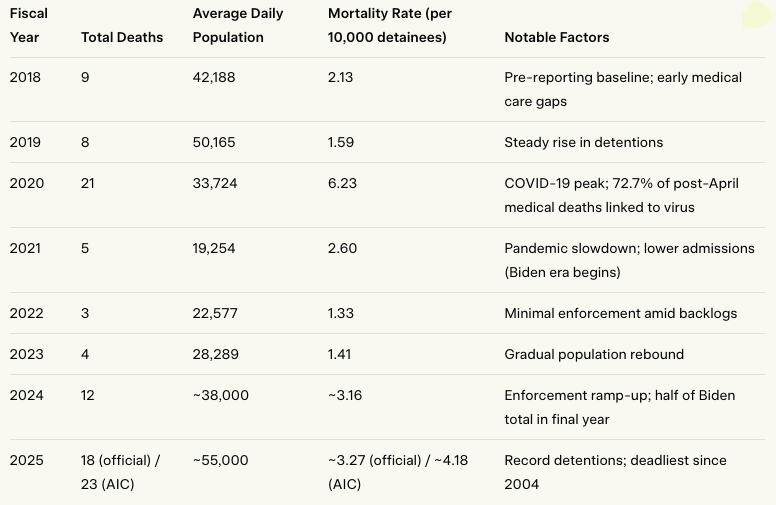
The rising mortality rate—approximately 3.27 per 10,000 detainees in fiscal 2025—compares unfavourably to the Biden administration’s four-year period (2021–2024), during which 24 deaths were recorded in total. ICE attributed most fatalities to natural or medical causes, but independent analyses by organisations such as the American Immigration Council and the Government Accountability Office (GAO) have identified systemic shortcomings, including delayed emergency responses and insufficient mental health oversight. A forthcoming GAO report is expected to assess whether the increase correlates with volume growth or policy changes following the resumption of large-scale detention and expedited removals under the new administration.
Field operations have been equally vigorous in the Mid-Atlantic and southern states. DHS reported that ICE’s Virginia field offices detained dozens over the past week, including an El Salvadoran in Loudoun County with prior convictions for assault and impaired driving, a Nicaraguan in Richmond convicted of child sexual abuse after being released under a previous parole program, a Jamaican in Chesterfield County charged with narcotics and firearms offenses, and a Dominican in Suffolk County for terroristic threats and possession of controlled substances. Two Guatemalan nationals in Richmond—one accused of rape and extortion, the other of multiple aggravated assaults—were also apprehended. “Under President Trump and Secretary Noem, ICE is doing what the American people expect: taking predators off the streets,” McLaughlin said.
Critics counter that the broad sweep risks conflating serious offenders with minor immigration violators and that some arrests occur in sensitive locations such as schools, workplaces, and hospitals despite long-standing agency guidance discouraging such practices. DHS officials reject those claims as misinformation. Nonetheless, the shutdown’s 38th day has left large swathes of the federal bureaucracy strained, with law enforcement and emergency services among the few categories exempted from furlough. The standoff, which began when Democrats refused to approve the administration’s full border security package, has paralysed funding negotiations as both parties trade blame for the prolonged impasse. The White House contends that Democratic leaders are “holding border safety hostage to political games,” while opposition lawmakers accuse the administration of “manufacturing crisis and cruelty.”
The scale of ICE’s operations during the funding lapse is also drawing logistical scrutiny. According to internal figures cited by oversight officials, the agency has logged thousands of removals each week despite budgetary uncertainty, deploying staff from furloughed offices under emergency authorisations. While DHS touts this as evidence of resilience, unions representing ICE employees have warned that extended unpaid deployments could lead to burnout. The administration’s line remains that enforcement “cannot pause while criminal aliens threaten American families.”
Beyond the enforcement statistics, humanitarian groups are tracking a rising toll in detention centres. Verified reports from Arizona, Pennsylvania, Georgia, and California in recent months point to cases of suicide, untreated illness, and delayed medical responses. At the Eloy Detention Center in Arizona, Oscar Rascon Duarte died September 8; Lorenzo Antonio Batrez Vargas died August 31 at the Central Arizona Correctional Complex; and Chaofeng Ge, a Chinese national, died August 5 at the Moshannon Valley Processing Center in Pennsylvania in what was ruled a suicide. Earlier in the year, Ismael Ayala-Uribe in California and Jesus Molina-Veya in Georgia also died in custody. ICE maintains that each death triggers a review, autopsy, and family notification, with reforms such as expanded telemedicine introduced since 2020. Yet watchdog groups say systemic issues persist, especially amid rising populations and reduced transparency.
With tensions mounting across multiple fronts—political, operational, and humanitarian—the administration’s dual message of toughness and defiance continues to dominate the federal landscape. To supporters, it reflects a necessary correction after what they see as permissive border management under President Biden. To detractors, it signals a return to punitive excess under conditions of fiscal instability and political brinkmanship. For the officers on the ground, it has meant an unrelenting tempo of raids and removals even as the government itself remains partly shuttered. As the stalemate drags on in Washington, the country watches an immigration system running at full throttle under half power—where every arrest is framed as a victory, and every criticism dismissed as a hoax.
– global bihari bureau