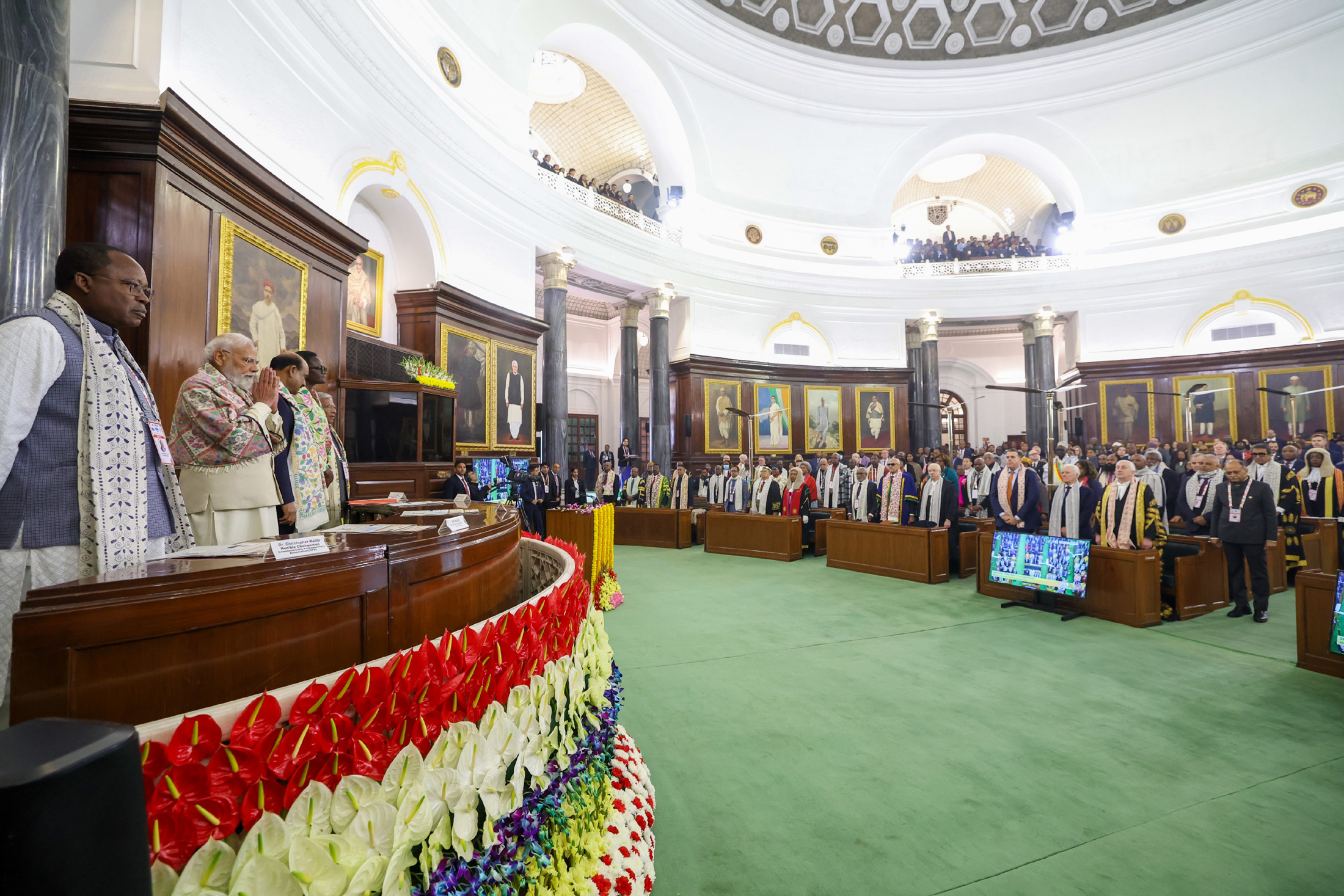
The 28th Conference of Speakers and Presiding Officers of the Commonwealth at Parliament House, in New Delhi on January 15, 2026.
“Parliamentary Democracy Needs Listening, Not Spectacle”
At the Commonwealth Meet, Modi Stresses the Speaker’s Democratic Role
New Delhi: Framing parliamentary democracy as a system sustained by restraint, listening and institutional balance rather than spectacle, Prime Minister Narendra Modi today used the opening of the 28th Conference of Speakers and Presiding Officers of the Commonwealth to project India’s democratic experience as both historically rooted and institutionally adaptive at a time when legislatures worldwide are grappling with declining public trust, procedural disruption and the challenge of remaining effective without eroding deliberative space.
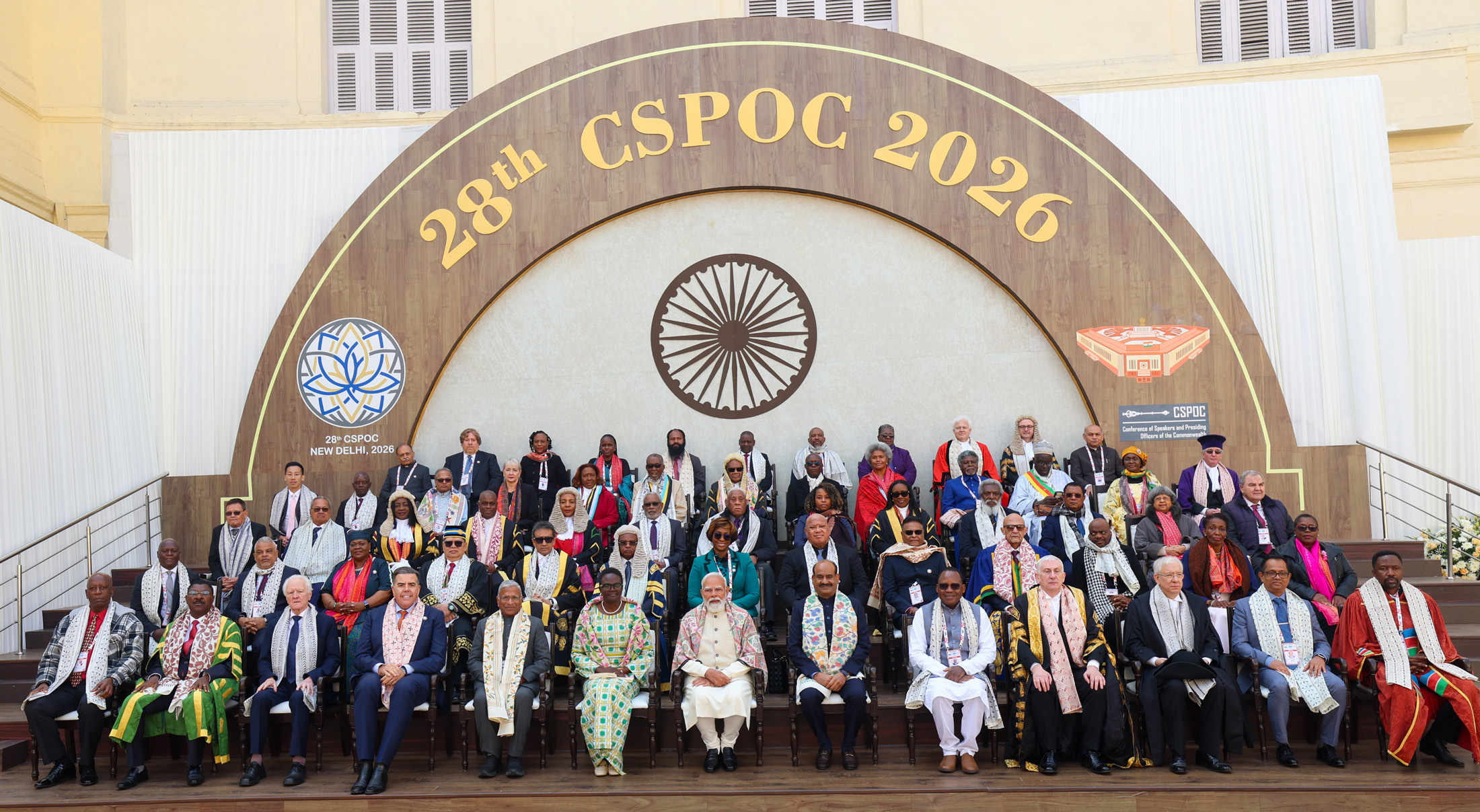
The conference, chaired by Lok Sabha Speaker Om Birla, brings together Speakers and Presiding Officers from 42 Commonwealth countries and four semi-autonomous parliaments. Its deliberations are expected to focus on the independence of presiding officers, the impact of social media and artificial intelligence on legislative functioning, and strategies to strengthen citizen engagement with parliamentary institutions beyond the act of voting, through shared norms and best practices.
The Central Hall, where the Constituent Assembly drafted the Constitution in the final phase of colonial rule and which served as Parliament for 75 years after independence, now stands renamed as Samvidhan Sadan. Modi described this transition as one of continuity, linking constitutional memory with contemporary democratic practice, particularly as India recently marked 75 years of the Constitution’s implementation.
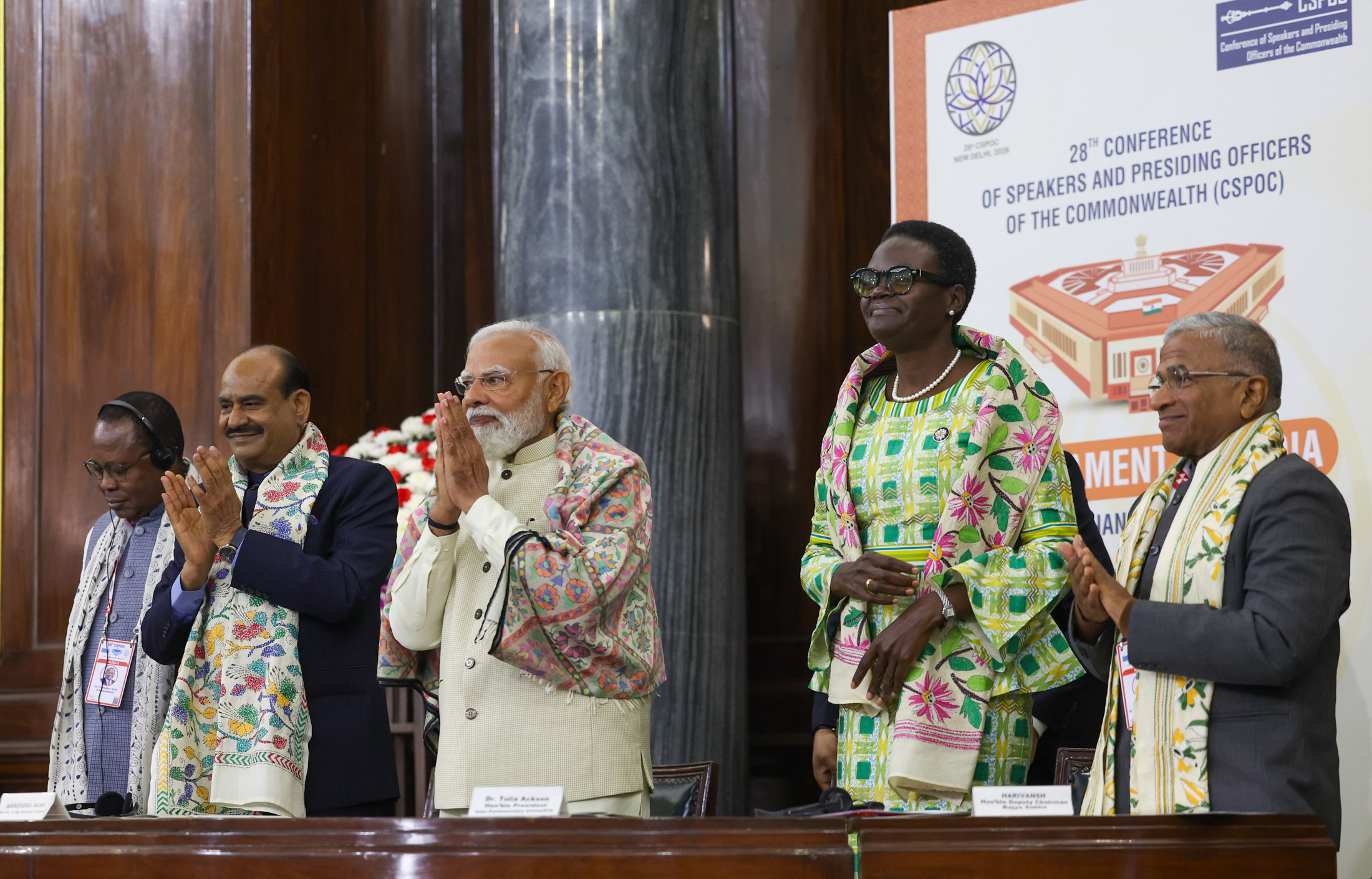
The choice of venue reinforced the institutional theme. Addressing presiding officers from across the Commonwealth at the Central Hall of Samvidhan Sadan, Modi dwelt on the often-overlooked authority of the Speaker in a parliamentary system, describing the office as one defined by patience, neutrality and arbitration rather than intervention. He argued that the credibility of parliamentary democracy rests on the ability of presiding officers to safeguard debate, protect minority voices and maintain order amid political polarisation and pressure for faster decision-making.
Returning to the conference theme of effective delivery of parliamentary democracy, Modi said India’s experience had defied early scepticism that democracy could endure or govern effectively in a society marked by linguistic, social and regional diversity. Democratic institutions, he said, had provided stability while enabling governance at scale. At the same time, he acknowledged—implicitly through emphasis on the Speaker’s role—that parliamentary systems face a persistent tension between executive efficiency and the need for scrutiny, debate and consensus-building.
The Prime Minister placed particular emphasis on what he described as last-mile delivery as a measure of democratic legitimacy, arguing that public faith in democracy is shaped as much by outcomes as by procedures. He linked welfare delivery and poverty reduction to institutional capacity, citing India’s response during the COVID-19 pandemic, when the country supplied medicines and vaccines to more than 150 nations despite domestic constraints.
Highlighting the scale of India’s electoral system, Modi described the 2024 general election as the largest democratic exercise in history, involving nearly 980 million registered voters, thousands of candidates and hundreds of political parties. He drew attention to record participation by women voters and to women’s leadership across constitutional offices and local bodies, where nearly half of all elected representatives are women, as evidence of widening democratic inclusion.
Situating India’s parliamentary traditions within a longer historical arc, Modi traced practices of collective deliberation to ancient assemblies, Buddhist councils and documented village institutions with codified rules of accountability. He argued that democratic legitimacy in India draws strength from these deep-rooted traditions even as institutions adapt to contemporary scale through technology.
On the international plane, Modi said parliaments have a growing role in shaping a more equitable global order. With nearly half of the Commonwealth’s population residing in India, he said the country bears a responsibility to amplify the concerns of the Global South. He linked this to India’s G20 presidency and to efforts to build open-source digital platforms, positioning these initiatives as tools for institutional capacity-building rather than prescriptive models.
The Prime Minister also outlined steps taken to widen public engagement with Parliament, including study programmes, training initiatives and the use of artificial intelligence to translate debates and proceedings into regional languages in real time. He noted that while such technologies expand access and transparency, they also require careful institutional oversight to preserve accuracy, neutrality and the integrity of parliamentary records—issues increasingly central to legislative discussions worldwide.
– global bihari bureau