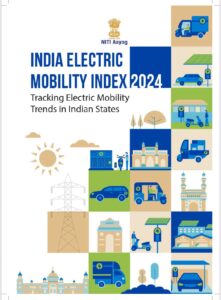
 New Delhi: India debuted a pioneering tool today to track how states and union territories are embracing electric vehicles (EVs) with the launch of the India Electric Mobility Index (IEMI) by NITI Aayog, the government’s policy think tank. This first-of-its-kind index ranks regions based on their efforts to promote EVs, providing a clear picture of progress toward cleaner transportation. The launch event in New Delhi was attended by NITI Aayog Member Rajiv Gauba, CEO B.V.R. Subrahmanyam, Secretary of the Ministry of Heavy Industries Kamran Rizvi, Distinguished Fellow O.P. Agarwal, and Programme Director for E-Mobility Sudhendu Sinha, among other officials.
The IEMI scores states and union territories out of 100 using 16 indicators across three areas: Transport Electrification Progress (tracking EV adoption), Charging Infrastructure Readiness (measuring charging station availability), and EV Research and Innovation Status (evaluating research efforts). Indicators include EV penetration rates, sales of electric two- and three-wheelers, public transport electrification, charging point density, and R&D investment. The index aims to compare state efforts, highlight areas for improvement, and encourage sharing of effective strategies to support India’s net-zero carbon emissions goal by 2070 through better policies and infrastructure.
In the first IEMI rankings, Delhi led with 73.19 points, followed by Maharashtra (64.27) and Chandigarh (63.76). Delhi excels in EV adoption, with 11.7% of new vehicle sales being electric in 2024, driven by subsidies and tax waivers. Maharashtra leads in public transport electrification, with 14% of its buses electric. Chandigarh stands out for charging infrastructure, offering incentives for 1,500 additional electric cars and subsidies for electric two-wheelers, especially for women, building on a program supporting 2,000 cars with up to ₹1.5 lakh in benefits. Haryana, Karnataka, Ladakh, and Himachal Pradesh also rank high for charging networks, while Delhi, Tamil Nadu, Maharashtra, Karnataka, Haryana, and Telangana lead in EV research, with Tamil Nadu’s EV Innovation Hub as a key example.
As of December 2024, India has over 12 lakh registered EVs, including 8.5 lakh two-wheelers and 3.2 lakh cars, with EVs making up 7.7% of new vehicle sales. The country has 25,824 public charging stations, led by Maharashtra (4,032) and Delhi (2,876). Twenty-nine states have EV policies offering incentives like purchase subsidies and road tax exemptions. However, states like Bihar and Chhattisgarh lag, scoring below 30 points due to limited infrastructure and policy implementation.
Rajiv Gauba said the IEMI offers a transparent framework to assess state efforts in EV adoption, infrastructure, and innovation. “It helps states measure their progress, identify gaps, and learn from each other,” he stated. B.V.R. Subrahmanyam noted that the index supports NITI Aayog’s work to advance India’s EV ecosystem through data-driven decisions.
An interactive IEMI dashboard provides data, state rankings, and visualizations for public use. The IEMI 2024 report outlines findings and recommendations, such as expanding charging stations in rural areas and standardizing EV policies. It highlights successful policies, like Karnataka’s focus on electrifying last-mile delivery vehicles, which boosted three-wheeler EV sales by 20% in 2024.
With electric two-wheelers and cars accounting for 5.3% of private vehicle registrations in 2024, the IEMI aims to guide states in strengthening EV policies, expanding charging networks, and fostering innovation to support India’s sustainable transport goals.
NITI Aayog today also launched the Report on ‘Unlocking a $200 Billion Opportunity: Electric Vehicles in India,’ which targets India to attain a 30% share of electric vehicles, in the total vehicles sold, by 2030. Sales of EVs in India went up from 50,000 in 2016 to 2.08 million in 2024, as against global EV sales having risen from 918,000 in 2016 to 18.78 million in 2024. Thus, India’s transition has been slow to start, but it is picking up. The report points out that India’s EV penetration was only about one–fifth of the global penetration in 2020, but has since increased to over two-fifths of the worldwide penetration by 2024. It continues to show an increasing trend, though relatively slow. According to the report, this calls for measures to give a stronger push to the EV transition.
– global bihari bureau