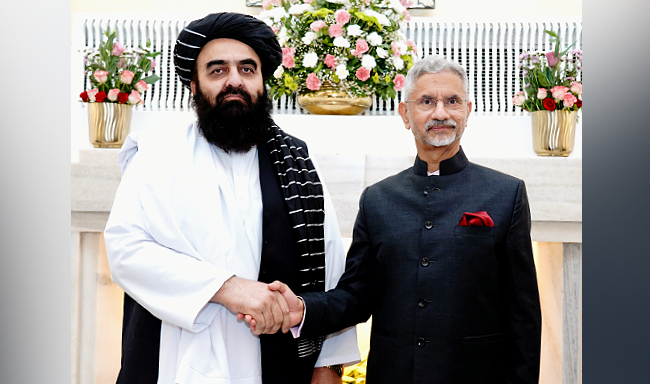
India's External Affairs Minister Dr. Subrahmanyam Jaishankar with Afghan Foreign Minister Amir Khan Muttaqi in New Delhi on October 10.
Women reporters barred as India, Taliban renew talks
New Delhi: The Taliban’s treatment of women journalists again came under scrutiny this week after reports confirmed that female reporters were denied entry to a press conference addressed by visiting Afghan Foreign Minister Amir Khan Muttaqi at the Afghan Embassy in New Delhi on October 10. The incident, widely seen as an extension of the group’s restrictive policies inside Afghanistan, has drawn condemnation from Indian journalist bodies and renewed debate over the limits of engagement with the Taliban regime.
The Delhi Union of Journalists (DUJ), in a statement issued on Saturday, expressed outrage over what it described as a “Talibani denial of entry to Indian women journalists.” The organisation said the deliberate exclusion of women from Muttaqi’s press conference was “unacceptable” and represented “blatant disregard of women’s rights.” It added that while the Indian government may have “strategic reasons” for re-engaging with the Taliban, “the deliberate exclusion of women journalists seems like tacit consent, if not approval, of the Taliban’s blatant discrimination against women.”
“It is evident that the Government of India has decided to now reset ties with the Talibani regime in Kabul. While the Government may have strategic reasons for this shift in policy, the blatant disregard of women’s rights is unacceptable. The deliberate exclusion of women journalists from Muttaqi’s press conference seems like tacit consent, if not approval, of the Taliban’s blatant discrimination against women. The DUJ unequivocally condemns the Taliban’s numerous constraints on women’s freedom and liberty in Afghanistan, especially the denial of education and the right to work, as well as human rights abuses under their regime.”
Signed by DUJ President Sujata Madhok, Vice President S.K. Pande, and General Secretary Jigeesh A.M., the statement also condemned the Taliban’s wider restrictions on Afghan women’s rights, including bans on education and employment. The DUJ urged both the Taliban and the Indian government to ensure that women journalists are not excluded from professional access or press interactions.
The controversy unfolded as External Affairs Minister S. Jaishankar held formal talks with Muttaqi, marking a significant diplomatic step as India announced the upgrading of its Technical Mission in Kabul to the status of a full Embassy. In his opening remarks, Jaishankar reaffirmed India’s “longstanding partnership” with the Afghan people and outlined new commitments, including the supply of ambulances, medical equipment, and vaccines, as well as support for reconstruction and refugee housing projects. He also emphasised cooperation on trade, education, water management, and counter-terrorism.
While India’s engagement was framed as a humanitarian and developmental partnership, the optics of a Taliban minister addressing a press event that barred women have sparked discomfort within India’s media fraternity. Several journalists noted that the episode reflected not only the Taliban’s entrenched gender policies but also the challenges democratic societies face when engaging diplomatically with regimes that curtail basic freedoms.
Inside Afghanistan, women journalists continue to face severe restrictions. Reports from Human Rights Watch, the International Federation of Journalists, and the Afghanistan Journalists Centre document that women are being denied access to offices, barred from interviewing male officials, and excluded from public press events. Many broadcast professionals have been ordered to cover their faces on air, and female voices have been removed from several provincial radio stations. Since the Taliban’s return to power in 2021, the number of women journalists has dropped from nearly 2,800 to fewer than 800, with several provinces now having none.
The Taliban maintain that female participation in media and public life will continue “within Islamic and Afghan cultural norms,” but observers note that such assurances rarely translate into equal access or freedom of expression. The New Delhi incident, though outside Afghanistan’s borders, appears consistent with the group’s domestic practices—illustrating how gender exclusion has become an institutionalised feature of Taliban engagement, even in international settings.
For Indian journalist groups, the episode has underscored a broader concern: that normalising ties with Kabul should not mean normalising discrimination. The DUJ’s protest, coming amid cautious diplomatic warmth between India and the Taliban, highlights the uneasy balance between strategic engagement and the principles of press freedom and gender equality.
– global bihari bureau