Enforcement, Targets Mark New Phase in NCR Air Governance
Closure Action, Targets Signal Shift in NCR Air Strategy
New Delhi: With closure action against non-compliant industrial units set to begin this month and quantified air-quality improvement targets formally articulated, Delhi–National Capital Region was positioned at a policy inflexion point where air-quality governance shifted from episodic crisis response to institutionalised, region-wide and enforceable compliance.
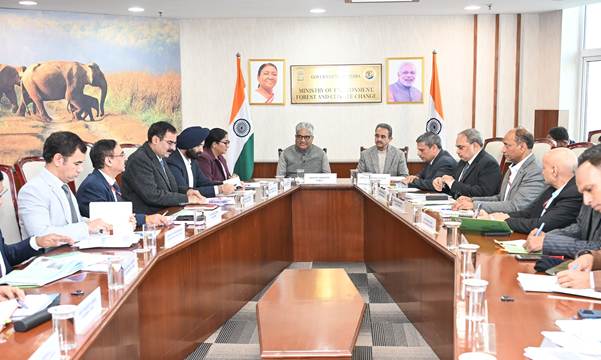
This transition was underscored on January 12, 2026, during a high-level review of the National Capital Territory of Delhi’s pollution control measures, held as part of the statutory annual assessment mechanism under the Commission for Air Quality Management. The review took place against a backdrop of strengthened legal authority, expanded regional coordination and a move towards time-bound enforcement actions across sectors that contribute to deteriorating air quality in the National Capital Region.
The Union Minister for Environment, Forest and Climate Change, Bhupender Yadav, noted that air pollution in the region was driven by a combination of anthropogenic activities and meteorological factors, and that durable improvement would depend on long-term policy interventions rather than short-term emergency measures. He recalled that the Union government enacted a dedicated law in 2021 to establish the Commission for Air Quality Management, identifying the Delhi–National Capital Region as a single airshed to enable coordinated planning across state boundaries and jurisdictions.
A central marker of the shift towards enforceable compliance was industrial regulation. During the review, it was stated that the Central Pollution Control Board had issued notices to 88 industrial units for failing to install Online Continuous Emission Monitoring Systems. Closure action against these units was scheduled to commence on January 23, 2026. While it was reported that 227 of the 240 industrial estates in the National Capital Region had already transitioned to piped natural gas, unplanned industrial activity outside designated estates continued to pose regulatory challenges. The Ministry of Environment, Forest and Climate Change directed that strict action, including sealing where required, be taken against illegally operating and non-conforming units.
Vehicular emissions, identified as a major contributor to urban pollution loads, were reviewed through the lens of congestion management and behavioural change. The Ministry emphasised the need for smart traffic management at 62 identified congestion hotspots to ensure smoother vehicular flow and reduced idling emissions. Measures discussed included strict action against polluting vehicles, a special registration verification drive, deployment of Automatic Number Plate Recognition systems at border entry points, and examination of staggered office timings to reduce peak-hour congestion. The review also covered incentives for electric vehicle adoption, accelerated expansion of charging infrastructure, congestion pricing, smart parking systems and the possibility of a uniform vehicle registration framework across the National Capital Region. Public participation and behavioural change were repeatedly highlighted as essential to the effectiveness of these interventions.
Construction and road dust management formed another pillar of the region-wide strategy. The review examined progress in the scientific handling of Construction and Demolition waste, including the designation of authorised dumping sites, restrictions on demolition activities during peak pollution periods and collaboration with recycler associations. Officials stated that a Construction and Demolition waste processing plant at Tehkhand was expected to become operational within the year. On road infrastructure, the Delhi government outlined plans to redevelop more than 3,300 kilometres of roads over the coming year, integrating dust abatement and traffic management into execution. Mechanised Road Sweeping Machines were to be deployed extensively under an operational expenditure model, with no diesel-based units, complemented by handheld vacuum machines and litter pickers for smaller roads. Road maintenance contracts were proposed to include mandatory pothole repair within 72 hours, alongside a review of recurring road damage to establish accountability.
Measures to curb emissions from thermal power generation were also reviewed. Progress on the installation of Flue Gas Desulphurisation systems in thermal power plants within a 10-kilometre radius of Delhi was noted, along with the mandatory five per cent utilisation of crop residue in thermal power plants to address stubble-burning related pollution. These steps were framed as part of a broader effort to align industrial and energy policies with air-quality objectives.
Public transport expansion emerged as a core component of the long-term pollution mitigation strategy. The Delhi Metro Rail Corporation presented its expansion plans for the coming years, while the Delhi Transport Department reported that, against a planned induction of 14,000 buses, an order had been placed with Convergence Energy Services Limited for 3,350 electric buses. These buses were expected to integrate with the metro network to improve last-mile connectivity across residential, commercial and high-density zones, thereby reducing dependence on private vehicles. In addition, pilot integration of electric autorickshaws, bike taxis and feeder cabs at 10 major metro stations was scheduled for implementation by January 31, 2026.
Solid waste management and landfill remediation timelines were reviewed with specific deadlines reiterated. Legacy waste clearance targets were restated for Okhla by July 2026, Bhalswa by October 2026 and Ghazipur by December 2027. Plans included deploying waste collection centres in a five-by-five-kilometre grid, exploring app-based waste collection services and establishing facilities to process 4,600 metric tonnes of fresh municipal solid waste by September 2027. Waste-to-energy plants at identified locations were expected to be completed by September 2026.
The Commission for Air Quality Management informed the meeting that a scientific source-apportionment study had been initiated from January 2026 through a consortium comprising The Energy and Resources Institute, Indian Institute of Technology Delhi, Indian Institute of Tropical Meteorology, Pune, and the Automotive Research Association of India. The study was intended to provide granular, evidence-based identification of pollution sources across the National Capital Region to support targeted interventions. It was also stated that, excluding the COVID-19 lockdown year, 2025 recorded the best Air Quality Index levels since 2018, indicating a trend of gradual improvement.
The review emphasised information, education and communication initiatives to sensitise stakeholders, alongside coordinated, target-based action by all National Capital Region governments. Authorities indicated that sustained implementation of identified measures could lead to a 15 to 20 per cent improvement in Air Quality Index levels by the end of the year.
The meeting was attended by the Delhi Chief Minister, Rekha Gupta, the Union Minister of State for Environment, Forest and Climate Change, Kirti Vardhan Singh, and the Delhi Environment Minister, Manjinder Singh Sirsa, along with senior officials from the Ministry of Environment, Forest and Climate Change, the Commission for Air Quality Management, the Central Pollution Control Board, the Delhi Pollution Control Committee, the New Delhi Municipal Council, the Delhi Metro Rail Corporation, Delhi Police and the Public Works Department.
Taken together, the enforcement timelines, quantified targets and statutory mechanisms reviewed signalled a structural shift in how air pollution is being addressed in Delhi–National Capital Region — from seasonal firefighting to year-round, compliance-driven governance anchored in law, data and inter-governmental coordination.
– global bihari bureau