Delhi NCR Schools Shift to Hybrid Mode
New Delhi: With the average Air Quality Index (AQI) in Delhi rising sharply to 425 by 9 a.m. today and remaining in the ‘Severe’ category through the day, the Commission for Air Quality Management (CAQM) invoked Stage-III of the Graded Response Action Plan (GRAP) across the Delhi National Capital Region (NCR), ordering an immediate expansion of curbs on construction, industrial operations, and road transport.
A review held by the CAQM Sub-Committee attributed the deterioration to calm surface winds, a stable lower atmosphere and persistent unfavourable meteorological conditions, which have collectively trapped pollutants near ground level since the weekend. With Stage I and Stage II actions already in force, officials stated that the escalation to Stage III was required to prevent further concentration of particulate pollutants.
Under Stage-III, authorities in Delhi, Haryana and Uttar Pradesh are now required to enforce a 9-point response applicable with immediate effect.
A central component of the curbs falls on road transport, with stricter restrictions on diesel-powered vehicles:
- BS-III petrol and BS-IV diesel light motor vehicles (LMVs) are now prohibited from plying in Delhi, and in Gurugram, Faridabad, Ghaziabad and Gautam Buddh Nagar, except for vehicles adapted for Persons with Disabilities (PwDs) for personal use.
- The Delhi government has also been directed to stop the movement of Delhi-registered diesel Medium Goods Vehicles (MGVs) of BS-IV standards and below, except for vehicles transporting essential commodities or providing essential services.
- Additionally, BS-IV diesel Light Commercial Vehicles (LCVs) registered outside Delhi are not permitted to enter the city, unless carrying essential goods.
Officials noted that vehicle-related dust resuspension and diesel exhaust constitute a major share of PM2.5 exposure, especially during stagnant winter conditions. The restrictions are expected to be continuously reviewed, based on forecasts from the India Meteorological Department (IMD) and the Indian Institute of Tropical Meteorology (IITM).
The order also reinstates wide-ranging curbs on construction and demolition (C&D) activity, particularly on those considered highly dust-generating. These include excavation work, demolition, road repairs, concrete batching plants, and the handling of materials such as cement, sand, crushed stone and fly ash. Minor indoor repairs are permitted, while construction for metro rail, airports, hospitals, national security projects, road overbridges, linear utilities and sanitation infrastructure is allowed subject to strict compliance with dust control and waste handling norms.
In addition, stone crushers and mining operations are to be shut down across the NCR. Pollution Control Boards in NCR states and the Delhi Pollution Control Committee (DPCC) have been instructed to ensure strict enforcement.
The Sub-Committee has also directed the implementation of hybrid schooling for students up to Class V in Delhi, Gurugram, Faridabad, Ghaziabad and Gautam Buddh Nagar, allowing parents the option of choosing between in-person and online classes. NCR states have been advised to consider similar arrangements in other districts.
To reduce congestion-related emissions, state governments have been asked to stagger office timings for public offices and municipal bodies, with the Union government to consider staggered working hours for Central government offices in the region.
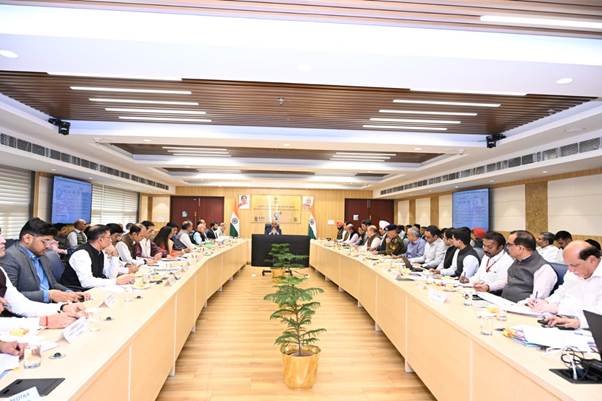
Meanwhile, Union Environment Minister Bhupender Yadav chaired a high-level review with officials from Delhi, Haryana, Punjab and NCR municipalities earlier in the day. The Minister directed authorities to submit district-wise action taken reports on pollution control, including crop residue management, road dust reduction, legacy waste processing, industrial emission monitoring, and traffic management plans for congestion hotspots.
He emphasised year-round monitoring of stubble burning, capacity building to expand farmer access to crop-residue management equipment, and strict vigilance against open burning of municipal solid waste. Yadav also called for a mission-mode roadside greening initiative and asked the Delhi Traffic Police to expedite the implementation of the Intelligent Traffic Management System (ITMS) to reduce pollution from idling vehicles.
CAQM has urged residents to support mitigation efforts by using public transport or shared vehicles, reducing short car trips, avoiding the use of coal and wood for heating, and providing electric heaters to domestic staff to prevent open burning.
Officials stated that the air quality situation will continue to be reviewed, and further escalation to Stage-IV (“Severe+ / Emergency”) will be considered if conditions worsen.
– global bihari bureau