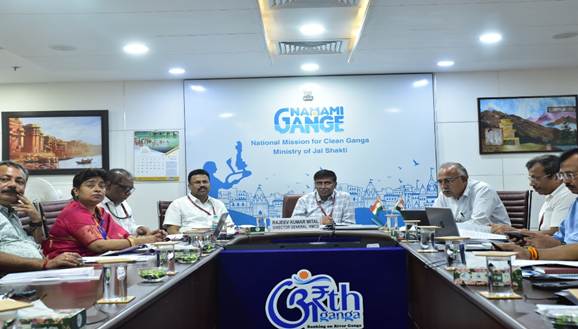
New Delhi: The 63rd Executive Committee meeting of the National Mission for Clean Ganga (NMCG) approved two pivotal projects to assess environmental flow in the Ganga’s tributaries, marking a significant step toward rejuvenating the river and its ecosystem. Held in New Delhi, the meeting focused on sustainability and innovation to enhance water quality, promote sustainable urban water management, and restore the Ganga basin’s ecological health.
The meeting approved five projects to ensure the long-term health of rivers and water bodies for future generations.
The cornerstone projects include a ₹6 crore initiative to assess environmental flow in the Kosi, Gandak, and Mahananda rivers and an ₹8 crore project for the Ghaghara and Gomti river basins. These three-year studies aim to develop sustainable flow regimes to maintain river health, support aquatic ecosystems, and balance human needs like agriculture and flood control. A ₹126.41 crore sewage management project in Agra, Uttar Pradesh, was approved to reduce pollution in the Yamuna, a Ganga tributary. It involves constructing 40 interception and diversion structures, laying 21.20 kilometres of sewer lines, installing 8 pumping stations, and placing trash screens in 5 major drains, using the Design-Build-Operate-Transfer model for sustainable management. A project to monitor Johkasou technology and other compact plug-and-play systems for domestic wastewater treatment was approved to improve on-site treatment quality and sustainability across the Ganga basin. Additionally, a ₹2.47 crore project for the conservation of the Asan Wetland, a Ramsar site in Dehradun, Uttarakhand, was approved for two years to enhance biodiversity through wetland inventory, assessment, monitoring systems, and conservation planning.
Environmental flow, defined as the quantity, timing, and quality of water required to sustain freshwater ecosystems and human livelihoods, is critical for the Ganga and its tributaries, which contribute over 60% of the river’s flow. The NMCG’s projects build on studies like the 2017 Wildlife Institute of India and IIT Roorkee assessment for the Upper Ganga, which recommended tailored flow regimes to support biodiversity, fisheries, and agriculture while mitigating flood risks in tributaries like the Kosi, known for its heavy siltation and flooding. These assessments aim to provide data-driven flow standards for the Kosi, Gandak, Mahananda, Ghaghara, and Gomti to ensure ecological balance.
The meeting was attended by Director General Rajeev Kumar Mital, Joint Secretary (Ministry of Power) Mahavir Prasad, Deputy Director General Nalin Srivastava, Executive Director (Technical) Anup Kumar Srivastava, Executive Director (Project) Brijendra Swaroop, Executive Director (Administration) S.P. Vashishtha, Executive Director (Finance) Bhaskar Dasgupta, Project Director (West Bengal) Nandini Ghosh, Additional Project Director (Uttar Pradesh SMCG) Prabhash Kumar, and Managing Director (UP Jal Nigam Urban) Ramakant Pandey,
Participants noted that the projects integrate tradition, technology, and public participation, aligning with the Namami Gange Mission’s objectives of pollution reduction and sustainable river management. The initiatives, spanning infrastructure, scientific studies, and conservation, aim to ensure the Ganga’s ecological vitality and establish a model for river management nationwide.
– global bihari bureau