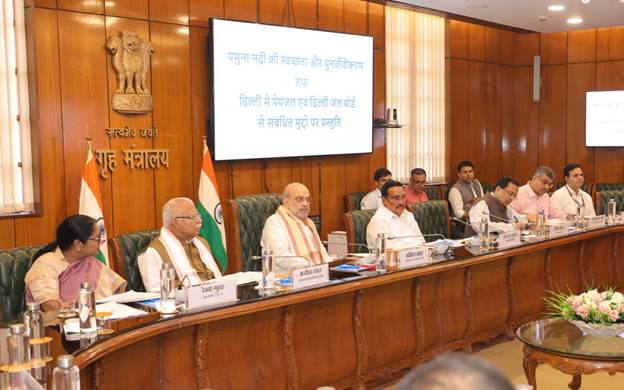
New Delhi: Union Home Minister and Minister of Cooperation Amit Shah convened a high-level meeting in New Delhi on May 22, 2025, to address the cleaning of the Yamuna River, drinking water supply, and sewage systems in Delhi. The meeting included Union Housing and Urban Affairs Minister Manohar Lal, Union Jal Shakti Minister C.R. Patil, Delhi Chief Minister Rekha Gupta, the Union Home Secretary, secretaries from the Ministries of Housing and Urban Affairs and Jal Shakti, Delhi’s Chief Secretary, and senior officials from central and Delhi governments. The discussion centred on a coordinated strategy to tackle long-standing environmental and infrastructural issues in the capital.
Shah described the Yamuna as both a river and a symbol of faith, emphasising the government’s commitment to its restoration. He directed the Ministry of Jal Shakti to develop a Standard Operating Procedure (SOP) for all Sewage Treatment Plants (STPs) across India. The SOP will establish uniform standards for STP quality, maintenance, and discharge to prevent untreated wastewater from polluting rivers. Shah instructed that this SOP be shared with all states to standardise wastewater management practices nationwide, potentially setting a model for other river conservation efforts.
The Home Minister stressed that plans for the Yamuna, drinking water, and drainage systems in Delhi must be designed with a 20-year perspective to ensure sustainability. He highlighted the Delhi Jal Board’s (DJB) critical role in these initiatives, particularly in cleaning the Yamuna, and called for immediate recruitment to fill vacant posts within the organisation.
Strengthening the DJB’s capacity, Shah noted, is essential to execute these plans effectively and address operational inefficiencies.
Shah also focused on improving Delhi’s water distribution system. He directed the DJB to address pipeline leakages, which cause significant water loss, to ensure a consistent drinking water supply across the city. Additionally, he advocated for the use of advanced technology for desilting drains to enhance drainage systems and mitigate flooding risks, a recurring issue during Delhi’s monsoon season. These measures aim to improve infrastructure resilience and public access to clean water.
The meeting underscored the interconnected nature of Delhi’s environmental challenges, from river pollution to water scarcity and urban flooding. Shah’s call for a holistic approach reflects the government’s intent to integrate efforts across ministries and local authorities. The involvement of senior officials from both central and Delhi governments signals a unified commitment to addressing these issues, with the Yamuna’s restoration as a priority. The proposed SOP for STPs could influence national policy, while the focus on long-term planning aims to future-proof Delhi’s infrastructure. By prioritising the Yamuna’s ecological health and the city’s water and sewage systems, the government seeks to balance environmental conservation with urban development, potentially offering a framework for other Indian cities facing similar challenges.