WHO Summit Positions India at Forefront of Integrative Health
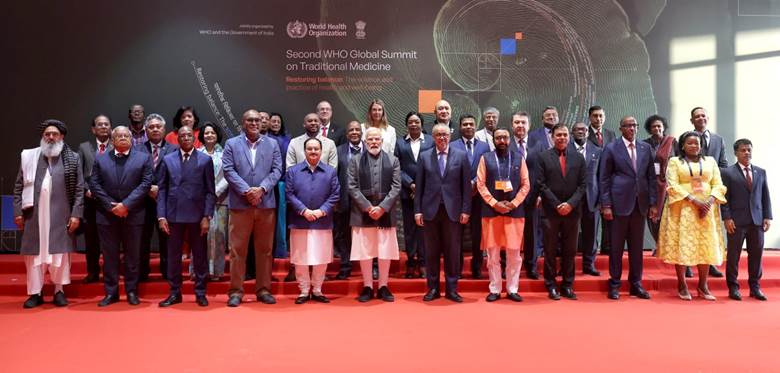
New Delhi: India successfully concluded the second WHO Global Summit on Traditional Medicine here today, underscoring the country’s growing influence in shaping international policy on integrative health systems. The three-day summit brought together delegates from more than 100 countries, including health ministers, practitioners, scientists, Indigenous leaders and multilateral agencies, to discuss the integration of traditional medicine into universal health coverage, resilient health systems and sustainable development frameworks. Key outcomes of the summit included the adoption of the Delhi Commitment, which sets out an action framework for evidence generation, regulatory standards, knowledge protection and responsible digitalisation of traditional medicine, as well as the launch of the WHO Global Traditional Medicine Library, a global platform for safeguarding intellectual property, community rights and equitable benefit-sharing while promoting evidence-informed policy and innovation.
Prime Minister Narendra Modi’s intervention focused on repositioning traditional medicine as an integral component of global public health systems. He highlighted the importance of aligning traditional knowledge with universal health coverage, preventive care, and responses to non-communicable diseases and climate-related health risks. Modi also called for global stewardship of traditional knowledge, emphasising collaboration on evidence generation, quality standards, regulatory frameworks and equitable benefit-sharing. His remarks linked traditional medicine to long-term health system resilience and framed India as a leader in setting standards and providing institutional models that can guide other nations.
The summit outcomes also carry implications for global health policy and markets. The WHO Global Traditional Medicine Strategy 2025–2034 provides a framework for integrating traditional medicine into health systems in a science-driven, ethical and equity-focused manner. Alignment between India’s Ayush initiatives and WHO standards could facilitate international recognition of Indian traditional medicine systems in healthcare delivery, education, research and commercial markets. Observers note that the combination of robust digital infrastructure, quality benchmarks and regulatory frameworks positions India to influence international standards, trade rules, and cross-border collaboration in the sector.
From a foreign-policy perspective, the summit further underscores India’s leadership role in traditional medicine at a time when other major powers, including China and European nations, have been active in promoting complementary health systems. India’s approach, emphasising evidence-based integration, multilateral cooperation and global governance, contrasts with more commercially or nationally anchored strategies elsewhere. By hosting the summit, shaping the Delhi Commitment, and driving institutional initiatives such as the WHO Global Traditional Medicine Library, India has positioned itself as a credible standard-setter, promoting shared international norms and cooperation in an area that intersects health, trade, innovation and cultural heritage.
WHO Director-General Dr Tedros Adhanom Ghebreyesus praised the collective outcomes of the summit, noting that traditional medicine is a living science with the potential to contribute to equitable, resilient and sustainable health systems. WHO reaffirmed its commitment to support member states through the Global Traditional Medicine Centre, technical cooperation, standards development and capacity-building, emphasising that the success of the summit will ultimately be measured by implementation at the country and community level.
– global bihari bureau