Investigators Trace Kashmir, Faridabad Links as Centre Calls it a Terror Attack
New Delhi: Investigators probing Monday’s deadly car explosion near Delhi’s Red Fort are examining possible links between the blast and a recently exposed terror module in Jammu & Kashmir and Haryana. The government has formally declared the incident a terrorist act carried out by “anti-national forces,” while the Union Cabinet adopted a resolution condemning the attack and vowing a coordinated national response. The Cabinet reiterated “India’s unwavering commitment to a policy of zero tolerance towards terrorism in all its forms and manifestations”.
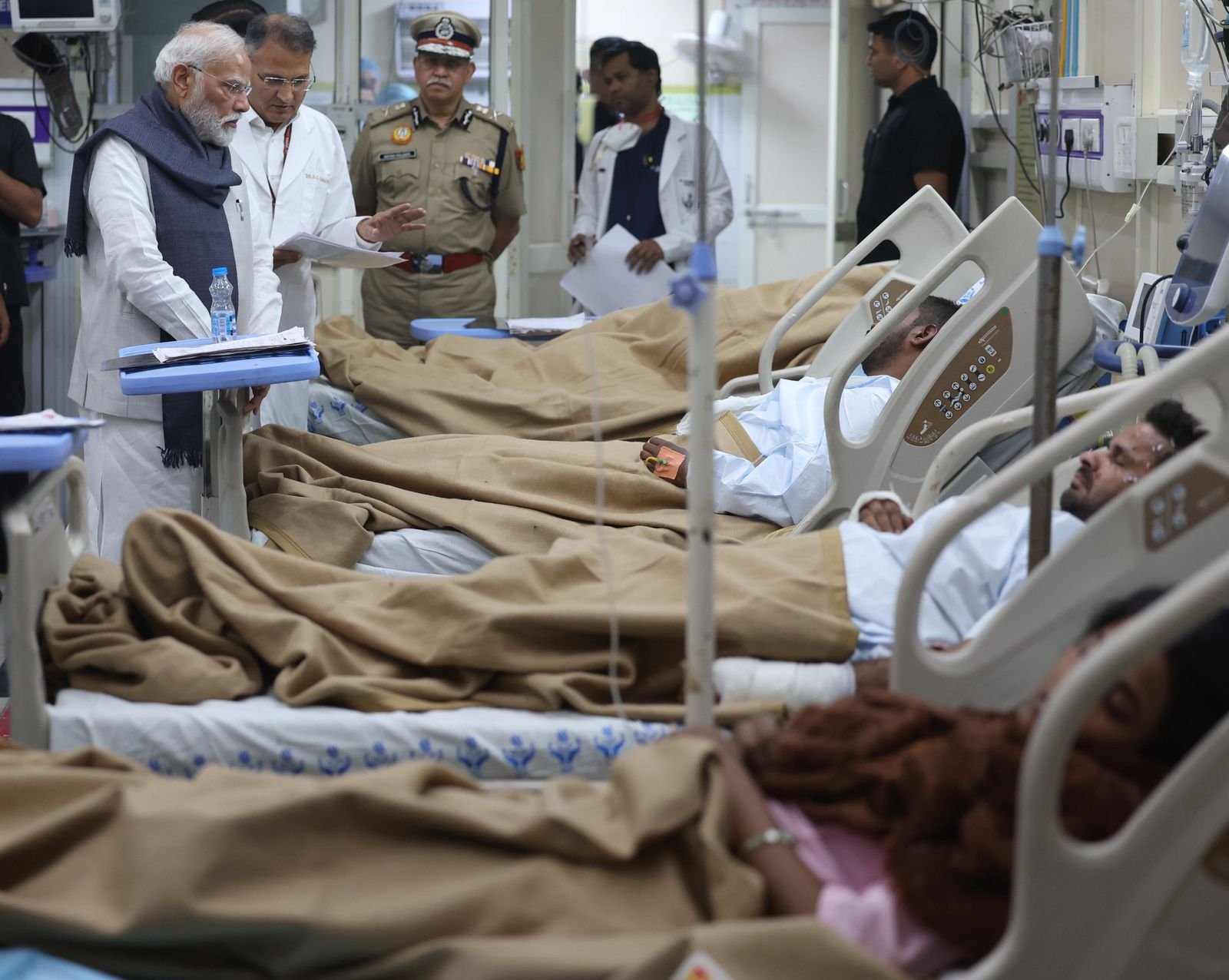
Prime Minister Narendra Modi today visited the Lok Nayak Jai Prakash (LNJP) Hospital in Delhi to meet those injured in the blast incident. He interacted with the victims and their families, inquired about their treatment, and conveyed his heartfelt prayers for their swift and complete recovery. Those behind the conspiracy will be brought to justice, he asserted.
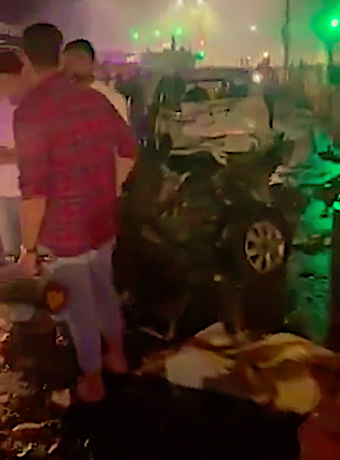
Informed sources said that the vehicle involved, a white Hyundai i20, had been sold on October 29, 2025, to a resident of Pulwama district in Jammu & Kashmir. The second-hand car dealer from Faridabad has been detained for questioning as part of the ongoing investigation. Preliminary forensic tests point to traces of high-grade explosive material consistent with an improvised explosive device (IED), though investigators have yet to determine whether the blast was intended as a suicide strike or if it detonated prematurely during transit.
The explosion occurred late evening on Monday, November 10, 2025, at a traffic junction near the Red Fort Metro station, igniting a massive fireball that engulfed several parked vehicles. Video footage captured by nearby CCTV cameras shows a brief flash followed by a shockwave of flames. Initial casualty counts have varied between eight and thirteen dead, with more than twenty people reported injured; authorities cautioned that the figures remain provisional pending hospital confirmations.
Central agencies are pursuing leads that connect the attack to an earlier series of arrests in Jammu & Kashmir, where seven men—including two doctors ( some unverified reports suggest 7–8 total, including 2–4 doctors) —were detained over the past fortnight on charges of plotting coordinated explosions. Police had also seized arms, detonators, and precursor chemicals in operations stretching from Kulgam and Anantnag to Faridabad. Investigators now believe components from that network may have been used in the Delhi blast, signalling an organised logistics chain extending across states.
According to Delhi Police officials involved in the investigation, the timing and choice of location—within view of a national monument and close to a busy metro corridor—suggest an effort to test urban counter-terrorism response mechanisms and exploit evening commuter density. The National Investigation Agency (NIA) and Delhi Police’s Special Cell are jointly reconstructing the vehicle’s route through number-plate recognition data and toll-plaza footage, while a team from the National Security Guard (NSG) has collected blast residues for laboratory analysis.
Heightened security measures were imposed across the capital and adjoining states within hours of the explosion. Barricades and vehicle checks were stepped up on arterial roads, including Netaji Subhash Marg, while entry to the Red Fort complex was temporarily suspended for visitors. Governments in Haryana, Goa, and Jammu & Kashmir were placed on alert, and metro security drills were intensified across Delhi-NCR.
While the full chain of command behind the attack remains unknown, intelligence sources indicated that encrypted communication channels and funding traces are being examined, with possible digital footprints on social media platforms under scrutiny. Officials declined to identify the detained suspects or disclose the quantum of explosives recovered, citing operational sensitivity.
Beyond the immediate investigation, the attack has renewed concern over the infiltration of professional cells and small, mobile units that move across states under civilian cover. The inclusion of individuals with medical or technical backgrounds in recent arrests underscores a shift in recruitment tactics. Security experts said this evolution may require new approaches to intelligence gathering, focusing on radicalisation networks and the movement of explosive precursors.
Forensic teams are also working to identify the precise composition of the device, believed to combine conventional explosive compounds with accelerants to produce the high-temperature blast seen in video footage. Early reports suggest traces of RDX and ammonium nitrate, but officials have not issued a definitive confirmation.
Authorities have pledged transparency as the investigation proceeds. “Every lead will be pursued to its conclusion,” a senior Home Ministry official said, noting that the Union government would ensure coordination between central and state agencies to prevent recurrence. The Centre is expected to table a brief on the incident in Parliament later this week, outlining initial findings and proposed security enhancements around heritage and high-footfall zones in the capital.
The Red Fort explosion, the most serious attack in Delhi since the 2011 High Court bombing, has revived questions about surveillance coverage, parking regulation near public monuments, and the ability of intelligence agencies to intercept localised terror logistics. As investigators sift through the wreckage, the unanswered questions—who planned the operation, how the explosives entered the city, and whether it was meant to cause larger casualties—remain at the heart of India’s latest counter-terror challenge.
– global bihari bureau