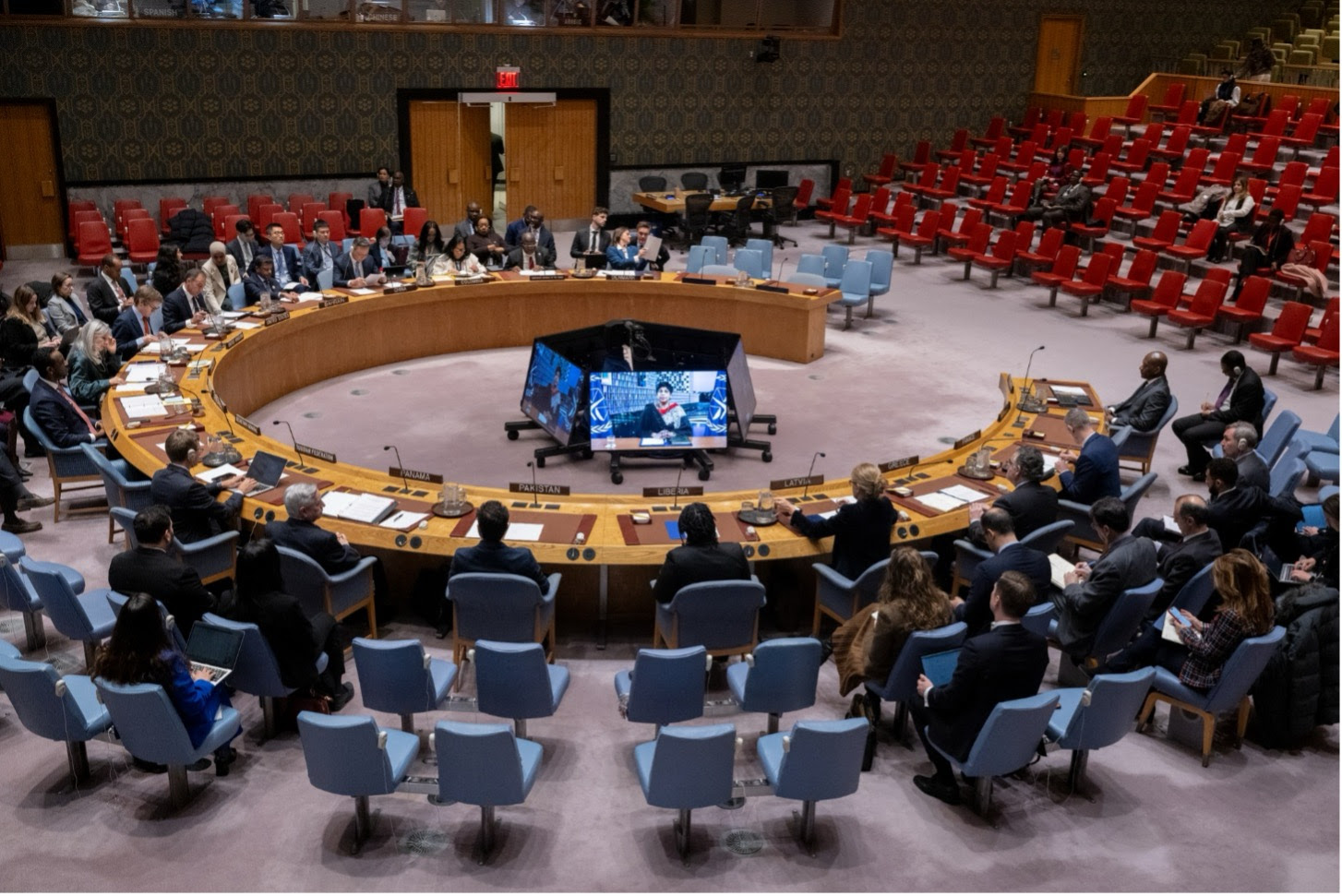
ICC Deputy Prosecutor Nazhat Shameem Khan briefs the UN Security Council on the Office of the Prosecutor’s investigations into alleged crimes in El Fasher and Al Geneina in Darfur. UN Photo/Manuel Elías
ICC Seeks Wider Cooperation as Darfur Atrocities Mount
The Hague/New York: The Deputy Prosecutor of the International Criminal Court (ICC), Nazhat Shameem Khan, told the United Nations Security Council (UNSC) that the situation in Sudan’s Darfur region has deteriorated sharply, with civilians subjected to widespread and systematic violence and accountability still largely absent. Briefing the Council on January 19, 2026, pursuant to Resolution 1593 (2005), Khan addressed members virtually from The Hague, noting that she had intended to appear in person but was unable to do so after not being granted a visa.
Since her previous briefing, Khan said, conditions in Darfur have worsened significantly. She reported that following the fall of El Fasher to the Rapid Support Forces, non-Arab communities in particular have been targeted in what she described as an organised campaign involving rape, arbitrary detention, executions and the use of mass graves. According to the ICC Prosecutor’s Office, many of these acts have been recorded and circulated by perpetrators themselves, contributing to what Khan characterised as a prevailing sense of impunity. She said the violence remains ongoing.

Khan told the Council that the Office of the Prosecutor is intensifying its work, collecting and analysing evidence and accelerating investigations in cooperation with affected communities. The focus includes alleged crimes committed in Al Geneina in West Darfur and in El Fasher in North Darfur. Based on information gathered during the reporting period, including video, audio and satellite data, the Office has assessed that war crimes and crimes against humanity were committed in El Fasher, particularly in late October 2025 during the siege of the city by the Rapid Support Forces.
According to the Prosecutor’s Office, video material analysed shows patterns similar to those documented previously in other parts of Darfur, including detention, mistreatment and killings of civilians from non-Arab tribes. Some footage, Khan said, depicts individuals celebrating executions and desecrating bodies. Investigators are seeking to corroborate such material through multiple sources to establish individual criminal responsibility. This work includes the analysis of satellite imagery indicating mass killing events and possible efforts to conceal evidence, engagement with affected communities to identify witnesses, and the review of submissions from civil society organisations that align with the video material collected.
Khan said the information gathered points to organised and widespread criminal conduct, including mass executions and other atrocities used to assert control. She reported that the Office has also made significant progress in investigations related to Al Geneina, conducting interviews with direct witnesses in countries hosting Sudanese refugees. Those interviewed have provided accounts of attacks on camps for internally displaced persons, looting, indiscriminate violence against civilians, arbitrary detentions, gender-based crimes and violations affecting children. The evidence, she said, indicates that patterns of violence seen in Al Geneina in 2023 were repeated in El Fasher in 2025 and continue to recur across Darfur.
The Deputy Prosecutor said the ICC is giving particular attention to the investigation of gender-based crimes. Based on the Office’s findings, sexual violence, including rape, has been used during the conflict, supported by survivor accounts and cooperation with United Nations partners and other organisations documenting abuses. She noted that cultural and gender-related barriers often hinder reporting of such crimes and said the Court is working to ensure investigations are conducted in a culturally sensitive and gender-aware manner, including through the involvement of its Gender and Children’s Unit.
Khan also told the Council that the Office is documenting reports of alleged Rome Statute crimes committed by the Sudanese Armed Forces in Darfur. She stressed that all parties to the conflict are required under international law to protect civilians and civilian infrastructure. She called on individuals and organisations with information related to alleged crimes in El Fasher, Al Geneina and elsewhere in Darfur to share it with the ICC, including through the Court’s secure online platform.
Alongside the assessment of ongoing violence, Khan referred to recent judicial developments at the ICC. On October 6, 2025, Ali Muhammad Ali Abd-Al-Rahman was convicted of war crimes and crimes against humanity committed in Darfur, including murder, torture and outrages upon personal dignity. He was sentenced on December 9 to 20 years’ imprisonment. The Court found that Abd-Al-Rahman was the Janjaweed leader known as Ali Kushayb and established his responsibility as a direct perpetrator, co-perpetrator and commander, as well as his links to senior Sudanese officials, including individuals who remain fugitives from the Court.
The Deputy Prosecutor noted that the conviction marked the first resulting from a Security Council referral to the ICC, the first conviction related to the Darfur situation, and the Court’s first conviction for gender-based persecution. She said victims from Darfur have indicated that the trial and verdict represent an important acknowledgement of the crimes committed against them, even as violence continues in the region.
Khan said further progress would depend on expanded cooperation from States and other partners. She outlined recent steps, including increased collaboration with African States such as Chad, which has facilitated access for interviews with affected communities, deeper engagement with civil society organisations on documenting crimes, and closer cooperation with the United Nations Fact-Finding Mission for Sudan, particularly on gender-based crimes. At the same time, she highlighted ongoing challenges, including limited access to witnesses and crime scenes and security risks faced by potential witnesses.
The Deputy Prosecutor called for additional support, including the sharing of satellite imagery and digital information relevant to investigations, assistance in identifying and interviewing members of the Darfuri diaspora, the provision of visas for ICC staff, and the secondment of specialised national experts. She also referred to obstacles to the Court’s work, including measures taken against ICC officials, and urged that such actions cease.
Khan reported some progress in cooperation with Sudanese authorities, including support for additional ICC missions and responses to requests from the Office. She said discussions with Sudan’s Attorney-General during the sentencing of Ali Kushayb included commitments to further cooperation. At the same time, she underscored the need for Sudan to take concrete steps to arrest individuals subject to ICC warrants who remain in the country, naming Omar Hassan Ahmad Al Bashir, Ahmad Harun and Abdel Raheem Muhammad Hussein.
Concluding her briefing, Khan quoted a Darfuri victim who testified at the Ali Kushayb trial, describing justice as essential to human dignity and social stability. She said the conviction demonstrated that cooperation between the Security Council and the ICC can lead to accountability, and that broader support would be required to extend such outcomes to other victims and to address ongoing crimes in Darfur.
– global bihari bureau