From Procurement to Deployment – India’s Defence Momentum Accelerates
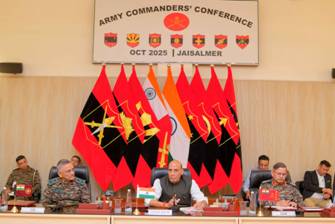
New Delhi/Jaisalmer: Yesterday’s Defence Acquisition Council’s clearance of Rs 79,000 crore in procurement proposals set the stage for an immediate and multifaceted operational rollout today. This momentum carried forward decisively as Defence Minister Rajnath Singh convened the Army Commanders’ Conference in Jaisalmer, a strategically chosen forward location that enabled direct oversight of desert warfare readiness while evoking the legacy of the 1971 Laungewala battle.
Engaging with the full spectrum of military leadership, including Chief of Defence Staff General Anil Chauhan, Army Chief General Upendra Dwivedi, Defence Secretary Rajesh Kumar Singh, and all Army Commanders, Singh facilitated exhaustive discussions on grey zone warfare, inter-service integration, self-reliance in defence production, and technological innovation. The conference served as more than a review; it functioned as a doctrinal alignment exercise, crystallising Operation Sindoor as the cornerstone of India’s evolving security posture. Singh framed the operation as a paradigm of national strength, where military effectiveness derives equally from advanced weaponry and ethical discipline, with actions calibrated to policy precision and human dignity. By declaring that the mission remains active until every trace of terrorist ideology is eliminated, he established a framework for sustained, proactive counter-terrorism that dictates terms rather than reacting to them, fundamentally altering the strategic calculus for state-sponsored proxy threats.
Also read: India Signals Deterrence, Clears Rs 79,000 Cr Defence Deals
This 24-hour continuum from financial authorisation to field-level execution illustrates a defence apparatus operating with unprecedented synchronisation, where policy decisions translate swiftly into tangible enhancements across land, maritime, and high-altitude domains. The approvals, focused heavily on domestic manufacturing under Aatmanirbhar Bharat, not only address capability gaps identified in recent border tensions and maritime threats but also signal to adversaries a reduced tolerance for incremental aggression, backed by rapid absorption of new assets into active service.
Singh’s directive to never underestimate adversaries, coupled with his call for perpetual vigilance, reinforced a culture of preparedness that permeates all ranks. He outlined priorities, including defence diplomacy to cultivate partnerships, countermeasures against information warfare to neutralise disinformation campaigns, accelerated infrastructure development for logistical agility, and comprehensive force modernisation to anticipate future battlefields. His acknowledgement of the Indian Army’s role in transforming Jammu and Kashmir post-Article 370—from a region of unrest to one of hope and local governance—highlighted how internal stability frees resources for external orientation. On the northern borders, he described ongoing talks and de-escalation steps as evidence of balanced diplomacy, yet stressed that dialogue proceeds in parallel with unyielding physical readiness, ensuring no compromise on territorial integrity.
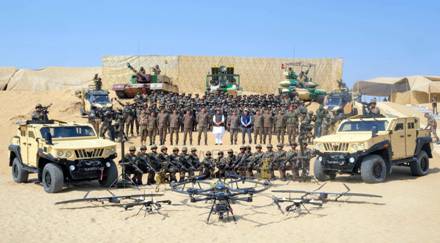
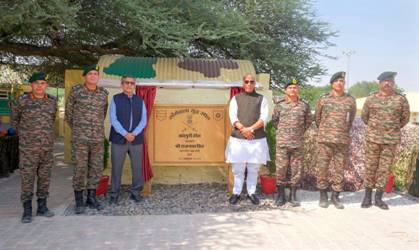
Technological advancements were not merely discussed but operationalised during the conference. Singh virtually commissioned Edge Data Centres for the Konark and Fire & Fury Corps, with a commitment to extend such facilities to all corps by 2026, enabling real-time data processing at forward edges critical for AI-driven decision-making in contested environments. He introduced practical tools like the Equipment Helpline for streamlined logistics, the Sainik Yatri Mitra App for personnel mobility, a compendium of millet-based nutritional dishes to enhance troop health, and Naman Centres dedicated to veteran welfare, demonstrating that modernisation encompasses both combat efficiency and human capital. The minister’s visit to Tanot and Laungewala included paying respects at the Yudh Sthal memorial, inaugurating Chandpuri Hall to honour Brigadier Kuldip Singh Chandpuri’s leadership in 1971, and interacting with surviving veterans, while ongoing infrastructure projects at the site aim to preserve it as a symbol of resilience. A live capability demonstration showcased the integration of newly raised units such as the Bhairav Battalion and Ashni Platoon with cutting-edge systems, illustrating how legacy tactics are being fused with modern technologies to create adaptive, multi-role formations.
In the maritime sphere, the Indian Coast Guard today marked a significant leap with the launch of ICGS Ajit and ICGS Aparajit at Goa Shipyard Limited, the seventh and eighth vessels in a series of eight indigenously designed fast patrol crafts. Measuring 52 meters in length and displacing 320 tonnes, these platforms introduce controllable pitch propellers—a domestic first in this class—offering unmatched manoeuvrability and propulsion efficiency for extended operations. Configured for fisheries protection, coastal surveillance, anti-smuggling, anti-piracy, and search-and-rescue missions, particularly in island territories and the exclusive economic zone, they enhance India’s ability to assert maritime domain awareness without triggering escalation. The event, attended by senior officials including Financial Advisor Dr Mayank Sharma, emphasised the vessels’ role in stimulating local industry, employment, and the MSME ecosystem, reinforcing the economic dimension of defence self-reliance.
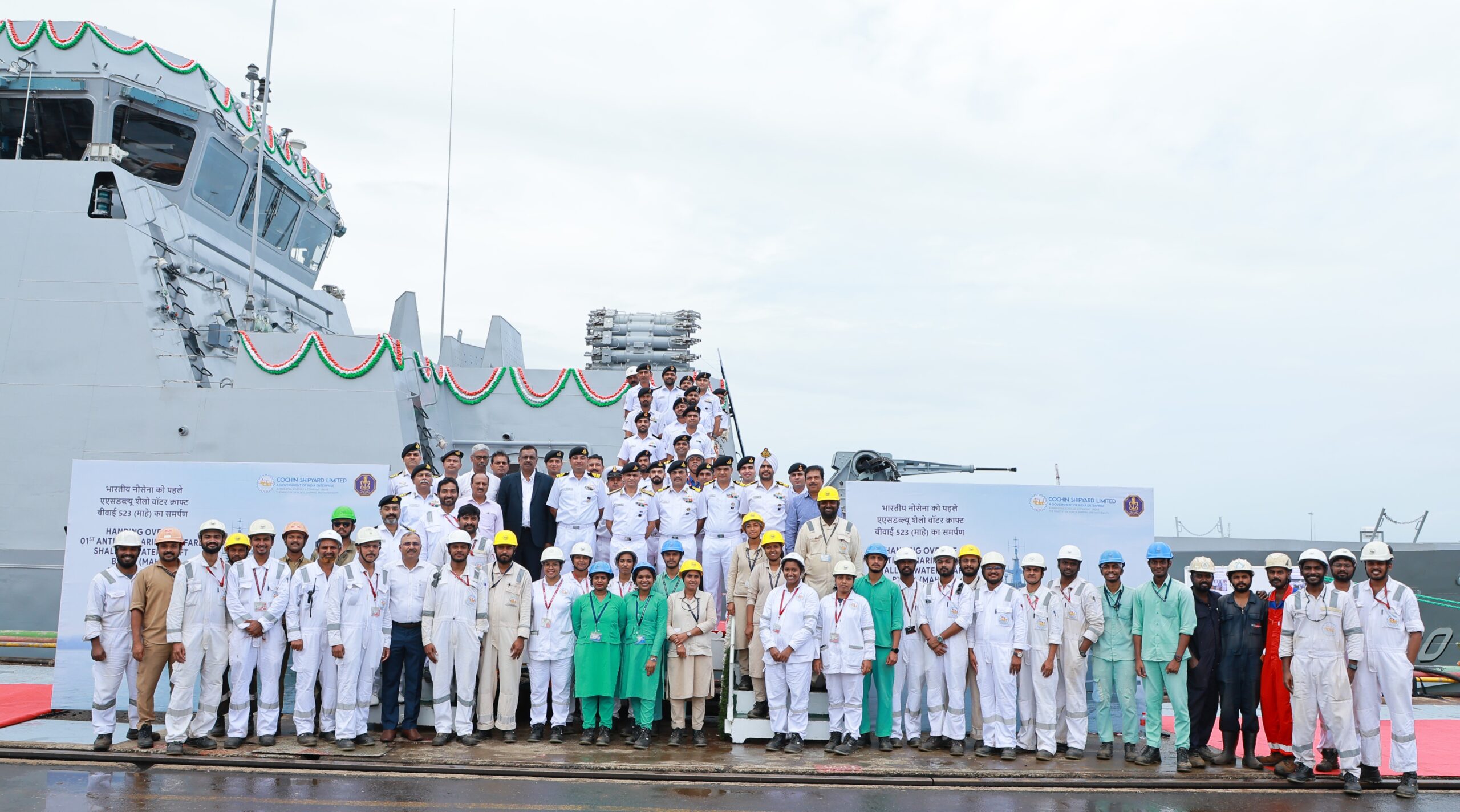
Complementing this, the Indian Navy formally received Mahe, the lead Anti-Submarine Warfare Shallow Water Craft, from Cochin Shipyard Limited on October 23, with its capabilities publicly acknowledged the following day. Spanning 78 meters with a 1,100-tonne displacement and over 80% indigenous content, Mahe is equipped for underwater surveillance, low-intensity maritime operations, coastal anti-submarine warfare, and mine-laying, armed with torpedoes, multi-role rockets, and advanced radar and sonar suites. This induction directly counters the proliferation of submarines in India’s littoral waters, creating a layered defence that complicates adversary planning in both peacetime grey-zone activities and potential conflict scenarios.
In Arunachal Pradesh, Project Arunank of the Border Roads Organisation commemorated its 18th Raising Day in Naharlagun, reflecting on 17 years of transformative infrastructure in one of India’s most challenging terrains. The project has delivered over 696 kilometres of roads and 1.18 kilometres of major bridges, connecting remote valleys and forward positions essential for military logistics. Milestones include the historic blacktopping of the 278-kilometre Hapoli-Sarli-Huri Road, the 2021 double-laning of Kimin-Potin, and the 2022 linkage to Maza along the Line of Actual Control, with the TCC-Maza and TCC-Taksing roads nearing completion and others like Huri-Tapa and Taksing Ghora Camp-Lung OP targeted for year-end finalisation. The adoption of sustainable materials—steel slag, cut-and-cover tunnels, geo cells, GGBFS concrete, and gabion walls—ensures durability in seismic and high-rainfall zones while minimising environmental impact. Looking ahead, planned expansions involve road widening, new bridges and tunnels, enhanced high-altitude connectivity for dual civilian and defence use, and the integration of geotextiles, slope stabilisation systems, digital monitoring tools, and eco-friendly construction practices to improve safety, longevity, and cost-effectiveness. Initiatives like planting 23,850 trees under ‘Ek Ped Maa Ke Naam’ and upgrading welfare for casual labourers further embed social and environmental responsibility into strategic development.
These developments on October 24 directly follow the procurement approvals of the previous day, with indigenous systems from the DAC list—such as electronic intelligence platforms and drones—aligning with the edge computing and surveillance enhancements inaugurated at the conference, and maritime vessels corresponding to the amphibious and patrol capabilities under acquisition. The timing and scope indicate a coordinated implementation framework where financial, doctrinal, technological, and infrastructural elements are advanced in parallel to maintain continuous operational momentum.
Operation Sindoor institutionalises a proactive, principle-guided approach to counter-terrorism that raises the cost of proxy warfare. The rapid fielding of controllable pitch propellers, 80% indigenous ASW platforms, and edge computing infrastructure demonstrates a shrinking gap between acquisition and deployment, reducing vulnerabilities to supply chain disruptions. Technology amplifies rather than supplants the soldier, with new battalions and data tools enhancing decision-making across physical and digital domains. Most critically, the synchronisation of land, sea, and mountain initiatives under a unified vision signals to both Pakistan and China that India’s deterrence is no longer static but dynamic, adaptive, and continuously evolving. This is not preparedness in isolation—it is deterrence in motion, where every approval, launch, and inauguration reinforces a singular message: India will shape the security environment on its own terms.
– global bihari bureau