Cuttack Clash: BJP’s Bihar Shadow?
VHP Rally Rocks Cuttack Calm
Cuttack: Cuttack, Odisha’s millennium-old silver city, renowned for its intricate filigree and a tapestry of communal amity woven over centuries, has been thrust into the spotlight by a flare-up of violence during Durga Puja immersions—a rupture that marks the first major eruption in the city in over two decades. The 2017 Bhadrak riots, often cited as Odisha’s last significant communal flashpoint, unfolded some 140 kilometres away in a separate district, sparked by inflammatory posts on social media during the Ram Navami festival and contained by then-Chief Minister Naveen Patnaik’s administration through curfews and community parleys, without fatalities or widespread spillover. Cuttack, by contrast, had preserved its legacy of harmony, with no major clashes since the early 2000s, when sporadic tensions around festivals were defused by local vigilance and interfaith bonds.
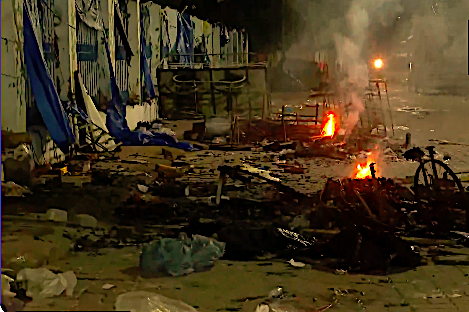
The October 2025 incidents are thus jarring: what began as objections to blaring music at 2 a.m. near Haathi Pokhari in the Dargha Bazaar area escalated into stone-throwing from rooftops, injuring 25 people, including Deputy Commissioner of Police (DCP) Khilari Rishikesh Dnyandeo, followed by a motorcycle rally led by the Vishwa Hindu Parishad (VHP) that defied police denial, fuelling arson and further skirmishes. Eight arrests followed, with Additional Director General of Police (ADG) Sanjay Kumar describing it as a “group clash” rather than purely communal, backed by closed-circuit television (CCTV) evidence and a deployment of 1,800 personnel, including Central Armed Police Forces (CAPF).
Yet, the timing prompts uncomfortable questions: why now, after Cuttack’s prolonged peace and Odisha’s eight-year lull since Bhadrak? Verified accounts point to a confluence of local triggers—high-decibel processions in a densely mixed neighbourhood at odd hours, amplified by unchecked social media whispers—but layered atop these are unmistakable political undercurrents.
The Vishwa Hindu Parishad’s swift call for a 12-hour bandh on October 6, protesting alleged administrative lapses in securing immersions, and its rally that veered into confrontation, underscore the role of Hindutva outfits in escalating what might have remained a neighbourhood spat.
Interestingly, Cuttack Urban Police District Police had conducted a flag march in the city to ensure peaceful and safe Durga Puja 2025 celebrations on September 28, 2025. The march had commenced from Cuttack Station Bazar and concluded at Purighat Devi Gada, covering sensitive areas of the city.
Cuttack UPD Police conducted a flag march in the city to ensure peaceful & safe #DurgaPuja2025 celebrations. The march commenced from Cuttack Station Bazar & concluded at Purighat Devi Gada, covering sensitive areas of the city.#PujaPreparations#SafePuja#PullutionFreePuja pic.twitter.com/BxiC8fyUTV
— DCP CUTTACK (@dcp_cuttack) September 28, 2025
However, VHP spokespersons decried the “failure to ensure peaceful immersion despite repeated requests,” demanding transfers of the district collector and DCP—a move opposition leaders like Sofia Firdous of the Indian National Congress (Congress) and Sanjay Dasburma of the Biju Janata Dal (BJD) lambasted as inflammatory, with Firdous stating, “This kind of scene is very shocking for us… Strictest possible action should be taken against antisocial elements.”
Under Chief Minister Mohan Charan Majhi’s Bharatiya Janata Party (BJP) regime, in office since June 2024 after unseating Patnaik’s 24-year BJD stronghold, such mobilisations carry weight; the BJP, ideologically tied to the Rashtriya Swayamsevak Sangh (RSS)-VHP ecosystem, faces accusations from critics of tacitly encouraging assertive Hindu assertions to consolidate its base in a state where Muslims form under 3 per cent of the populace. Reports describe the bandh as “VHP-BJP” in character, with rallies waving saffron flags and chants blurring protest and provocation, though the government blames “anti-social elements” and has imposed a 36-hour curfew under Section 163 of the Bharatiya Nagarik Suraksha Sanhita (BNSS) alongside a 24-hour internet blackout to douse rumours.
Is there a deliberate political motive? Evidence suggests opportunism over orchestration: the BJP’s nascent grip on Odisha, post its 2024 breakthrough, aligns with a national uptick in festival-related frictions, where right-wing groups seize grievances to project victimhood and rally support. No police probes or official statements indicate high-level BJP directives; the pattern mirrors 2024 Sambhal clashes, where local disputes snowballed via organisational muscle. As for a nexus with Bihar’s assembly polls, announced on October 6 for November 6 and 11, 2025, speculation on cross-border polarisation—engineering Hindu-Muslim divides to sway migrant voters or amplify narratives in Bihar’s eastern belt—lacks concrete backing. Yet, history offers sobering parallels. The 2013 Muzaffarnagar riots in Uttar Pradesh, where Jat-Muslim clashes left over 60 dead before the 2014 Lok Sabha polls, saw the BJP gain as polarised Hindu votes swung saffron in riot-hit areas. The 2002 Gujarat pogrom post-Godhra, killing over 1,000, cemented BJP dominance there and influenced the 2003 polls in Rajasthan and Madhya Pradesh, where anti-minority rhetoric shaped narratives. The 1992-93 Bombay riots, spilling into Gujarat’s 1995 polls, hardened communal lines, showing how porous state borders—like Odisha-Bihar’s shared migrant workforce in Patna’s mills and Bhagalpur’s fields—can turn local sparks into regional tinder.
In Bihar, where Nitish Kumar’s Janata Dal (United) (JD(U))-BJP-Telugu Desam Party (TDP) alliance faces Tejashwi Yadav’s Rashtriya Janata Dal (RJD), Cuttack’s unrest could theoretically feed saffron pitches in eastern Bihar’s 17 per cent Muslim belt, scarred by the 1989 Bhagalpur riots. But with no leaks or opposition claims tying Odisha to Bihar’s polls, and the BJP’s Odisha focus on schemes like Subhadra Yojana and mining rows, this remains speculative, not substantiated. Still, the template endures: in India’s electoral bazaar, where social media transmutes midnight melees into viral memes overnight, the vigilant must watch if Cuttack’s embers find footing in Begusarai’s backlanes.
What then? This episode, echoing Kandhamal’s 2008 scars without its scale, exposes Odisha’s equilibrium as perilously thin: a state that tamed Bhadrak through secular swiftness now grapples with a governance shift that may embolden fringes. Without proactive bridges—beefed-up festival protocols, neutral social media sentinels, and depoliticised dialogues—the silver city’s harmony risks fraying into routine. Authorities must probe beyond arrests, for true deterrence lies in addressing why a midnight melody ignited a midnight blaze, lest the next spark finds drier tinder.
– global bihari bureau