Shubman Gill’s 430, Akash Deep’s 10 Wickets Stun England
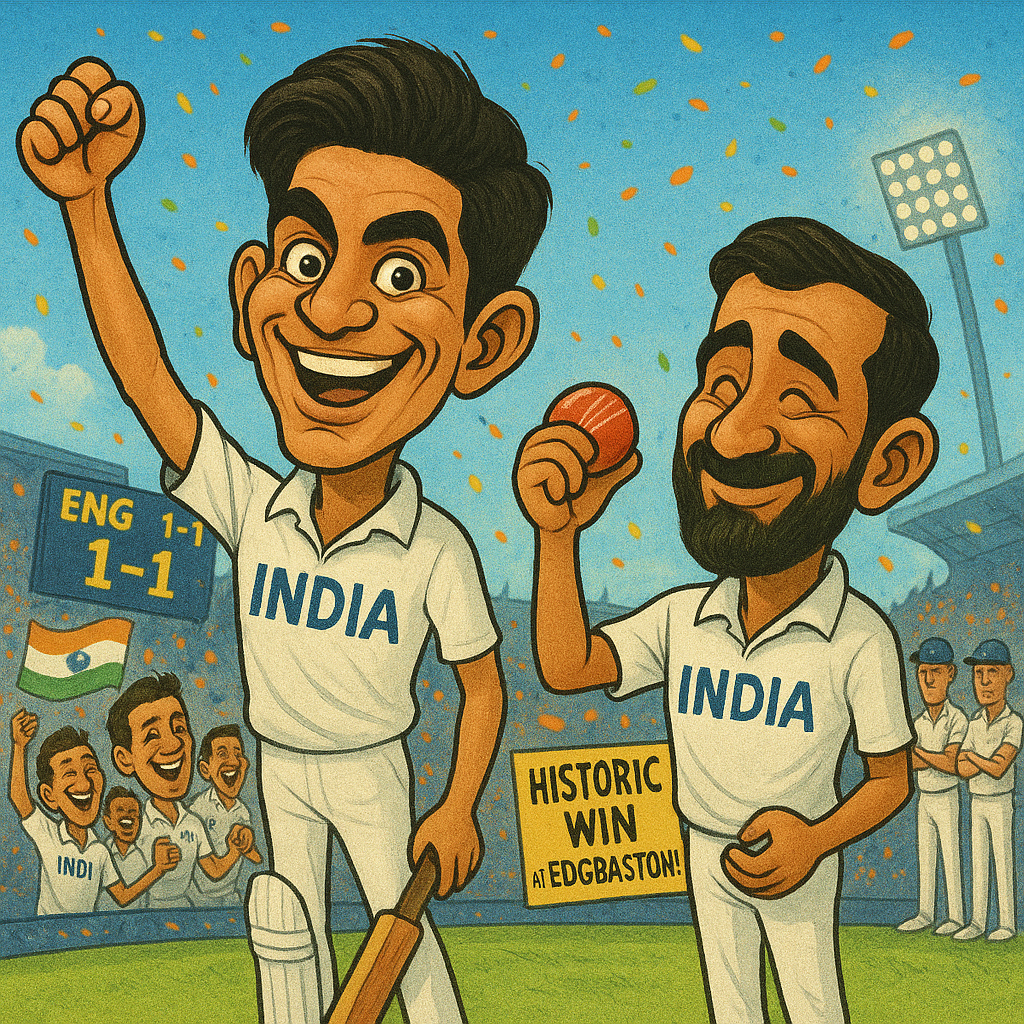
Edgbaston: For decades, Edgbaston has been a fortress India couldn’t conquer, a ground where dreams of Test victories crumbled under the weight of history. Eight attempts, seven losses, one draw—no Indian side had ever tasted triumph here. Until July 6, 2025, when a spirited bunch of young cricketers, led by the audacious Shubman Gill, rewrote the script with a thumping 336-run victory over England, levelling the five-match series 1-1.
Morning rains on the final day raised the heartbeats of Indian fans who had foreseen a historic victory at Edgbaston, fearing a draw, but the clouds parted, and the Young Turks ensured the jinx was broken.
This wasn’t just a win; it was a statement from a new generation of Indian cricketers who refused to be shackled by the past, turning the Edgbaston jinx into a tale of redemption while valiantly filling the void left by the retirements of Virat Kohli and Rohit Sharma, two giants whose 296 Tests and colossal run tallies had defined Indian cricket for over a decade.
The Indian team arrived in Birmingham bruised from a five-wicket defeat at Headingley, where England’s Bazball approach chased down 371 with ease. Questions swirled around the squad’s ability to bounce back, especially without their talismanic pacer Jasprit Bumrah, rested for this Test, and the gaping holes left by Kohli and Sharma, whose retirements in May 2025 had sparked fears of a batting collapse. Critics doubted whether India’s young brigade could match England’s aggression on a ground that had historically favoured the hosts. But the “Young Turks”—Gill, Akash Deep, Yashasvi Jaiswal, and others—answered with a performance that blended grit, flair, and fearless cricket, proving they could not only compete but dominate, stepping boldly into the shoes of their predecessors.
At the heart of this triumph was Shubman Gill, the 25-year-old captain who has emerged as Indian cricket’s new pin-up boy. His batting was a masterclass in composure and aggression, amassing 430 runs across both innings—269 in the first and 161 in the second. Gill’s first-innings 269, a record for an Indian captain, was a marathon of elegance, surpassing Kohli’s 254* and etching his name as the highest Indian scorer in England. Facing a relentless English attack, he navigated Chris Woakes’ nip-backers and Ben Stokes’ tactical traps with a calm assurance, his cover drives and paddle sweeps silencing a partisan Edgbaston crowd. In the second innings, he switched gears, smashing 161 off 162 balls, ensuring India set a daunting 608-run target. Gill’s leadership wasn’t just about runs; it was about instilling belief in a side that had faltered in Leeds. “We knew 400 or 500 would keep us in the game if we held our catches,” he said post-match, his words reflecting a captain who trusted his bowlers to deliver. Sunil Gavaskar, a legend whose 221 at The Oval in 1979 was eclipsed by Gill’s knock, praised his captaincy, saying, “Gill’s maturity at just 25 is extraordinary. This is how captains are made.” Gavaskar’s endorsement, coupled with Gill’s sublime form, has positioned him as the face of India’s new era. This stylish leader blends Kohli’s intensity with Sharma’s calm, carrying the hopes of a billion fans.
Yet, Yashasvi Jaiswal, the 23-year-old opener, is no less a contender for India’s next poster boy. His brisk 87 on Day 1 set the tone alongside Gill, breaking Sudhir Naik’s 51-year-old record for the highest score by an Indian opener at Edgbaston. Jaiswal’s fearless approach, honed in the streets of Mumbai and the cauldron of the IPL, was evident as he took on England’s pace attack with crisp drives and audacious lofted shots. His consistency against England—seven consecutive Tests with a 50-plus score—marks him as a prodigy ready to carry forward Kohli’s legacy of dominating overseas conditions. While Gill’s elegance and captaincy have made him the focal point, Jaiswal’s raw energy and hunger for runs make him equally beloved, a dynamic force who could rival Gill for the mantle of India’s next big star.
The retirements of Kohli and Sharma left a void that seemed insurmountable, with their combined 25,000-plus Test runs and match-winning aura. But Gill and Jaiswal, backed by the likes of Rishabh Pant and KL Rahul, showed India’s future is in safe hands. Pant, true to his see-ball-hit-ball mantra, dazzled with a 65 off 58 balls in the second innings, his bat flying in a moment that left the crowd in splits and underlined his role as the team’s entertainer. Rahul’s composed 55 added stability, proving the batting line-up could thrive without its former stalwarts. India’s 587 in the first innings and 427/6 declared in the second showcased a depth that amassed 1,849 runs across the first two Tests—the highest ever by any team in the opening two games of a Test series.
The bowling attack, too, rose to the occasion without Bumrah. Akash Deep, the unheralded pacer from Bihar’s Sasaram, filled the void with a 10-wicket match haul. His incisive new-ball spells, exploiting the grass-covered Edgbaston pitch, dismantled England’s top order, dismissing Joe Root, Ben Duckett, Ollie Pope, and Harry Brook. His final-day burst, including a clever bouncer to dismiss Jamie Smith, ensured England’s chase of 608 ended at 272. From playing tennis-ball cricket for pocket money to starring at one of England’s most iconic venues, Akash’s journey embodied the spirit of this Indian side—hungry, fearless, and unrelenting. Mohammed Siraj complemented Akash with six wickets in the first innings and a crucial blow in the second, removing Zak Crawley for a duck. The spinners, Ravindra Jadeja and Washington Sundar, played their part, with Sundar’s dismissal of Stokes before lunch on Day 5 tilting the game decisively. India’s fielding, often a weak link, was razor-sharp, with Gill himself diving to take a stunning catch at slip to dismiss Duckett.
England, led by Stokes, fought hard, with Jamie Smith’s 184* and 88 showing resilience. But India’s bowlers, led by Akash and Siraj, ensured the hosts were always playing catch-up. Stokes, gracious in defeat, praised Akash’s skill: “He used his angles well and was very accurate.” The 336-run margin marked India’s biggest-ever victory by runs in an away Test, a testament to how ruthlessly Gill’s side outplayed England over five days.
This win wasn’t just about breaking a 58-year jinx since India’s first Test at Edgbaston in 1967; it was about a new India asserting itself in the post-Kohli-Sharma era. Gill, with his record-breaking exploits and Gavaskar’s seal of approval, has emerged as the leading light, but Jaiswal’s meteoric rise ensures the spotlight is shared. Together, these Young Turks have not only filled the void but redefined India’s Test legacy, proving they can conquer fortresses like Edgbaston with a blend of skill and swagger. As the series heads to Lord’s, with Bumrah set to return, India’s momentum is palpable, and the debate over who will be India’s next pin-up boy—Gill or Jaiswal—promises to be as thrilling as their on-field exploits.
– global bihari bureau