FAO Yearbook 2025 Redefines How We Count Nutrition
 Rome: The world’s diets remain dangerously unbalanced, with vast inequalities in access to nutrient-rich food despite rising global food production, according to the Food and Agriculture Organization of the United Nations (FAO) Statistical Yearbook 2025. The report finds that fewer than one in three women in sub-Saharan Africa meet the minimum dietary diversity standard — compared to over two-thirds in Latin America — exposing the persistent gap between food quantity and food quality nearly a decade before the 2030 deadline for ending hunger.
At the centre of the Yearbook’s findings is a new global indicator — the prevalence of minimum dietary diversity — that tracks what people eat rather than how much they consume. This metric, designed to monitor Sustainable Development Goal (SDG) 2 on ending hunger and malnutrition, measures whether women and children consume at least five out of ten key food groups, the minimum needed to ensure micronutrient adequacy. FAO analysis shows that poor dietary diversity correlates directly with productivity loss, impaired health, and economic strain. In sub-Saharan Africa, where only 26 per cent of women aged 15–49 achieve minimum diversity, FAO and World Bank data estimate a 12–15 per cent Gross Domestic Product (GDP) loss attributable to stunting-linked productivity deficits.
The findings underscore that the global food system’s challenge is no longer limited to producing enough calories but ensuring nutritional adequacy across populations. Although India’s minimum dietary diversity score for women rose from 32 per cent in 2015 to 41 per cent in 2023 — thanks to school meal programmes and biofortified crops — large pockets of deficiency persist. In China, urban dietary diversity exceeds 70 per cent, but rural western provinces lag at 48 per cent, illustrating the dual-speed nature of progress even in high-growth economies.
The Yearbook, launched as FAO marks its 80th anniversary and coinciding with World Statistics Day, is more than a statistical digest; it is a mirror of global agrifood systems in flux. Drawing on harmonised data from national statistical offices, international partners, and FAO’s vast databases, the 2025 edition spans the economic significance of agriculture, input use, production trends, environmental pressures, and human well-being. It covers 245 countries and territories, feeding into over 20,000 indicators hosted on the FAOSTAT (FAO Statistics Division Database) platform — the world’s largest open-access agricultural data repository. The Yearbook’s release underscores FAO’s continuing mission to ensure that reliable, comparable, and timely data form the basis of sound agricultural and environmental policy worldwide.
The new dietary diversity indicator directly supports the monitoring of Sustainable Development Goal (SDG) 2 — “Zero Hunger” — and specifically its targets to end all forms of malnutrition by 2030. Unlike conventional food security measures that focus on energy intake or supply availability, this indicator captures whether individuals, particularly women and children, consume foods from a sufficient variety of groups — such as cereals, legumes, fruits, vegetables, dairy, and meat. FAO statisticians highlight that diverse diets are the most practical proxy for micronutrient adequacy, and hence for long-term nutritional well-being. Preliminary findings show that while global food supply per capita has risen over the past two decades, diversity in consumption remains uneven. Sub-Saharan Africa and parts of South Asia record the lowest dietary diversity, largely reflecting income inequality, food price volatility, and limited access to nutrient-rich foods. Notably, India’s Minimum Dietary Score (MDS) for women rose from 32 per cent in 2015 to 41 per cent in 2023, driven by mid-day meals and biofortification, while China’s urban MDS exceeds 70 per cent — yet rural gaps persist, with only 48 per cent in western provinces (FAO/China National Bureau of Statistics (NBS), 2025).
FAO’s Chief Statistician and Director of the Statistics Division, José Rosero Moncayo, said the Yearbook reflects FAO’s ongoing commitment to evidence-driven policymaking. “The Statistical Yearbook and Pocketbook series remains the most authoritative source of information on world food and agriculture,” he noted. “In the face of increasing demand for data, statistics, and the trust we build around them remain our biggest asset. Reliable data is essential for designing effective policies, monitoring progress, and ensuring accountability.”
The Yearbook 2025 also revisits key structural changes in global agriculture. While total agricultural output continues to grow, productivity gains remain geographically uneven. Regions such as East Asia and Latin America have seen sustained efficiency improvements through technology adoption and better land management, while low-income economies, particularly in sub-Saharan Africa, still depend heavily on manual labour and face stagnating yields. FAO data reveal that agricultural employment, though declining globally, remains a critical livelihood source for over one billion people. Women account for nearly 37 per cent of the agricultural labour force, but disparities in land ownership, access to inputs, and credit persist. These gaps are particularly acute in countries where customary laws limit women’s control over productive resources, leading to measurable yield losses at the national level.
The Yearbook places strong emphasis on the interplay between agriculture and the environment. Global greenhouse gas emissions from Agriculture, Forestry and Other Land Use (AFOLU) remain significant, though the rate of increase has slowed. FAO estimates that agricultural emissions contribute around 18–20 per cent of global anthropogenic emissions, dominated by enteric fermentation in livestock, synthetic fertiliser use, and land conversion. However, improved agricultural practices and reforestation are helping to offset part of this impact. The Yearbook notes that forests still cover approximately 31 per cent of the Earth’s land area, though deforestation in tropical regions remains a concern. In 2024 alone, the world lost around 4.7 million hectares of forest, largely driven by agricultural expansion, mining, and infrastructure growth. Of this, 42 per cent was linked to commodity-driven deforestation — palm oil (18 per cent), soy (14 per cent), and cattle ranching (10 percent) — with Indonesia, Brazil, and the Democratic Republic of the Congo (DRC) accounting for 68 per cent of total loss (FAO/Global Forest Watch (GFW), 2025).
A new section on forest product trade highlights shifts in the global bioeconomy, with processed wood, pulp, and paper products gaining importance in both developed and emerging markets. FAO analysts note that as nations push to cut greenhouse gas emissions, sustainably managed forests and forest-based industries are central to achieving low-carbon growth. The updated dataset on forest product flows aims to help countries calibrate trade policies to balance environmental goals with economic development. FAO’s Forestry Division emphasises that better trade monitoring can also support the circular economy by promoting the reuse of wood-based materials and improving traceability in supply chains.
In parallel, the Yearbook commemorates the centennial of the World Programme for the Census of Agriculture, which provides methodological guidelines for countries conducting national agricultural censuses. This milestone underscores the enduring value of standardised, internationally comparable data. The latest census cycle has seen rising participation, with over 150 countries adopting FAO’s guidelines — an achievement that reinforces the organisation’s role as custodian of global agricultural data systems.
Digital transformation is another major theme of the 2025 edition. FAO’s online Yearbook provides dynamic visualisations, downloadable datasets, and geospatial mapping tools that allow policymakers, researchers, and the public to interact with complex data in real time. FAO’s Artificial Intelligence (AI)-powered yield forecasting models — piloted in 12 countries including Kenya, Vietnam, and Peru — now achieve 87 per cent accuracy in predicting maize yields 60 days pre-harvest, outperforming traditional surveys by 23 per cent (FAO Digital Agriculture Report, 2025). Complementing it is the FAO Statistical Pocketbook 2025, a compact reference presenting key highlights and regional comparisons. Both resources are part of FAO’s broader effort to make agricultural data open, interoperable, and policy-relevant, leveraging innovations in big data analytics, satellite observation, and artificial intelligence. These tools enhance national capacities to collect, validate, and use data for evidence-based decision-making.
The report also reiterates the deep links between agriculture, trade, and nutrition. International trade in agricultural goods has doubled in value since 2000, but the composition of trade is changing. While traditional staples still dominate, exports of high-value commodities such as fruits, vegetables, dairy products, and processed foods are expanding rapidly, reshaping diets and rural economies alike. FAO economists observe that this diversification reflects a dual trend: rising middle-class demand for variety and growing integration of developing countries into global value chains. However, they caution that such shifts can exacerbate nutritional inequalities if not matched by policies ensuring affordability and access for the poor.
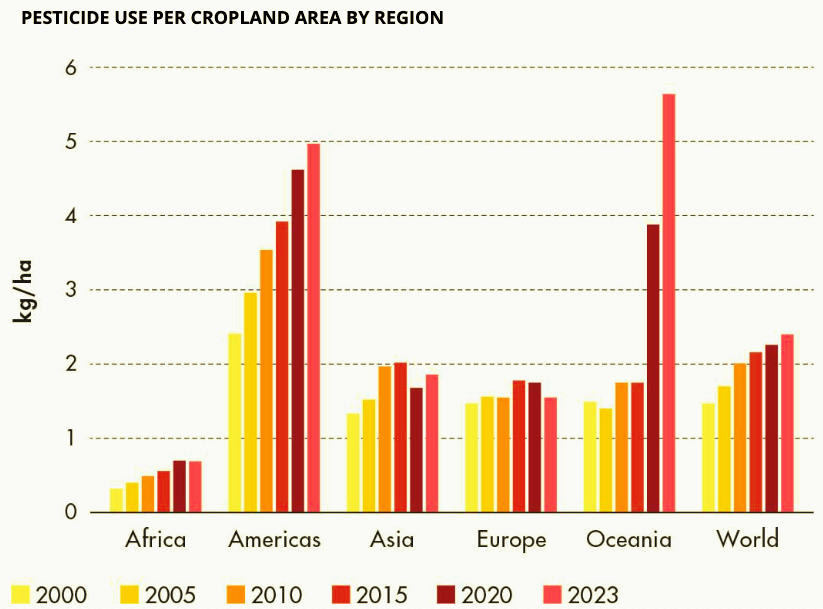
Pesticide use has risen sharply in the early 21st century and now constitutes an important input and environmental policy challenge. Global pesticide use increased by 71 per cent between 2000 and 2023 to about 3.7 million tonnes of active ingredients; the Americas accounted for nearly half of that total in 2023 (49 percent), followed by Asia (28 percent) and Europe (12 percent), while Africa and Oceania recorded the fastest proportional growth rates (+187 percent and +396 percent respectively). Pesticide application intensity averaged about 2.40 kilograms per hectare of cropland globally in 2023, with the highest rates in Oceania (5.6 kg/ha) and the Americas (5.0 kg/ha). Brazil was the largest single user in absolute terms in 2023 at some 0.8 million tonnes (about 21 per cent of the world total), well ahead of the United States of America (0.43 million tonnes) and Indonesia (0.29 million tonnes); Brazil’s pesticide use per cropland area (about 12.6 kg/ha) was also among the highest reported. FAO notes that country reporting practices differ (sales, distribution, formulation or applied quantities), so figures are expressed in tonnes of active ingredient and should be interpreted with those caveats in mind.
Statistical work, FAO notes, lies at the heart of its mandate. Since its founding in 1945, FAO has viewed the collection, harmonisation, and dissemination of agricultural data as a global public good. The 2025 Yearbook reinforces this vision at a time when demand for accurate, comparable, and accessible information has never been higher. By expanding the scope of indicators to include dietary diversity, environmental impact, and gender equity, FAO aims to ensure that the transformation of agrifood systems is both measurable and inclusive. FAO’s own projections warn that at current trends, Sustainable Development Goal (SDG) 2.1 (ending hunger) and SDG 2.2 (ending malnutrition) will be missed by 2030 in 57 countries — unless dietary diversity improves by at least 18 percentage points in the lowest-performing quintile (FAO State of Food Security and Nutrition in the World (SOFI) Report, 2025).
In essence, the FAO Statistical Yearbook 2025 represents not just a catalogue of figures but a reflection of the global struggle to reconcile productivity, nutrition, and sustainability. It provides governments, researchers, and citizens alike with a data-rich foundation for navigating one of the century’s most complex challenges — feeding a growing population equitably, nutritiously, and within planetary boundaries. As the world edges closer to 2030, the Yearbook’s evolving metrics remind policymakers that progress against hunger is not only about producing more food but about producing better food, guided by reliable data and informed by shared accountability.
– global bihari bureau