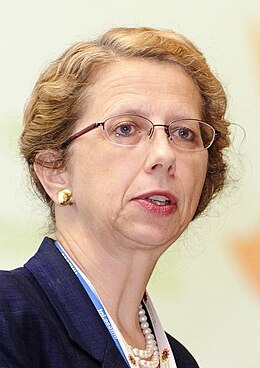
Inger Andersen
Andersen: COP30 Shows Paris Pact Delivering Results
Belém: The United Nations Environment Programme (UNEP) said the conclusion of the 30th Conference of the Parties (COP30) in Belém demonstrated that the Paris Agreement continues to function as intended despite rising geopolitical tensions. UNEP Executive Director Inger Andersen said the summit unfolded “at the gateway to the Amazon” at a moment when “geopolitical tensions continue to rise,” noting that “achieving progress in such uncertain and challenging times is never guaranteed.” She said the Belém talks nonetheless showed that “the Paris Agreement is working and delivering results,” pointing to negotiated decisions that included a call to triple adaptation finance by 2035, a Just Transition Mechanism designed to ensure the green economy “benefits everyone,” and new dialogues on how trade can support climate-resilient economic transformation and how mountain ecosystems can be integrated into climate policy.
Her statement offers an indication of how these outcomes may influence future climate policy. By highlighting the agreement to triple adaptation finance, Andersen links escalating climate impacts to the need to “better finance, implement and prioritise adaptation efforts.” This positions adaptation as a central organising principle for future national climate plans, reflecting her view that adaptation finance must be strengthened alongside mitigation. She also emphasised that UNEP science “reinforces the significant size of the challenge ahead, but equally reinforces proven solutions exist and a pathway remains to meet our global commitments,” suggesting that the next phase of policy will depend less on identifying new solutions and more on accelerating the implementation of known ones.
Her reference to the Just Transition Mechanism signals increased global attention on equity within the green transition. By saying the emerging green economy must “benefit everyone,” Andersen points to future policy frameworks that may place stronger emphasis on economic restructuring, social protection measures and community participation. This framing positions the mechanism as a benchmark for how countries address employment, reskilling and distributional impacts within their climate strategies.
Andersen said new dialogues launched in Belém on trade and mountain protection expand the scope of climate policymaking by connecting climate action with broader economic and ecological governance. Her description of discussions on “how trade can support climate-resilient economic transformation” suggests that future national policies may examine trade structures, supply chains and investment rules through a climate lens. At the same time, efforts to integrate the protection of mountains into climate policy signal a widening focus on diverse ecosystems and geographic regions within global mitigation and adaptation strategies.
Her statement also links COP30 to the momentum generated at COP28 regarding the global transition away from fossil fuels. Andersen said the Belém meeting reinforced a “growing global momentum, both in and outside of the negotiating halls, to transition away from fossil fuels as agreed in Dubai at COP28.” This indicates that the political expectation of fossil-fuel transition is likely to influence national energy and industrial strategies in the next round of climate plans.
Nature-based action remains another significant theme. Andersen highlighted efforts to “halt deforestation,” including the launch of the Tropical Forest Forever Facility, which she said “now stands at US$6.7 billion.” By foregrounding this facility and linking forest protection to COP30’s achievements, she identifies land-use action as an essential component of future climate policy. Her emphasis on rapid, high-impact steps such as “cutting methane emissions” further signals that short-lived climate pollutants will remain a priority area in coming policy cycles.
A defining element of her statement is the breadth of participation at COP30. Andersen said the Action Agenda under the Brazil Presidency drew “unprecedented Indigenous Peoples leadership from the Amazon and across the world,” as well as contributions from “businesses, cities and regions, local communities, civil society, women, people of African descent, youth, and many more.” This suggests that future climate policy may be shaped by rising expectations for inclusive consultation, community involvement and multi-actor engagement across national and subnational levels.
Central to Andersen’s assessment is the warning that “no one is saying this will be easy or we are on track.” She argued that countries must “do much more, move much faster, and stretch our collective ambition even further,” insisting that national climate plans should serve as “a baseline to build on, not a ceiling for ambition.” Her call to accelerate “the era of implementation at an unprecedented rate” frames future climate action around delivering measurable outcomes such as “affordable clean energy, good jobs, clean air, and a safer, more resilient future for all.”
UNEP said it would continue supporting governments and partners to “deliver the promise of the Paris Agreement, for people and for planet.” Viewed through Andersen’s statement, COP30’s outcomes may help shape the next phase of global climate policy by reinforcing adaptation financing, equity-focused transition planning, broader integration of trade and ecosystem considerations, strengthened nature and methane action, and heightened expectations for inclusive participation. Her remarks suggest that the core task ahead is to convert negotiated outcomes into faster and more comprehensive implementation across all sectors and regions as countries prepare their next climate plans.
– global bihari bureau