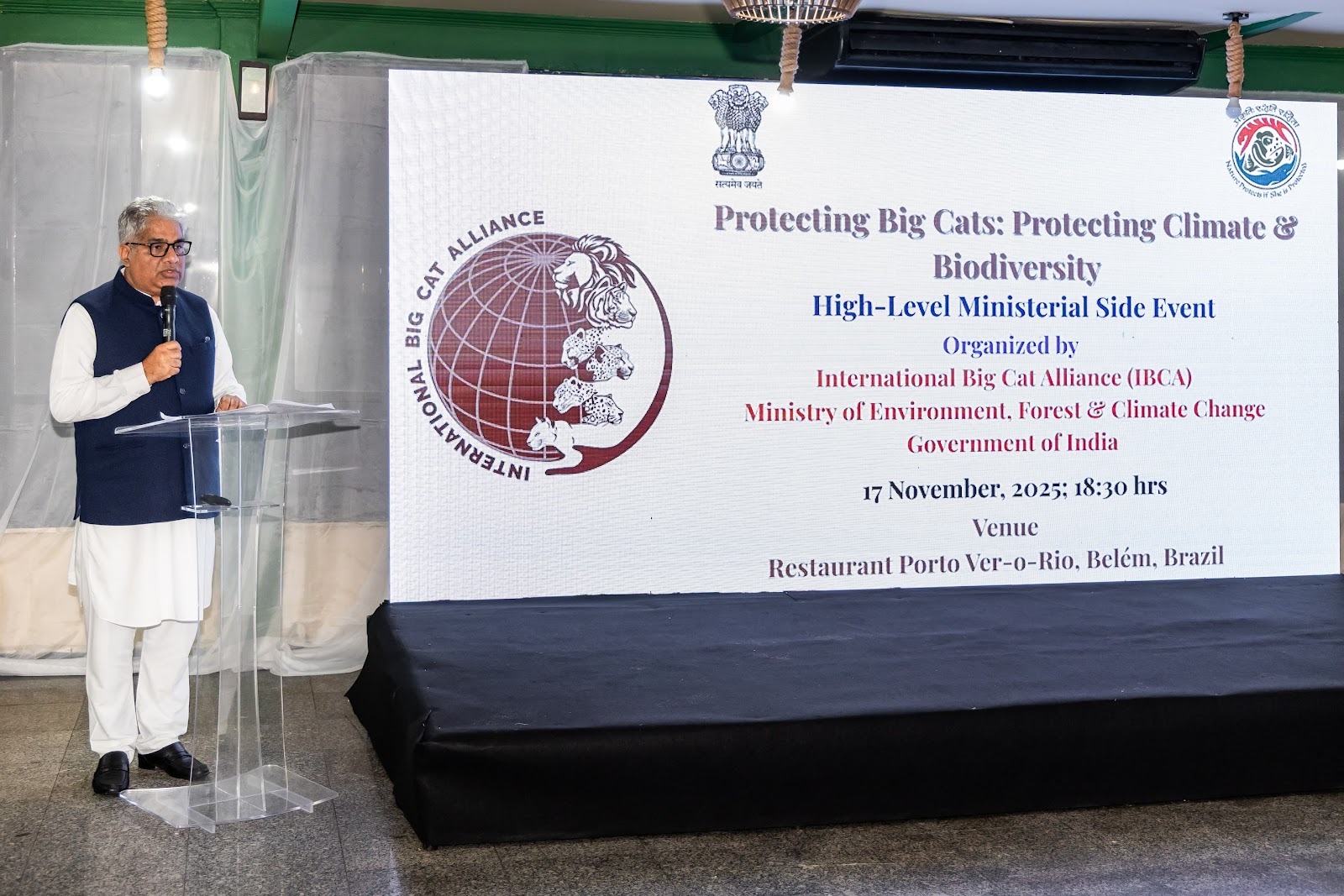
Union Minister for Environment, Forest and Climate Change, Bhupender Yadav, addressing the High-Level Ministerial Segment on the International Big Cat Alliance at UNFCCC CoP30 in Belém.
New Delhi to Host Global Big Cats Summit 2026
Belém, Brazil: Tigers stalking dense forests, Asiatic lions patrolling open grasslands, leopards slipping silently through rocky hills, and snow leopards navigating snow-covered peaks—these apex predators are more than wildlife icons.
At the High-Level Ministerial Segment on the International Big Cat Alliance (IBCA) during the 30th Conference of the Parties to the United Nations Framework Convention on Climate Change (CoP30) here, India highlighted the critical role of big cats in sustaining ecosystems and mitigating climate change. Union Environment, Forest and Climate Change Minister Bhupender Yadav represented India, and the session also included international participation, such as Dr Madan Prasad Pariyar, Minister of Agriculture and Livestock, Government of Nepal, reflecting the global scale of the initiative. India announced it will host a Global Big Cats Summit in New Delhi in 2026, inviting nations to exchange strategies and experiences for protecting these species and their habitats.
Big cats are apex predators, regulators of ecological balance, and sentinels of ecosystem health. Where they thrive, forests are denser, grasslands regenerate, water systems function, and carbon is stored efficiently in living landscapes. Declines in their populations can destabilise ecosystems, diminish natural carbon sinks, and weaken resilience to climate extremes. “What we often call ‘wildlife conservation’ is, in fact, climate action in its most natural form,” the Indian delegation stated, linking biodiversity protection directly with climate strategy.
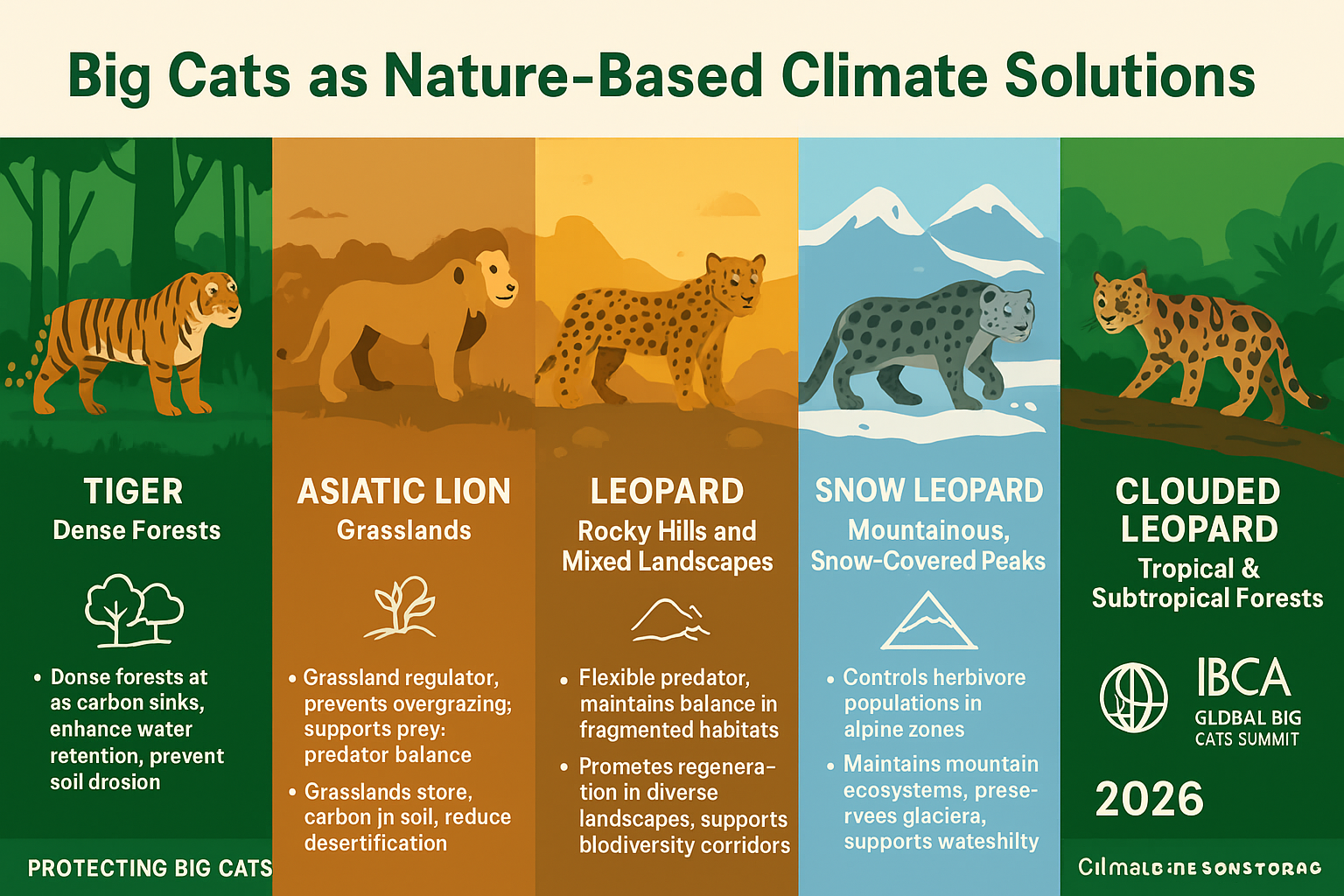
The intervention described big cat landscapes as nature-based climate solutions, highlighting how habitat conservation supports carbon sequestration, watershed protection, disaster risk reduction, climate adaptation, and sustainable livelihoods. India underscored that the International Big Cat Alliance can assist member countries through technical assistance, standardised tools, capacity building, south–south cooperation, and mobilisation of blended finance and biodiversity-carbon credit mechanisms, ensuring conservation is both strategic and globally coordinated.
India highlighted its own conservation achievements. The country is home to five of the world’s seven big cat species, has doubled its tiger population ahead of schedule, and continues to monitor the Asiatic lion population. Comprehensive wildlife databases now track tigers, lions, leopards, and snow leopards, while expanded protected areas, secure ecological corridors, and community-based conservation programs demonstrate how scientific monitoring and local engagement can work together to sustain species and landscapes while supporting human livelihoods.
Building on India’s domestic conservation successes, the intervention emphasised that no single country can safeguard big cats in isolation. These species traverse multiple countries and landscapes, making regional and global collaboration essential. Strengthening international networks, sharing best practices, and aligning national policies with cooperative frameworks can amplify the impact of local conservation efforts, ensuring that the ecological, climate, and livelihood benefits of big cat protection extend beyond national borders.
The International Big Cat Alliance currently includes 17 formal member countries, with over 30 additional nations expressing willingness to join. India aims to bring together all big cat range countries and other nations committed to biodiversity and climate security under a cooperative framework, promoting knowledge sharing, collective conservation efforts, and integration of big cat habitats into Nationally Determined Contributions (NDCs) as part of national and global climate strategies.
The Global Big Cats Summit in New Delhi in 2026 is expected to convene policymakers, scientists, conservation practitioners, and forest managers from around the world to exchange experiences, explore practical strategies, and strengthen partnerships for protecting habitats critical to biodiversity and climate resilience. India also released its report, One Earth, One Family, One Future: A Decade of Climate Action, which provides a comprehensive overview of national progress in climate mitigation, adaptation, climate finance, and sustainable development, while emphasising the interconnection between biodiversity and climate action.
By presenting big cat conservation as central to ecosystem health, climate strategy, and sustainable livelihoods, India’s intervention at CoP30 highlighted that the survival of these apex predators is inseparable from the health of forests, grasslands, and the broader climate system. Protecting big cats is, effectively, protecting the future of life on Earth—a call for global cooperation, action, and shared responsibility.
– global bihari bureau