 By Rahul Laxman Patil*
Bangladesh Nationalist Party Leader at Awami League Office Sparks Political Storm
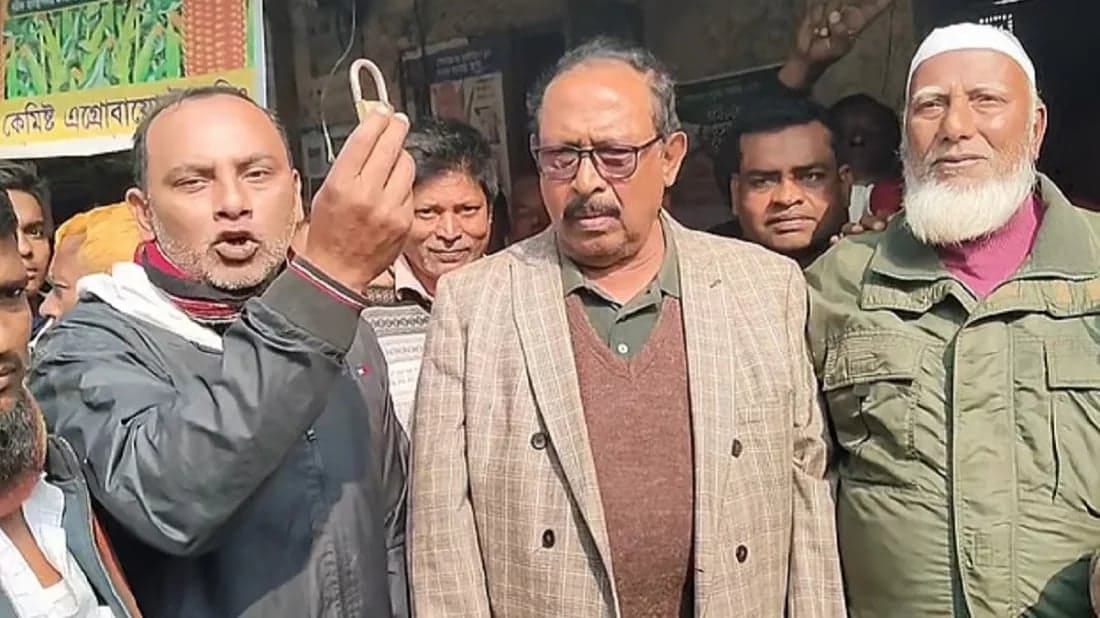
Panchagarh, Bangladesh: A political storm erupted in Panchagarh’s Chaklahat Bazar yesterday morning after a premises recognised locally as an office of the Bangladesh Awami League was reopened in the presence of Abu Daud Pradhan, the Bangladesh Nationalist Party upazila president and former chairman of Chaklahat Union Parishad. The event quickly drew attention across political circles, with a video of the reopening going viral on social media, capturing both local leaders and residents in a tense and animated gathering outside the building.
The approximately one-minute-and-thirty-five-second video shows Kamruzzaman, an Awami League functionary known locally as Bullet, speaking outside the premises and expressing gratitude, while roughly thirty people, including local political figures, watch closely. The imagery of leaders and residents gathered around the building underscores the high local stakes and the sharp public interest in the incident.
Abu Daud Pradhan, seeking to defuse speculation, told reporters that his presence was not politically motivated. “This was not a party decision. I acted only to prevent unrest and ensure order in the area,” he said, emphasising that rising tensions around the closed premises prompted his involvement. Pradhan also alleged that activists associated with Bangladesh Jamaat-e-Islami had earlier locked the premises and accused some parties of spreading misinformation regarding the reopening. He claimed that his involvement was aimed solely at maintaining peace in the locality, reiterating that tensions had been rising due to the closure of the building.
The reopening has sparked criticism from parts of the local political leadership. Some questioned the authority under which the building was reopened, warning it could be perceived as an attempt to normalise Awami League activities despite current restrictions. Others described the move as a pragmatic intervention at the local level to avoid confrontation rather than a political statement.
Political analysts and observers note that the incident highlights the complexity of grassroots politics in Bangladesh, where local-level decisions often intersect with broader national rivalries. Although no directive from the Bangladesh Nationalist Party leadership has been reported on lifting the ban on the Awami League, the episode has fueled debates over political coexistence, law-and-order considerations, and the role of local actors in a sensitive post-election environment.
The reopening of the premises has rapidly become a flashpoint, illustrating how local actions, amplified by social media, can resonate far beyond Panchagarh and shape perceptions of party competition nationwide.
*Political and Strategic Analyst