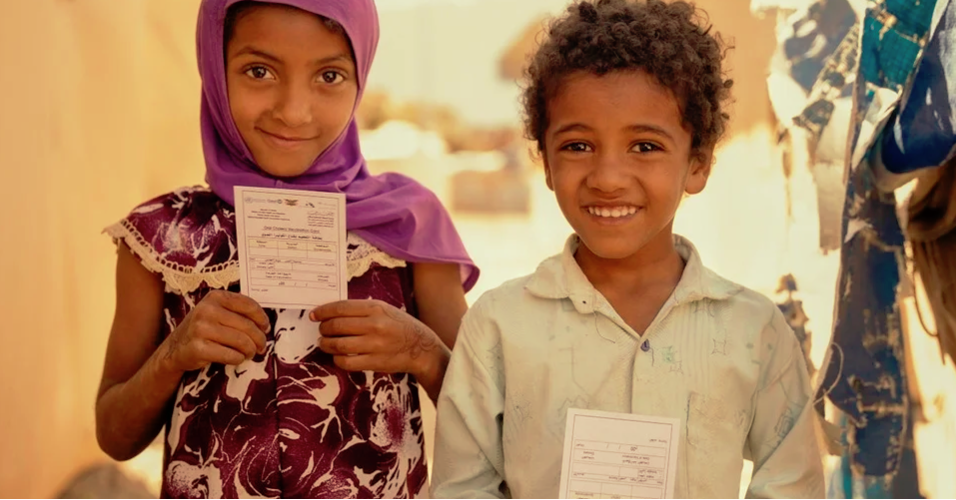
Photo credit: WHO EMRO Two children hold their vaccination cards after receiving the oral cholera vaccine in Sannah camp in Al Dhale'e, Yemen.
Geneva/New York: In 2024, millions of parents worldwide brought their children to clinics, health posts, and vaccination drives to protect them from preventable diseases, contributing to a global effort that saw 89% of infants—approximately 115 million children—receive at least one dose of the diphtheria, tetanus, and pertussis (DTP) vaccine, according to a new report from the World Health Organization (WHO) and the United Nations Children’s Fund (UNICEF). Another 85%, or about 109 million children, completed all three doses, marking a modest improvement from 2023, with 171,000 more children receiving at least one dose and one million more finishing the series. These numbers reflect the tireless work of families, health workers, and communities, yet they also reveal a troubling gap: nearly 20 million children missed at least one DTP dose, including 14.3 million “zero-dose” children who received no vaccines at all—1.4 million more than in 2019 and 4 million above the target for the Immunization Agenda 2030, a global strategy to expand vaccination coverage by 2030.
For parents in stable regions, getting children vaccinated is often a routine task, but for those in remote or conflict-affected areas, it’s a daunting challenge. In 26 countries facing fragility, conflict, or humanitarian crises—home to a quarter of the world’s infants—half of all unvaccinated children live. The number of unvaccinated children in these regions has surged from 3.6 million in 2019 to 5.4 million in 2024. A mother in a rural village might walk hours to find an open clinic, only to face vaccine shortages, while a father in a war-torn area risks unsafe roads to reach a health post.
Misinformation about vaccine safety, shrinking health budgets, and supply chain disruptions further complicate efforts. “Vaccines save lives, allowing individuals, families, communities, economies, and nations to flourish,” said Dr. Tedros Adhanom Ghebreyesus, Director-General of the World Health Organization (WHO). He warned that drastic cuts in aid and misinformation threaten decades of progress, urging countries to invest in local solutions to reach every child.
The data reveals stark inequalities. Of 195 countries tracked, 131 have consistently achieved at least 90% coverage for the first DTP dose since 2019, but only 17 countries with lower coverage in 2019 have improved over the past five years.
Meanwhile, 47 countries are stalled or declining, including 22 that previously met the 90% target but have since slipped. Even high- and upper-middle-income countries, once models of vaccination success, are seeing small drops in coverage, increasing the risk of disease outbreaks that strain already overstretched health systems. Measles coverage, for example, improved slightly, with 84% of children receiving the first dose and 76% the second, reaching two million more children than in 2023. However, this falls far short of the 95% needed to prevent outbreaks, leaving over 30 million children vulnerable. As a result, the number of countries experiencing large or disruptive measles outbreaks nearly doubled, from 33 in 2022 to 60 in 2024.
Despite these hurdles, there are stories of hope. In 57 low-income countries supported by Gavi, the Vaccine Alliance, a global partnership to improve vaccine access, 650,000 fewer children were unvaccinated or under-vaccinated in 2024. Health workers in these nations have expanded vaccines for diseases like human papillomavirus (HPV), meningitis, pneumococcal disease, polio, and rotavirus. For adolescent girls, HPV vaccine coverage rose to 31% in 2024, up from 17% in 2019, largely due to single-dose schedules in some countries. While still far from the 90% target for 2030, this progress means more girls are protected from cervical cancer. “In 2024, lower-income countries protected more children than ever before,” said Dr. Sania Nishtar, Chief Executive Officer of Gavi, the Vaccine Alliance, though she noted that population growth, fragility, and conflict remain major obstacles to equity.
Catherine Russell, Executive Director of the United Nations Children’s Fund, emphasised that no child should die from a preventable disease, calling for urgent action to overcome barriers like shrinking budgets, fragile health systems, and misinformation.
With funding gaps, growing instability, and rising vaccine misinformation threatening progress, WHO and UNICEF urged governments and partners to take specific steps: close the funding gap for Gavi’s 2026–2030 strategy to protect millions in lower-income countries and bolster global health security, strengthen immunization in conflict and fragile settings to reach zero-dose children and prevent deadly outbreaks, prioritize locally-led strategies and domestic investment to embed immunization in primary health care, counter misinformation with evidence-based approaches, and invest in robust data and disease surveillance systems to guide effective vaccination programs. For the millions of parents striving to protect their children, these actions are critical to ensuring no child is left behind.
– global bihari bureau