 By Nava Thakuria*
Short films, deep scars, louder hope
When Cinema Refuses to Stay Silent at Jyoti Chitraban
Guwahati: On the evening of November 29, 2025, the auditorium at Jyoti Chitraban Film Studio in Kahilipara wore a different kind of energy. No red-carpet glamour, no paparazzi flashbulbs—just the steady glow of oil lamps and the quiet anticipation of people who believe films can do more than sell tickets.
Outside the main entrance, the November air carried the faint smell of wet earth from an afternoon shower, mixed with burning camphor and fresh marigold garlands strung across the gate. By 5:45 pm, college students, retired teachers, local journalists, young filmmakers clutching pen drives, and a few senior Rashtriya Swayamsevak Sangh (RSS) volunteers in white kurtas were already streaming into the courtyard. A large portrait of Bharat Mata dominated the backdrop, flanked by three life-size framed photographs: Dr Bhupen Hazarika in his trademark white cap and muffler, Zubeen Garg frozen mid-song with eyes half-closed, and flautist Deepak Sarma cradling his long bamboo flute. Five polished brass oil lamps sat on a low wooden table, wicks already trimmed and soaked in ghee.
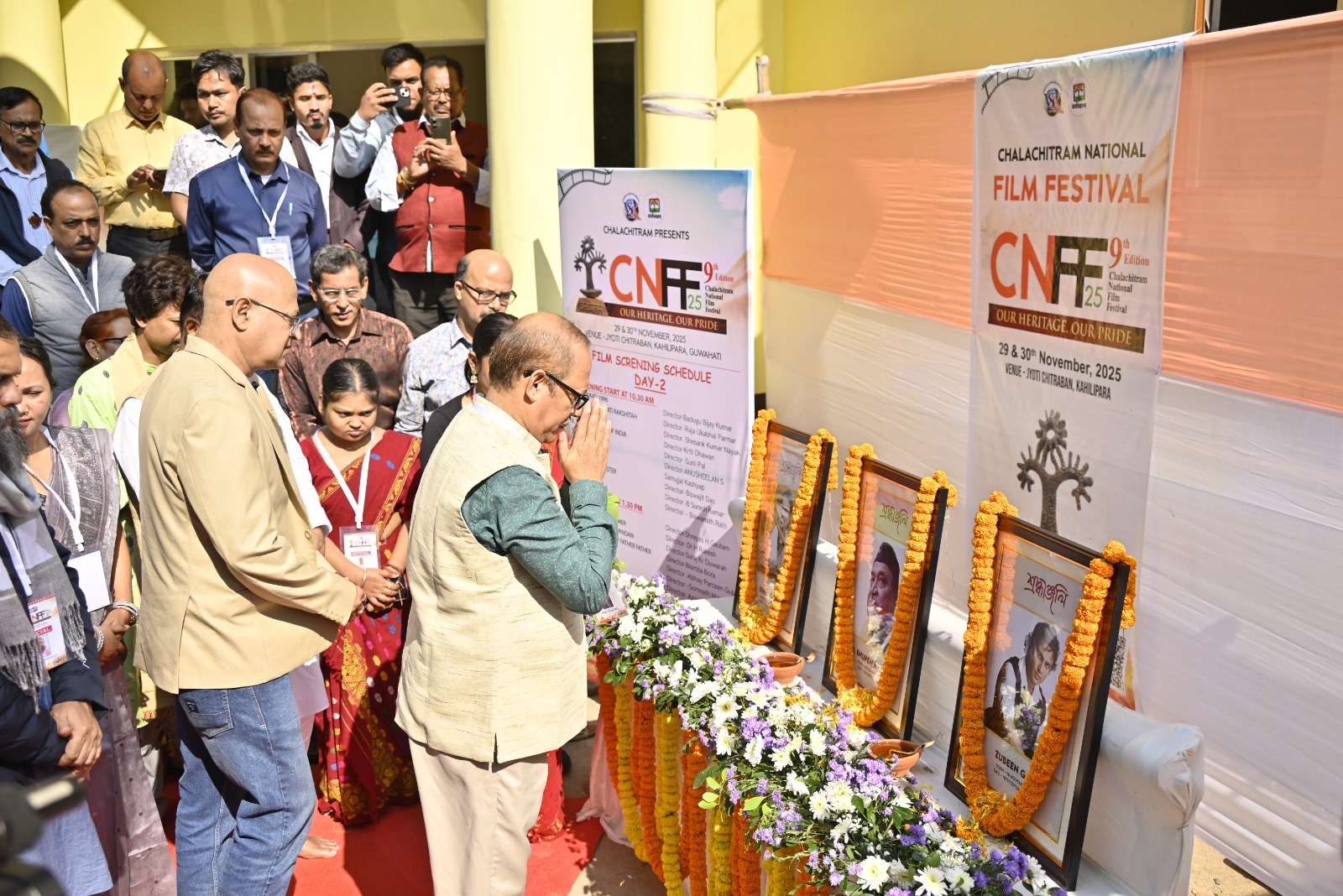
At exactly 6:00 pm, Dr Sunil Mohanty walked in wearing a simple cream kurta-pyjama and a light shawl against the evening chill. He bent down, touched the floor in pranam, then lit the lamps one by one—first before Bharat Mata, then before each of the three Assamese icons. The flames rose straight in the still air, throwing golden reflections across the brass and onto the faces of the roughly 250 people now seated inside the 300-seat auditorium. The moment the last lamp was lit, the organisers played a 45-second excerpt of Dr Hazarika’s “Moi Eti Jajabor.” The hall went completely silent except for the gravel in the legend’s voice.
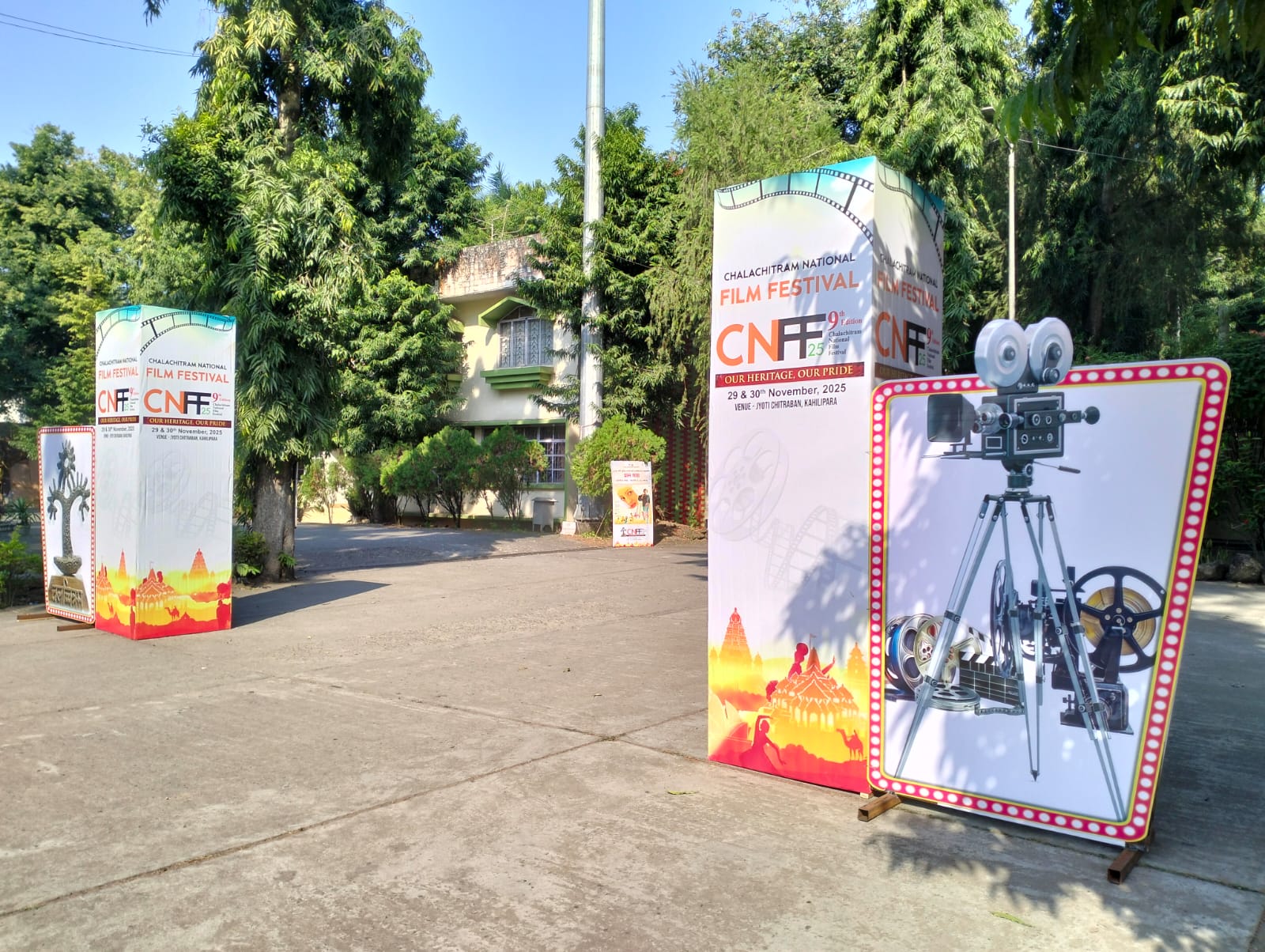
Organised by Chalachitram (the film wing of Vishwa Samvad Kendra-Assam), the two-day 9th Chalachitram National Film Festival (CNFF-25) is presenting 32 short films and documentaries. The competitive section is open only to filmmakers from the eight North-Eastern states; a non-competitive section showcases works from the rest of the country. The official opening film at 7:15 pm was Bharat Bala’s Aham Bhartam. The festival will close on 30 November with Piyush Thakur’s The First Film.
With the traditional inauguration complete, Dr Mohanty took the microphone beneath a long horizontal banner in Assamese, English and Hindi that read “Our Heritage, Our Pride.” He spoke for twelve measured minutes without notes. “Cinema today is too often reduced to weekend entertainment and box-office crores,” he began. “We seem to have forgotten that this is the most powerful mass medium ever invented. If cinema is used only for earning money with entertainment alone, we are wasting it. It has a far greater responsibility—to awaken national consciousness, to pay homage to a civilisation that has survived thousands of years, to fight social discrimination, to protect our rivers and forests, to rebuild civic sense, and to remind every generation of the sanctity of family bonds.” The audience broke into sustained applause when he praised Chalachitram for deliberately choosing the short-film format and for giving North-East filmmakers their own exclusive competitive arena.
The flame Joymoti lit still burns in Guwahati
The North-East has never had it easy with cinema. Ninety years ago, a young aristocrat named Jyotiprasad Agarwala pawned his wife’s jewellery, studied at Germany’s UFA studios, and returned to build a bamboo-and-thatch studio near Tezpur. In 1935, he released Joymoti—India’s first Assamese-language talkie, shot during the monsoon with a generator that died every twenty minutes and a fifteen-year-old widow as heroine who was later ostracised by society. The British banned the film for its nationalist fire; cinemas refused to screen it. Undeterred, Jyotiprasad loaded the print onto bullock carts and showed it under banyan trees across villages, powered by truck batteries. He made only two more films before money and health ran out, but he had already done the impossible: given Assam its own cinematic voice. Bhupen Hazarika, Jahnu Barua, Bhabendra Nath Saikia—all later giants stood on the foundation he laid with elephant-back cameras and unbreakable conviction. Tonight, in the very studio complex named after him, that history felt close enough to touch.
At 6:30 pm, the house lights dimmed once more. As a special tribute to Zubeen Garg—one of the three cultural icons honoured minutes earlier—the festival rolled its first reel: the 2008 Assamese blockbuster Mon Jai, directed by Moirangthem Maniram and starring Zubeen himself opposite Shyamontika Sharma. It tells the story of a young man from rural Assam who falls in love with a city girl while chasing his musical dreams, carried along by Zubeen’s own evergreen songs like “Junaki Porua” and “Pakhi Pakhi.” When Zubeen roared onto the screen on a black Pulsar, helmet under one arm, the college crowd erupted in cheers and whistles.
The official curtain-raiser at 7:15 pm was Bharat Bala’s Aham Bhartam. In its compact fifteen minutes, the film stitches sweeping aerial shots of the Himalayas, the Thar desert and the Sangam – the confluence of Ganga, Yamuna and the mythological Saraswati rivers – at Prayagraj with the voices of farmers, soldiers and schoolchildren reciting lines from ancient texts and the Constitution, ending on a single unbroken shot of a child lighting a lamp in a remote Arunachal village as the national anthem swells. The lights came up to thirty seconds of complete silence, followed by a standing ovation.
The festival will close tomorrow evening with Piyush Thakur’s twenty-eight-minute The First Film. Shot in black-and-white, it recreates the historic day in 1913 when D.G. Phalke screened Raja Harishchandra at Bombay’s Coronation Theatre, intercutting period re-enactments with present-day shots of the same locations now swallowed by high-rises, and ending inside a Pune laboratory where a young archivist restores the last surviving print, frame by frame.
Between these bookends, the real heart of CNFF-25 beats in the competitive section—thirty-two short films and documentaries made exclusively by filmmakers from the eight North-Eastern states. Over two days, the screens have been alive with stories that refuse easy comfort. There is Pranabjit Saikia’s Maa, nineteen minutes set inside a single bamboo hut on a monsoon night, where a widowed tea-garden worker discovers her son has joined an ULFA-I camp and can only cry silently as rain hammers the tin roof. Utpal Borpujari’s The Last Rhino follows a Kaziranga forest guard who must choose between shooting a poacher and letting him escape with the horn of the very rhino the guard named after his dead sister.
Takhe Tamo’s Borderline, shot in a Monpa village of Arunachal, traces the wordless friendship between a Hindi-speaking Central Reserve Police Force (CRPF) jawan and a schoolgirl who speaks only Tshangla, ending on the morning the jawan is transferred. Rajiv Saikia’s Kopili shows a seventy-year-old fisherman and his granddaughter paddling the dying river, collecting dead fish in plastic bags as evidence against coal-mine pollution. Pradip Kurbah’s Iewduh lingers in Shillong’s Bara Bazar with an elderly Khasi woman selling bamboo baskets while concrete malls rise around her; the final shot is her basket inside a museum glass case labelled “Khasi heritage artefact.”
Manipur’s Ronel Haobam reconstructs the 2004 protest of the Mothers of Manipur—twelve Meira Paibi women who stripped naked before Kangla Fort—using only archival audio and present-day interviews with the surviving mothers. From Nagaland, Sesino Yhoshü’s Silent River follows a young Ao boy hiding an injured Amur falcon in his school bag while the village prepares its annual hunt. Tripura’s Bamboo Blooms documents teenage girls in an unelectrified village who secretly build a bamboo wind turbine from YouTube instructions until a single LED bulb finally glows in their dormitory. Mizoram’s Mapuia Chawngthu unearths the forgotten story of Mizo labourers in World War I France through sepia re-enactments and newly discovered letters in Mizo script. And Bhaskar Jyoti Das’s tender twelve-minute Gamoosa captures a Bodo weaver teaching his city-bred son the sacred patterns on the night before the boy leaves for Bengaluru.
These are only ten of the thirty-two titles, yet the range is staggering—grief, defiance, quiet pride, and stubborn hope, all told in languages from Ao Naga to Kokborok, all under half an hour. Audience reactions have been raw: tears after Mothers of Manipur, heated arguments in the courtyard after The Last Rhino, stunned silence when the single bulb lights up in Bamboo Blooms.
Festival secretary Bhagawat Pritam said the final selection emerged only after days of sometimes heated debate by the preview committee—National Award-winning director Jhulan Krishna Mahanta, veteran filmmaker Bibhu Dutta, and cinematographer Hiten Thakuria. A separate jury—Kerala’s Vijayakrishnan, Manipur’s Maipaksana Haobam, and Guwahati’s Debajit Gayan—now carries the difficult task of choosing the winners.
The valedictory function and award ceremony will take place tomorrow, 30 November, at 6:30 pm with Assam Legislative Assembly Speaker Biswajit Daimary presiding, cultural personality Pranjal Saikia on stage, and the hall expected to be packed. Winners will receive trophies, certificates and cash prizes, confirmed VSK-Assam secretary Kishor Shivam.
As the first day ended around 9:45 pm, the courtyard lights flickered on beneath the old banyan tree. Small groups lingered, some still humming Zubeen’s songs, others replaying in their heads the image of twelve naked mothers or a single LED bulb glowing against the darkness. A 22-year-old director from Dhemaji quietly told a friend, “My grandfather carried the generator for Jyotiprasad’s unfinished *Rupohi* when he was twelve. Tonight I screened my short here. The circle feels complete.” Paper cups of tea and jalebi passed from hand to hand. For once, no one was checking box-office numbers.
All screenings and events on 30 November remain free and open to the public at Jyoti Chitraban Film Studio, Kahilipara.
*Senior journalist