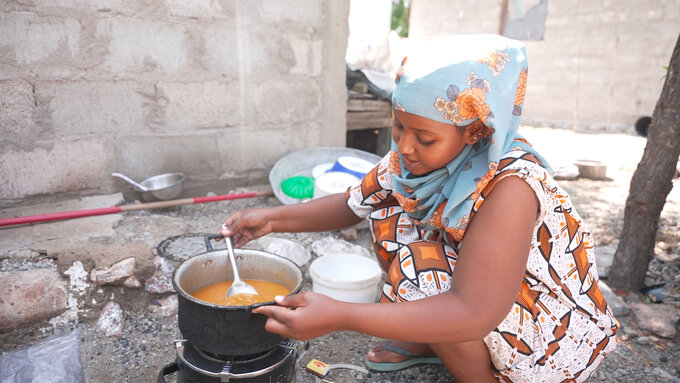
Hilina was born in the Ali-Addeh camp in Djibouti. It is the only home she has ever known. 17 000 people live in this camp alone. ©FAO/Nick Oloo
In the heart of the Ali-Addeh refugee camp in Djibouti, where the sun scorches the earth and hope can feel as scarce as shade, Hilina crouches next to a compact and energy-efficient stove, stirring her soup with a smile that defies her surroundings. The aroma of her meal fills the air, unmarred by the choking smoke that once clouded her days.
“This stove is so amazing; it’s burning without any smoke and cooking very well,” says Hilina with genuine joy, her voice a beacon of resilience amidst a landscape that doesn’t easily lend to this emotion.
Hilina, a young woman with eyes that carry both strength and stories, is one of more than 17,000 residents of the Ali-Addeh camp. Born within its dusty confines, this barren settlement is the only home she has ever known. Her family fled the violence of Ethiopia in 1991, seeking safety in this remote corner of Djibouti, where survival is a daily act of courage.
The Ali-Addeh camp is a stark, desolate expanse that butts up against rugged mountains, which seem to watch over the settlement like stoic sentinels guarding a fragile sanctuary. Here, families from Somalia, Ethiopia, Eritrea, and Yemen—uprooted by conflict, persecution, and hardship—continue to cook, care, and hope, many for more than a decade. Their lives are woven into the fabric of this temporary home, where dreams of return flicker but often fade.
According to the United Nations High Commissioner for Refugees (UNHCR), nearly 140 million people around the world are expected to be forcibly displaced and stateless by 2025, driven by an unrelenting tide of conflict, violence, persecution, and climate-related shocks—challenges compounded by economic turbulence that deepens their plight.
In East Africa alone, over 5.5 million refugees and asylum seekers, alongside nearly 22 million internally displaced people, navigate lives in limbo. Most reside in camps or settlements, often for years, because returning home is not an option. For many, like Hilina, “home” is a memory they’ve never touched.
Since her mother’s passing, Hilina has shouldered the weight of household responsibilities alone. Cooking for her family is among the main ones, a task that once demanded a long and dangerous trek to collect firewood under the relentless Djibouti sun.
“The journey to collect wood takes a long time. Starting in the afternoon, to the night. It is very far!… Also, children they leave school to collect wood,” she said, her words heavy with the memory of endless walks and lost opportunities.
In places like the Ali-Addeh camp, long-term displacement puts immense pressure on scarce natural resources and can spark tension between displaced and host communities. Forests, water resources, arable land: all of these valued resources are strained by camps that might go up overnight but persist for decades, their inhabitants caught in a cycle of survival that depletes the land and frays community bonds.
“The challenges that these communities face day by day are access to livelihoods, protection and health risks, and not least, tensions between the host communities and the camp dwellers themselves,” said Indira Joshi, Emergency and Resilience Officer at the Food and Agriculture Organization of the United Nations (FAO). “What is very worrying is the protracted nature of this displacement. So, the question is, what are we, the international community, doing about this?”
One powerful answer emerges from the Greening the Humanitarian Response (GHR) project, a beacon of innovation implemented by FAO in collaboration with UNHCR and funded by the European Union. This initiative empowers displaced people, host communities, and local authorities to manage natural resources more effectively and improve energy access for cooking and livelihoods, transforming daily struggles into opportunities for sustainability.
Traditional cooking methods are not only resource-consuming and time-consuming, they are also potentially hazardous, blanketing homes in harmful smoke and exposing families to health risks that linger like shadows.
To address this, the GHR project has distributed energy-efficient cookstoves, a simple yet revolutionary tool that has changed lives like Hilina’s.
“It [the stove] protects us from going far away into the mountains to collect firewood… so now life is easy,” said Hilina, her smile reflecting a newfound sense of freedom and safety.
Beyond cookstoves, the project also promotes the use of *Prosopis juliflora*, an invasive plant species, to craft sustainable charcoal for cooking. This ingenious approach reduces the need for firewood, curtails deforestation, and helps manage Prosopis, turning an environmental challenge into a resource.
“The fact that we are now trying to transform the Prosopis into charcoal is very important so that we limit the degradation of natural resources but also use it rationally,” said Kwami Dzifanu Nyarko-Badohu, FAO Representative in Djibouti, his voice underscoring the urgency of balancing human needs with environmental stewardship.
Arturo Gianvenuti, FAO Agroecological Engineer, notes that the GHR project has also generated valuable baseline data on environmental impact and energy needs. This data lights the way for more cost-effective interventions that support sustainable forest-based value chains, ensuring that solutions are as enduring as the challenges they address.
The Greening the Humanitarian Response project offers a scalable model for protecting the environment while improving lives—bringing cleaner energy, restored ecosystems, and greater resilience to the people living in some of the world’s most vulnerable situations. So far, the project has sparked change in Djibouti, Somalia, Tanzania, and Uganda, offering a blueprint for hope where despair once took root. For Hilina and countless others, it’s not just about cooking a meal—it’s about reclaiming time, health, and dignity in a world that often offers none.
Source: The FAO News And Media Office, Rome
– global bihari bureau