Photo source: @proemliss|X
Border Battle Escalates: Cambodia–Thailand Conflict Deepens
Peace Accord Collapses: New Wave of Cambodia–Thailand Fighting
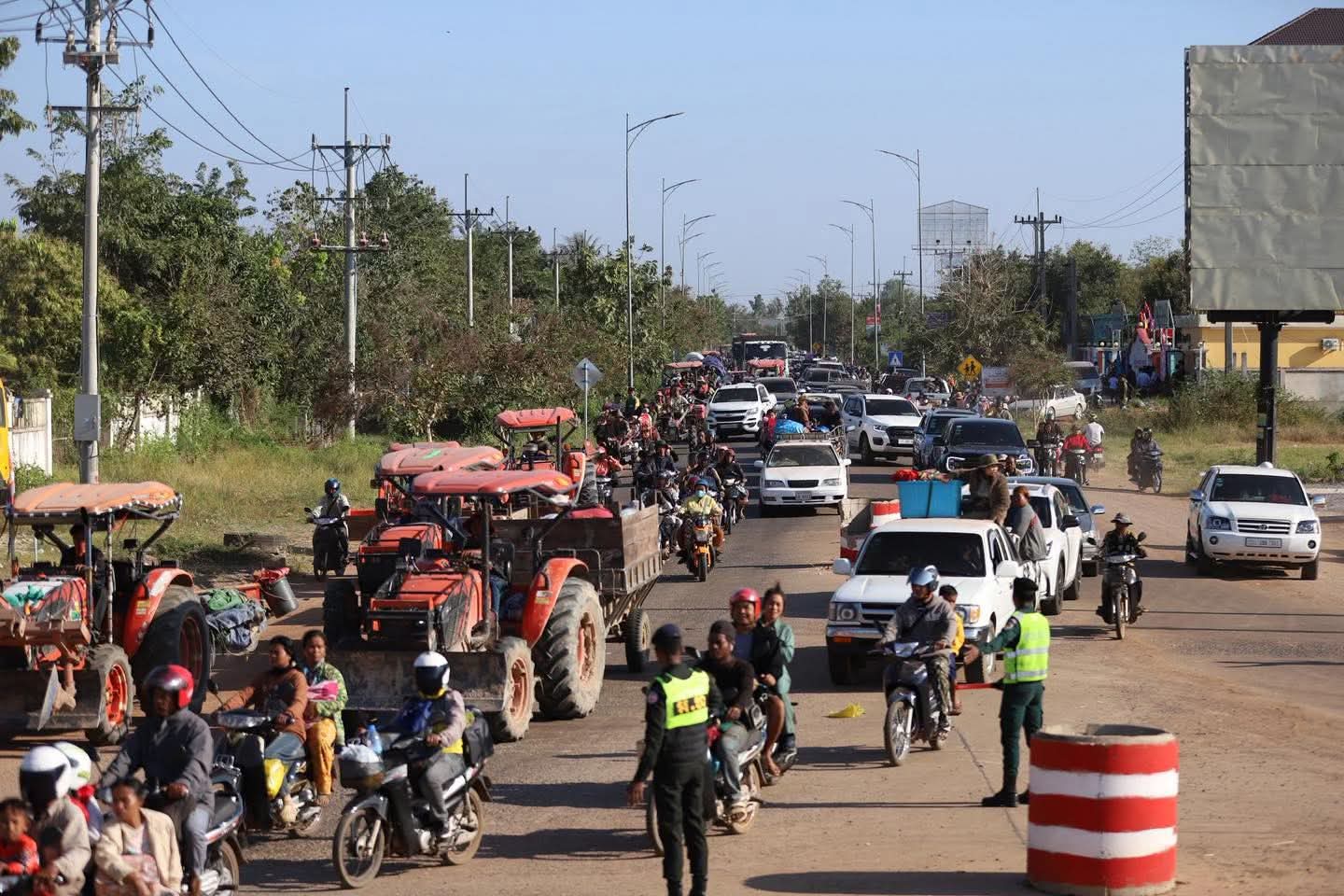
Bangkok/Washington: Heavy fighting continued throughout the day today, along the Cambodia–Thailand frontier, as artillery exchanges, drone strikes and ground skirmishes expanded into new sectors overnight, shattering what remained of a ceasefire that had barely lasted six weeks. Thousands poured out of border villages before dawn, fleeing along cratered roads toward inland towns, as columns of smoke rose from the highlands where both armies have deployed reinforcements. Cambodian officials reported multiple civilian casualties across three provinces, while Thai sources confirmed new military losses in operations that Bangkok describes as defensive and retaliatory in nature.
The latest escalation began after a renewed Thai assault on Cambodian positions yesterday afternoon, hours after a mortar strike killed a Thai soldier during earlier clashes. Cambodia insists it did not initiate hostilities and that its forces engaged only after Thai troops crossed into disputed territory. Thailand rejects this account and accuses Phnom Penh of systematically violating the ceasefire by planting mines and firing rockets into frontier zones. Neither narrative has been independently verified, but both governments appear to have abandoned diplomatic restraint in favour of military resolve, raising fears that the violence could spiral beyond border districts.
Washington reacted swiftly. In a statement issued today, the United States Secretary of State Marco Rubio expressed concern over mounting casualties and urged an immediate end to hostilities. The appeal called for the protection of civilians and for both sides to return to the terms of the Kuala Lumpur Peace Accord, signed on October 26 by the Cambodian and Thai prime ministers and witnessed by the U.S. and Malaysia in Putra Jaya. Diplomats familiar with the negotiations say the accord had been designed precisely to prevent a relapse into open fighting, binding both sides to withdraw heavy weapons from contested areas, reopen joint border commissions and accept an observer mechanism to verify compliance. Its collapse now raises questions about whether any meaningful enforcement framework existed beyond the signatures and cameras that sealed the agreement.
The failure of the accord is less surprising to analysts who note that it attempted to manage symptoms rather than resolve the underlying cause. The border dispute is rooted in colonial-era mapmaking, when French surveyors drew lines that placed a series of temples and highland plateaus under Cambodian jurisdiction. Thailand has long rejected those maps, arguing that natural watershed boundaries should prevail. Even a ruling from the International Court of Justice in the 1960s — which confirmed Cambodian sovereignty over one of the most prominent temples — left much of the surrounding terrain undefined. The result has been a century-long fault line where national memory, historical grievance and political opportunism blur into military posturing.
Border clashes have therefore tended to erupt in cycles, most dramatically between 2008 and 2011 when both armies sustained casualties in battles over temple zones. A new phase began in 2025, when a midsummer confrontation displaced hundreds of thousands and pushed regional governments to intervene diplomatically. The October deal briefly rekindled hope that a final settlement might be within reach. But mistrust remained embedded on both sides, and neither military appeared willing to relinquish strategic high ground while the underlying territorial claims remained unresolved.
For civilians, the stakes are immediate rather than historical. Families have abandoned livestock, schools have emptied overnight, and makeshift shelters are being prepared as fighting intensifies. Local administrators on both sides admit they cannot guarantee safety if the conflict widens, and humanitarian agencies warn that shortages of food, fuel and medical supplies could emerge within days if the exodus continues.
As gunfire echoes across the border region this evening, neither government shows readiness to step back. Bangkok argues it will not negotiate under fire, and Phnom Penh maintains that territorial sovereignty is non-negotiable. Unless both sides allow the ceasefire mechanism to be rebuilt — or accept external monitoring they so far resisted — the frontier risks becoming the arena for a prolonged confrontation, where civilians pay the price for maps and memories drawn long before any of them were born.
– global bihari bureau