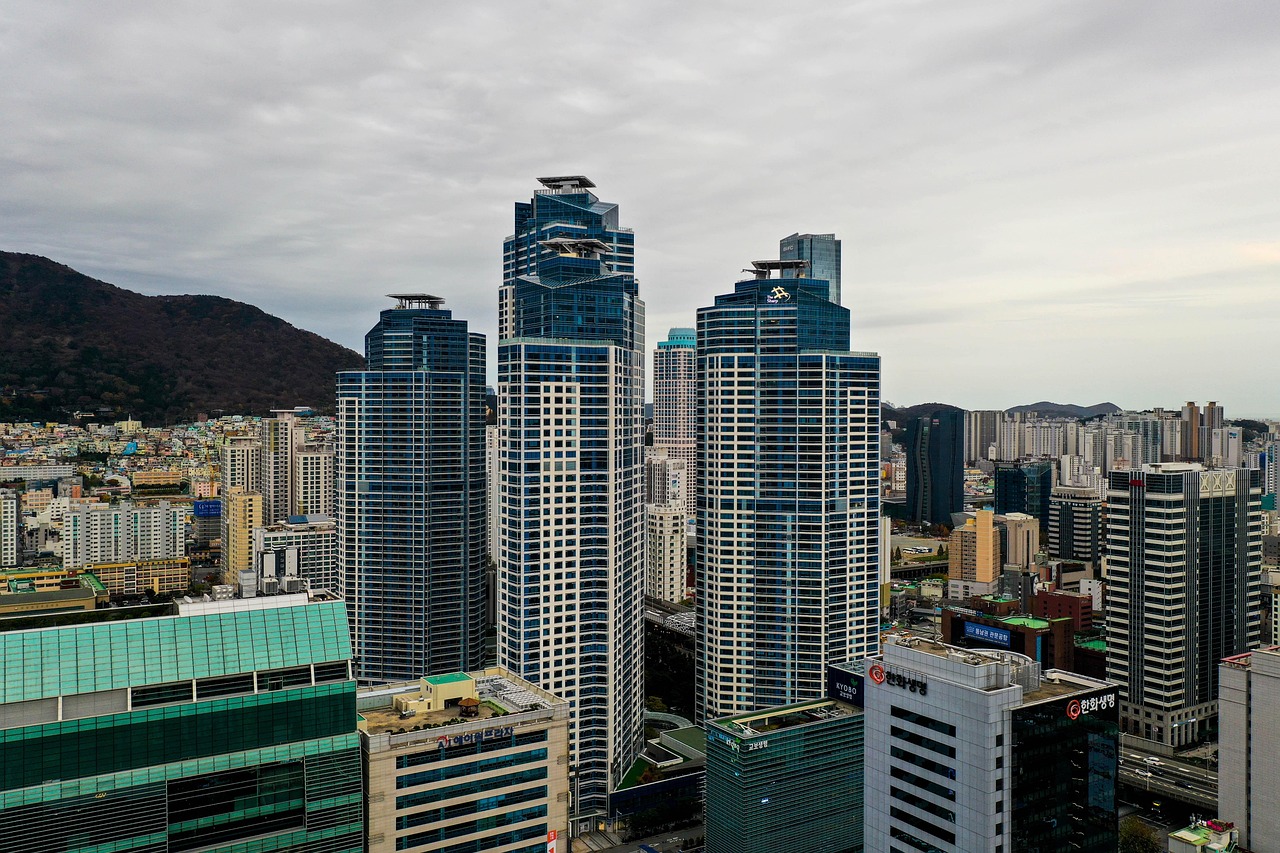
Busan cityscape, South Korea
 By
By Beijing’s Verbal Chess Ahead of Busan
As Washington and Beijing edge toward their first presidential meeting since 2019, diplomacy is turning into a duel of words. Beneath Beijing’s poised restraint lies a choreography of control — deft, deliberate, and deflective — shaping the stakes of Busan’s coming handshake.
As autumn winds sweep through Asia’s corridors of diplomacy, a high-stakes encounter brews in Busan, South Korea. On October 30, 2025, the United States (U.S.) President Donald Trump and Chinese President Xi Jinping will meet for the first time since Osaka 2019 — this time on the trade-soaked stage of the Asia-Pacific Economic Cooperation Chief Executive Officer (APEC CEO) Summit.
Their handshake comes atop a fragile scaffold built in Kuala Lumpur, where, In their fifth round since May’s Geneva thaw, held on the sidelines of the Association of Southeast Asian Nations (ASEAN) Summit on October 25-26, 2025, U.S. Treasury Secretary Scott Bessent and Chinese Vice Premier He Lifeng sparred through a weekend of talks on tariffs, rare earths, soybeans, fentanyl, and more.
Yet beneath the cordial communiqués, Beijing’s today briefing revealed something subtler: a strategy of deflection dressed as dialogue. Foreign Ministry spokesperson Guo Jiakun, clipped and controlled, parried every question with the same refrain — sovereignty is sacrosanct, specifics will be deferred — leaving observers to wonder whether China’s restraint was discipline or disguise. Terse on trade’s fine print, unyielding on sovereignty’s sanctity, Jiakun wove a veil to shield China’s flanks, casting adversaries into the glare while taming disputes with artful ambiguity.
Hours before, US Secretary of State Marco Rubio’s hotline call with Foreign Minister Wang Yi heralded the “importance of the U.S.-China relationship,” a faint breeze of thaw before the gathering storm in Busan. Yet Beijing’s measured cadence, more shadow than substance, seeks leverage over persuasion—framing concessions as tethered to “mutual respect,” while domestic drums demand displays of unbowed resolve. This choreography—neutralising criticism without mending rifts, cloaking intent in procedural mist, and spinning divergent tales for China’s hawks and foreign envoys—narrows the path to accord at Busan, a deft sleight that holds the stage but risks a stumble into mistrust.
Markets leapt 300 Dow points on trade’s whispered promise, yet beneath this shimmer, geopolitical fractures, etching 0.5% from global GDP yearly since 2018, betray a maelstrom masked by veiled vows. Beijing’s deflection, an evolved instrument of containment, buys short-term sanctuary but courts long-term peril, a dance where narrative reigns, yet clarity wanes, threatening to unravel the delicate threads of trust before Xi and Trump take the spotlight.
The South China Sea, a churning crucible of rival maps, roared anew at the ASEAN-US Summit in Vientiane, Laos. On October 26, Philippine President Ferdinand Marcos Jr. voiced unbridled regret over China’s “dangerous manoeuvres and coercive use” of equipment, imperilling Philippine personnel, vessels, and aircraft near Scarborough Shoal, or Bajo de Masinloc, where Beijing’s “nature reserve” designation ignited Manila’s cry of sovereignty shredded. Marcos, wielding the Philippines’ 2026 ASEAN mantle, decried violations of the 2016 arbitral award, which upheld Manila’s exclusive economic zone and traditional fishing rights under the United Nations Convention on the Law of the Sea (UNCLOS), urging a “legally binding” code of conduct after two decades of desultory drafts—a pivot to multilateral tides amid bilateral shipwrecks. Guo recast the expanse as a “common home” for China and ASEAN, pinning strife on “the Philippines’ deliberate infringement and provocative activities”; he vowed to “firmly safeguard” China’s sovereignty and rights, while offering dialogue and swifter Declaration on the Conduct of Parties in the South China Sea (DOC) implementation—an olive branch laced with steel, masking Beijing’s dismissal of the Hague verdict and third-party mediation.
This rhetorical reversal, textbook in its charge-flipping, isolates Manila, tethered to China’s $3 trillion trade orbit for 20% of ASEAN’s commerce; it casts a wary shadow over Busan, where Xi may barter fewer US patrols for trade easings, testing Trump’s willingness to trade security commitments for economic wins in a region pulsing with over $3 trillion in maritime trade.
That same day, today, twin US Navy tumbles—an MH-60R Seahawk helicopter from Helicopter Maritime Strike Squadron 73 plunging at 2:45 p.m., followed 30 minutes later by an F/A-18F Super Hornet from Strike Fighter Squadron 22, both amid routine drills off the USS Nimitz en route from Middle East duties, with all five crew plucked safely from the waves—prompted Guo to note media reports and offer “humanitarian” aid if sought. Trump, citing mechanical gremlins, quelled foul-play whispers. Guo pivoted, accusing the US of “flexing muscles” with frequent vessels and aircraft as the “root cause” of regional instability, sidestepping China’s October 12 Thitu Island ramming and any nod to deconfliction protocols or safety synergies.
This deft blend of feigned sympathy and swift censure recasts mishaps as manifestations of US meddling, amplifying Beijing’s narrative of external provocation to justify grey-zone escalations like Thitu’s ramming, tilting Busan’s security discourse toward China’s script of stability on its terms.
Echoes of empire ripple through Taiwan’s contested narrative. On October 24, China’s National People’s Congress Standing Committee anointed October 25 as “Commemoration Day of Taiwan’s Restoration,” marking the 80th anniversary of Japan’s 1945 Taipei surrender to Republic of China envoys, ending five decades of colonial chains. Guo evoked the “14 years of strenuous struggle with tremendous sacrifice” in the Chinese People’s War of Resistance, restoring Taiwan and Penghu Islands to China’s “sovereign jurisdiction”—“irrefutable evidence” of indivisibility, a “shared memory of all Chinese” embodying resolve to uphold the one-China principle and defend territorial integrity. Timed for this wartime echo, it rallies “Chinese sons and daughters at home and abroad, including Taiwan compatriots,” affirming the Communist Party of China’s (CPC) “firm resolve” for “complete reunification” while urging global rejection of “Taiwan independence” separatist activities—an appeal to honour World War II (WWII) fruits.
This narrative, woven with anti-fascist legitimacy and post-war pacts, silences discourse on Taipei’s de facto self-governance since 1949; it stokes nationalism to counter domestic economic headwinds, with China’s Q3 2025 GDP growth slowing to around 4.8% year-on-year according to official data, and erects rhetorical ramparts before Busan, where US arms sales topping $18 billion loom as tinder. Taiwan, marking Retrocession Day with Kinmen’s Guningtou Victory Memorial since restoring holiday status in May, branded the decree a historical hijack, noting no People’s Republic of China (PRC) rule post-1949—a chasm of perception that may inflame Busan, as Rubio’s “nonnegotiable” stance on Taiwan challenges Trump’s dealmaker instincts against alliance imperatives.
Europe’s frost sharpens the diplomatic stage. Germany abruptly shelved Foreign Minister Johann Wadephul’s inaugural Beijing visit on October 25, after China offered only a single powwow with Wang Yi, redirecting him to NATO’s Mark Rutte and India’s Commerce and Industry Minister Piyush Goyal. Wadephul, a Chancellor Joachim-Friedrich Martin Josef Merz cabinet’s stalwart since May, sought to loosen China’s rare-earth and semiconductor curbs—choking Europe’s electric vehicle (EV) ambitions—and press Beijing to rein in Russia’s Ukraine campaign; the snub, against a $200 billion trade tapestry, signals deepening rifts over “de-risking,” Indo-Pacific tensions, stalled market reforms, and human rights shadows. Guo’s velvet refrain—“China always views and grows its relations with Germany from a strategic and long-term perspective” as major economies where “cooperation is mutually beneficial”—called for “mutual respect, equality, and win-win cooperation” to advance ties on the “right track,” sidestepping Berlin’s thorns and wielding silence as a deliberate policy to douse escalation, while both sides eye rescheduling amid European Union (EU) probes into Chinese overcapacities. This soft-shoe sidestep, echoing EU tariff clashes, whispers warnings of a Western pincer, arming Beijing to cast Busan as a bulwark against collective containment through trade truces; Wadephul’s post-snub call for “fair” trade in rare earths and chips amplifies the summit’s economic pulse, a thread in the broader tapestry of global jostling.
Pragmatism glimmers through the trade veil. Kuala Lumpur’s weekend talks, on ASEAN’s sidelines, birthed a framework Guo praised as “candid, in-depth, and constructive,” yielding “basic consensus” to address concerns, pending domestic nods. Bessent and Greer, facing He Lifeng and Li Chenggang in their fifth round since May’s Geneva thaw, unveiled a cascade of breakthroughs: China’s commitment to “substantial” multi-year soybean hauls, reversing a roughly $12-13 billion 2024 boycott that shunted trade to Brazil and Argentina, dodging Trump’s 100% tariff set for November 1; a one-year deferral on rare-earth licensing, where Beijing controls a dominant share of global processing and refining—estimates vary by stage but typically range from roughly 70% to as high as the low-90s depending on the metric, easing US chokepoints for semiconductors, electric vehicles, and jets; a TikTok ownership transfer to American hands, sketched in Madrid’s talks, awaiting leaders’ “consummation” to quell data dreads tied to congressional ban fears; plus ancillaries like fentanyl flux curbs, port fee parleys, and a truce extension past November 10, averting a “ruinous” 157% tariff on Chinese imports that could spike US consumer costs by 0.5-1% yearly.
Guo, pressed by mediapersons, demurred: “We have answered questions on the China-U.S. trade consultation just now. For specifics, I’d refer you to competent authorities. On TikTok, China’s position is consistent”—a masterclass in silken deflection, neither affirming nor denying, clutching bargaining chips.
This evokes spats where Bessent dubbed Li “unhinged,” shrouding implementation in the fog of “domestic procedures,” allowing Beijing to calibrate commitments against Busan’s yields, a tactic that risks projecting stonewalling to Washington, where procedural haze may read as foot-dragging against Trump’s transactional tempo. Bessent’s “successful framework” and state media’s vague “consensus” spark market hope but risk Washington’s ire, as past Geneva and Madrid pacts unravelled on fine-print snags. [The Geneva pact refers to a preliminary trade agreement reached in May 2025 during U.S.-China talks in Geneva, Switzerland. It aimed to ease tensions over tariffs, rare earths, and technology transfers, but faltered due to vague terms and domestic resistance, with both sides failing to finalise implementation details. The Madrid pact refers to September 2025 negotiations in Madrid, Spain, where U.S. and Chinese officials sketched a provisional deal, notably on TikTok ownership transfer to U.S. hands, but it remained incomplete, hinging on further approvals and mired in unresolved specifics. Both pacts, cited in the Kuala Lumpur framework, highlight recurring U.S.-China efforts to stabilise trade but often unravel due to mistrust and fine-print disputes.]
Today, Rubio’s call with Wang, per State Department readout, affirmed the bilateral relationship’s bedrock and prepped Busan’s stage; Wang, via Xinhua, urged the U.S. to “meet halfway” without “pressure at will,” hailing Xi-Trump ties as the “most valuable strategic asset” while decrying trade “twists and turns” resolvable through dialogue. Hours later, Guo’s briefing radiated unyielding control, not warmth, prioritising containment over clarity to deflect criticism without ceding ground, crafting a steely image for domestic hawks while dangling openness to foreign partners.
Busan looms as a dual-edged crucible: the Kuala Lumpur framework dangles Trump’s prizes—tariff pauses to curb inflation, soybean surges to sway heartland ballots, rare-earth relief to bolster supply chains, TikTok trinkets to tame congressional tech tantrums—potentially crowning a “productive” parley, as Bessent foresees, steadying a $500 billion trade ledger and dulling fentanyl’s sting, while painting Beijing as a resolute defender abroad and deft negotiator at home.
Yet South China Sea squalls, Taiwan’s taut timelines, Nimitz nosedives, and restoration rites threaten to chain talks to security’s thorns; Xi may barter economic lures for US restraint on arms or patrols, dimming deal lustre if Rubio’s red lines on Taiwan, deemed “nonnegotiable,” harden. Germany’s icy drift, mirroring EU tariff clashes, whispers a Western pincer, urging Beijing to pitch trade truces as a shield against containment.
Deflection’s razored edge—narrative finesse netting short-term sanctuary, as glimpsed in May’s Geneva grace or September’s Madrid musings—risks fracture if opacity turns to distrust; past pacts, unravelling on fine-print fumbles, narrow compromise corridors where Trump’s transactional urgency collides with Beijing’s veiled ambiguity in a rivalry etching 0.5% from global GDP yearly.
In Busan’s crucible, soybeans may eclipse shoals, and trade reels may outshine reefs; yet Rubio and Wang’s guarded words cast a wary glow: will artful gambits weave a grand accord or cloak a multipolar maelstrom? Beijing’s brushstrokes hint at a fleeting salve, not a lasting cure—restraint posing as strategy, deflections stalling the storm, leaving observers to ponder if this verbal alchemy tames disputes or merely masks them for another act, risking eroded trust and missteps in Asia’s tinderbox.
*Senior journalist