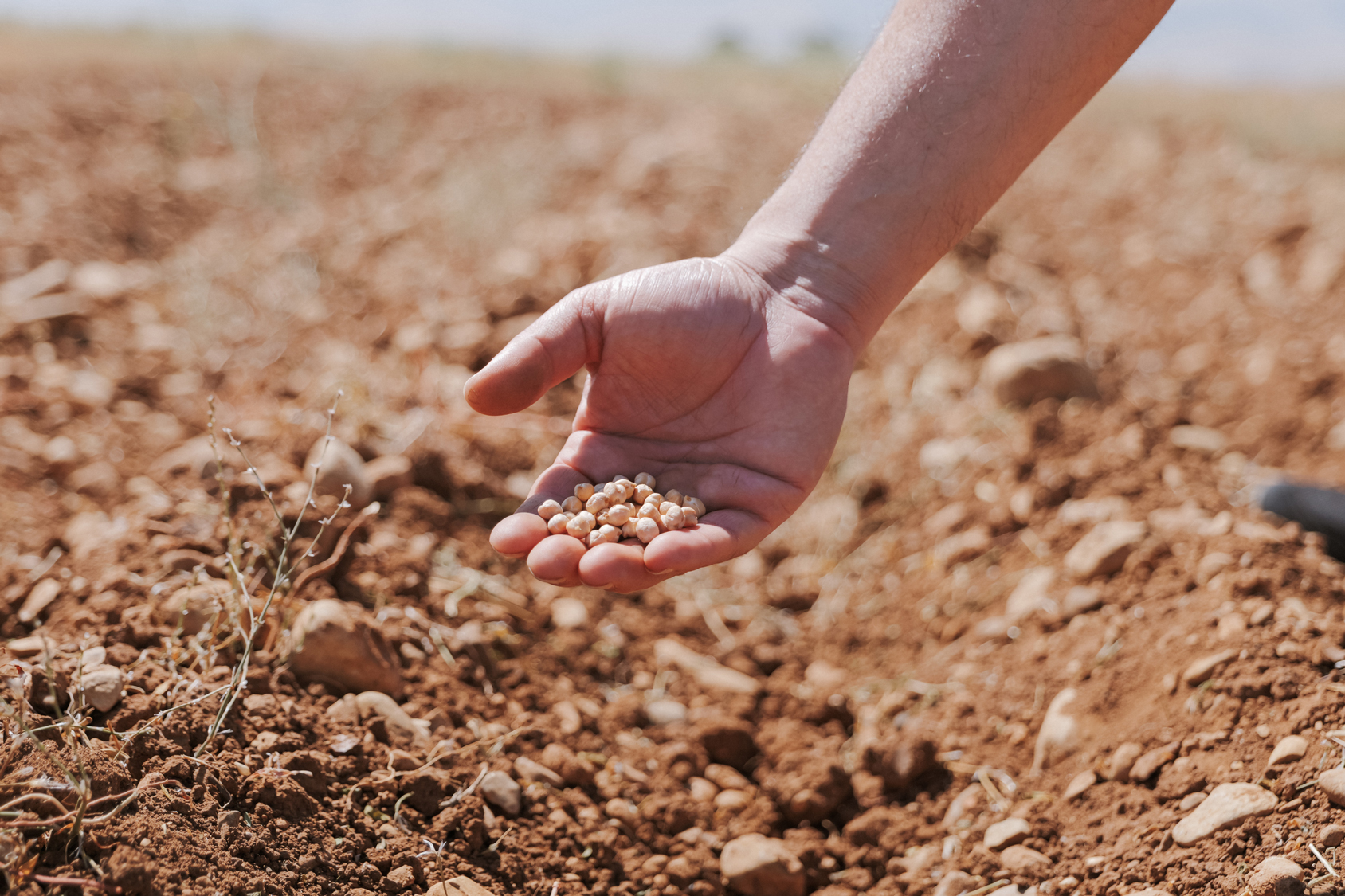
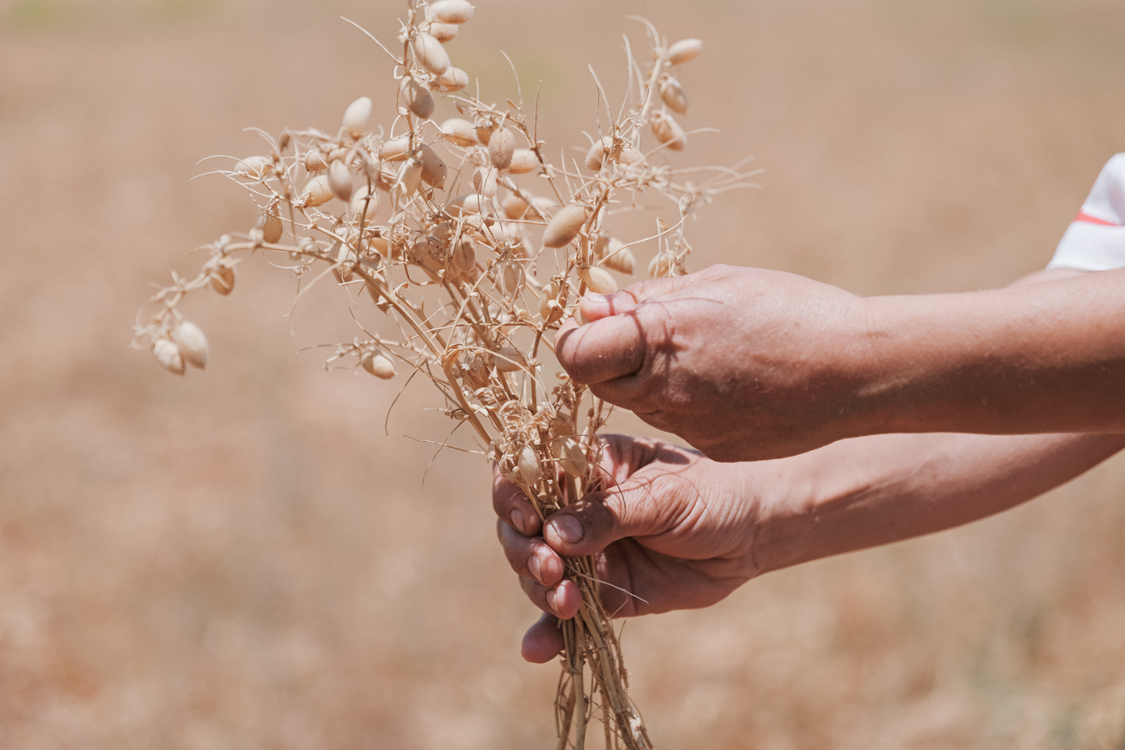
For generations, chickpeas have been at the heart of Lebanese cuisine. They are woven into the country's cultural identity, with domestic consumption averaging 3.25 kilograms per person per year. ©FAO/Ralph Azar
Lebanon’s Chickpea Revival Puts Farmers Back at the Centre
In a world where food supply chains are increasingly shaped by conflict, climate shocks and currency volatility, even a handful of chickpea seeds can carry geopolitical weight. In Lebanon’s Bekaa Valley, farmer Marie Therese Zeidan bends over her field and scoops seeds from an open sack, letting them fall slowly through her fingers as she prepares to sow.
“Holding these chickpea seeds means more than preparing for the next planting season,” she says. “It is a gesture of hope for future seasons.”
For Lebanon, that hope is inseparable from food security. Chickpeas are not a niche crop here but a dietary cornerstone. From hummus and falafel to balila, they are consumed year-round, with average per capita consumption reaching 3.25 kilograms annually. Yet despite favourable growing conditions, Lebanon today imports more than 70 per cent of the chickpeas it eats, exposing households to volatile global prices and a fragile import system in a country already strained by economic collapse.
This vulnerability is not unique to Lebanon. Across import-dependent economies, particularly in the Middle East and North Africa, reliance on global pulse markets has become a growing risk as climate change disrupts production, logistics costs rise and exporting countries tighten supplies. Chickpeas, a key source of plant-based protein, have quietly emerged as a strategic food commodity.
In Lebanon, the roots of dependency run deep. Years of limited access to quality seeds, outdated cultivation methods and inconsistent yields pushed farmers away from chickpeas, despite their cultural and agronomic importance. As production declined, imports filled the gap, weakening local farming systems and increasing exposure to external shocks.
That trajectory is now being challenged. In the Bekaa Valley and North Lebanon, farmers are returning to chickpea cultivation under a renewed national push supported by the Food and Agriculture Organization of the United Nations (FAO) through its One Country One Priority Product initiative, implemented in partnership with Lebanon’s Ministry of Agriculture. The effort is not simply about reviving a traditional crop but about restoring a measure of control over a critical food source.
At the centre of the shift is access to certified, high-performing chickpea varieties, replacing recycled seeds that delivered uneven results. Farmers are being trained in improved agronomic practices, including optimal sowing times, seeding rates, row spacing and fertiliser use. Integrated pest and disease management is emphasised, with early detection and preventive methods such as pheromone and insect traps reducing dependence on chemical pesticides.
Chickpeas offer an advantage that few crops can match in a warming, resource-constrained world. Grown largely under rain-fed conditions, they form a symbiotic relationship with nitrogen-fixing bacteria, improving soil fertility and lowering the need for synthetic fertilisers. In farming systems facing rising input costs and soil degradation, this dual role as food source and soil builder is increasingly valuable.
A critical innovation has been the introduction of winter chickpea varieties developed by the Lebanese Agricultural Research Institute. More tolerant to cold and drought, these varieties allow planting in November and December rather than March, making better use of seasonal rainfall and reducing exposure to late-season drought. For a country where chickpea production is predominantly rain-fed, the yield gains are significant.
During recent training sessions led by FAO in collaboration with the Ministry of Agriculture and the Lebanese Agricultural Research Institute, more than 500 farmers gathered to learn practical techniques aimed at improving productivity and resilience. “We learned how to prepare the land, treat seeds to prevent disease and irrigate at the right stages,” Marie Therese says. “Even with less rain, we saw that a good harvest is still possible.”
In North Lebanon, Bilal Abdul Karim Muhammad, a farmer with four decades of experience, has seen the results firsthand. “We learned about organic practices that are less costly and better for soil health,” he says. Since adopting winter cultivation and improved seed treatments, his yields have climbed to around 300 kilograms per dunum. “The quality, the taste, the size and the texture are also much better.”
Since Lebanon joined the One Country One Priority Product initiative in 2022, the country has begun rebuilding its chickpea value chain. More than 520 farmers have been trained in improved crop management, while 29 extension agents from the Ministry of Agriculture have been equipped to conduct field demonstrations, extending the reach of new knowledge beyond initial participants.
The effort extends beyond production. Public events and value-chain dialogues are linking farmers to consumers, policymakers and agrifood system actors, reinforcing the role of local pulses in national nutrition and food security strategies. At the same time, innovation is reshaping markets. Chickpea-based products such as gluten-free flour, roasted snacks, protein bars, pasta, chips and beverages are creating new demand and increasing the value of local harvests.
The Lebanese government has set a target of meeting 40 per cent of national chickpea demand through domestic production by 2030, while maintaining premium quality standards and generating rural employment. FAO is supporting this scale-up by strengthening farmer capacity, developing accessible technical resources, convening investment workshops and promoting the chickpea sector at the national level.
For global food security observers, Lebanon’s experience offers a broader lesson. As climate variability intensifies and international markets become more unpredictable, rebuilding domestic production of resilient, nutrient-dense crops is no longer a matter of nostalgia or rural development. It is a strategic response to systemic risk.
For farmers like Marie Therese, the global implications are felt in everyday decisions in the field. Each planting season tests whether knowledge, innovation and collective effort can outpace uncertainty. If they succeed, Lebanon’s chickpea revival may stand as a reminder that food security is not secured at ports and contracts alone, but in soils, seeds and the hands that sow them.
Source: The FAO News And Media Office, Rome
– global bihari bureau