 By Dr. Adish C. Aggarwala*
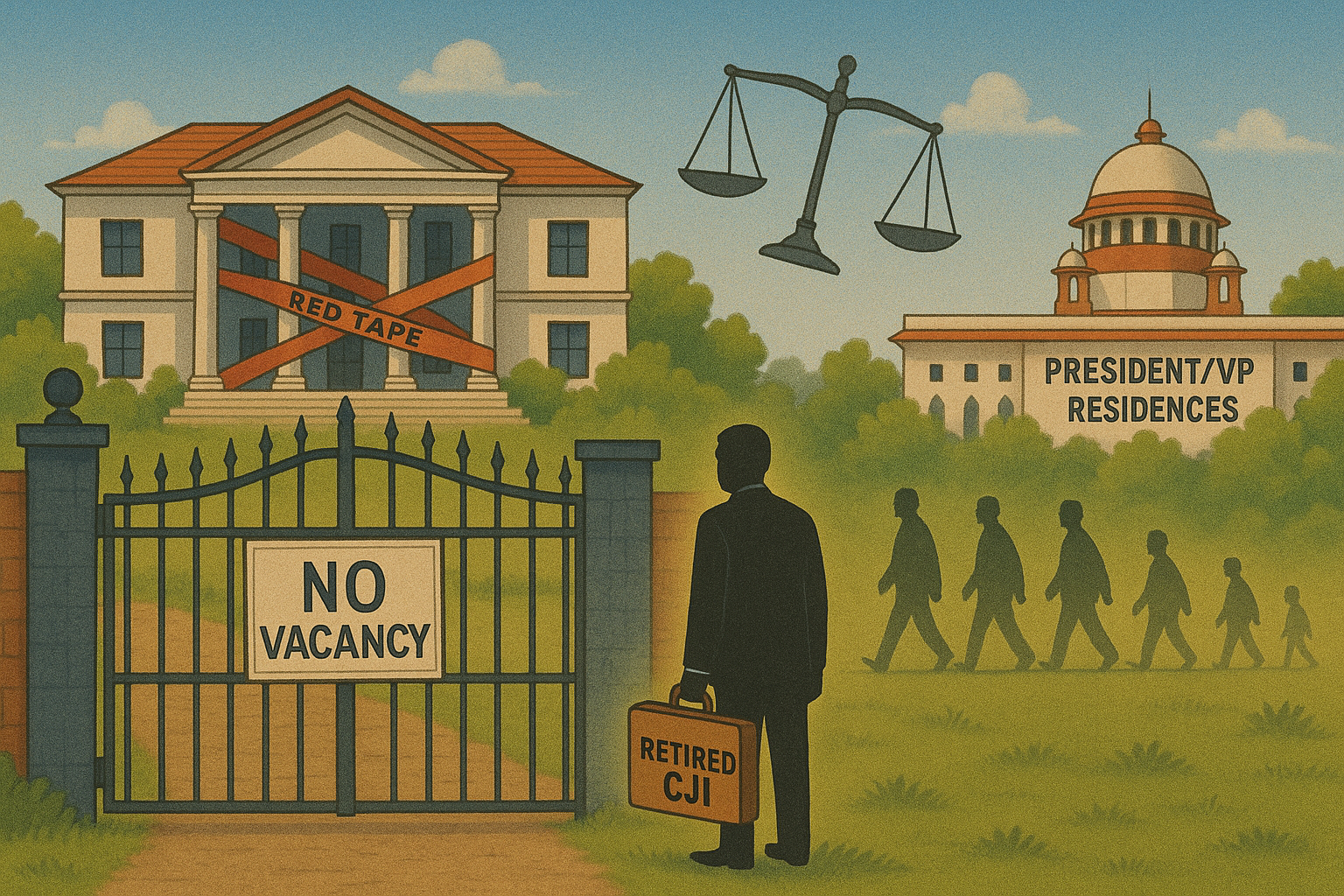
New Delhi: The controversy over former Chief Justice of India, Justice Dr. Dhananjaya Yashwant Chandrachud, overstaying in his official residence has exposed a critical gap in supporting India’s highest constitutional functionaries, prompting calls for legislative reform to ensure their post-retirement dignity. The proposed legislation would provide lifelong government accommodation to former Prime Ministers, Speakers of the Lok Sabha, and Chief Justices of India, mirroring the privileges granted to former Presidents and Vice-Presidents under Section 2(a) of the President’s Emoluments and Pension Act, 1951, and Section 2(a) of the Vice-President’s Pension Act, 1997, respectively. Such a measure would honour the democratic framework by ensuring stability for those who have served in these esteemed offices.
The issue emerged when Dr. Chandrachud, who served as Chief Justice for two years and one day, faced significant difficulties in securing suitable private housing in Delhi after his retirement. Under Rule 3B(5) of the Supreme Court Judges (Amendment) Rules, 2022, a retired Chief Justice is entitled to a rent-free Type-VII accommodation in the capital for a period of six months from the date of retirement.
Despite this provision, Dr. Chandrachud could not find a residence meeting the standards of dignity, security, and status befitting his former office. In a spirit of accommodation, the Government of India granted an extension for him to retain the official Chief Justice residence at 5, Krishna Menon Marg, a designated bungalow. This decision, however, inadvertently delayed the occupation of the residence by his successor, Justice Sanjiv Khanna, and subsequently, the current Chief Justice, Justice B.R. Gavai, who, 47 days into his tenure, remains unable to move into the official bungalow. The Supreme Court Registry was compelled to approach the Secretary, Ministry of Housing and Urban Affairs, to facilitate steps to vacate the residence, underscoring the practical challenges faced by even the nation’s highest judicial officers.
The brevity and uncertainty of judicial tenures, driven by India’s seniority-based appointment system, stand in stark contrast to the fixed five-year terms of Presidents, Vice-Presidents, Prime Ministers, and Lok Sabha Speakers, who are often eligible for re-appointment. Historical tenures of Chief Justices highlight this disparity: Justice Y.V. Chandrachud served for seven years and 139 days, the longest tenure; Justice K.G. Balakrishnan for three years and 117 days; Justice Adarsh Sein Anand for three years and 21 days; Justice Sarosh Homi Kapadia for two years and 139 days; Justice J.B. Pardiwala is expected to serve two years and 100 days; Justice D.Y. Chandrachud for two years and one day; Justice Ramesh Chandra Lahoti for one year and 152 days; Justice Sharad Arvind Bobde for one year and 156 days; Justice N.V. Ramana for one year and 124 days; Justice Vishweshwar Nath Khare for one year and 134 days; Justice Yogesh Kumar Sabharwal for one year and 73 days; Justice H.L. Dattu for one year and 65 days; Justice Ranjan Gogoi for one year and 45 days; Justice Dipak Misra for one year and 35 days; Justice T.S. Thakur for one year and 31 days; Justice Surya Kant is expected to serve one year and 78 days; Justice Altamas Kabir for 292 days; Justice P. Sathasivam for 281 days; Justice K.V. Viswanathan is expected to serve 287 days; Justice Jagdish Singh Khehar for 235 days; Justice Vikram Nath is expected to serve 226 days; Justice B.R. Gavai will serve for 194 days; Justice P.S. Narasimha is expected to serve 186 days; Justice Sanjiv Khanna served for 183 days; Justice R.M. Lodha for 153 days; Justice Joymalya Bagchi is expected to serve 130 days; Justice Uday Umesh Lalit for 73 days; Justice B.V. Nagarathna is expected to serve 36 days; and Justice S. Rajendra Babu for a mere 29 days. These varying tenures emphasise the need for a systemic solution to ensure post-retirement stability.
Private housing in Delhi rarely meets the standards required for constitutional functionaries who have shouldered the immense responsibility of upholding India’s democratic values. The rationale for granting lifelong government accommodation to former Presidents and Vice-Presidents is rooted in safeguarding their dignity and upholding the prestige of their offices in the public eye and on the global stage.
Extending similar provisions to former Prime Ministers, Speakers, and Chief Justices would address practical challenges and reflect India’s collective national respect for the heads of all three pillars of democracy—the Legislature, the Executive, and the Judiciary. Such a measure would align with existing provisions and strengthen constitutional governance by addressing real challenges faced by these office-bearers.
This issue transcends individual inconvenience, raising broader questions about how India supports those who have served at the apex of its constitutional framework. The proposal has sparked discussions in legal and political circles, highlighting the need for reform to uphold the dignity of constitutional offices.
*The writer is a Senior Advocate, Chairman, All India Bar Association, & Former President, Supreme Court Bar Association. He has also raised these points in a letter to Prime Minister Narendra Modi today.