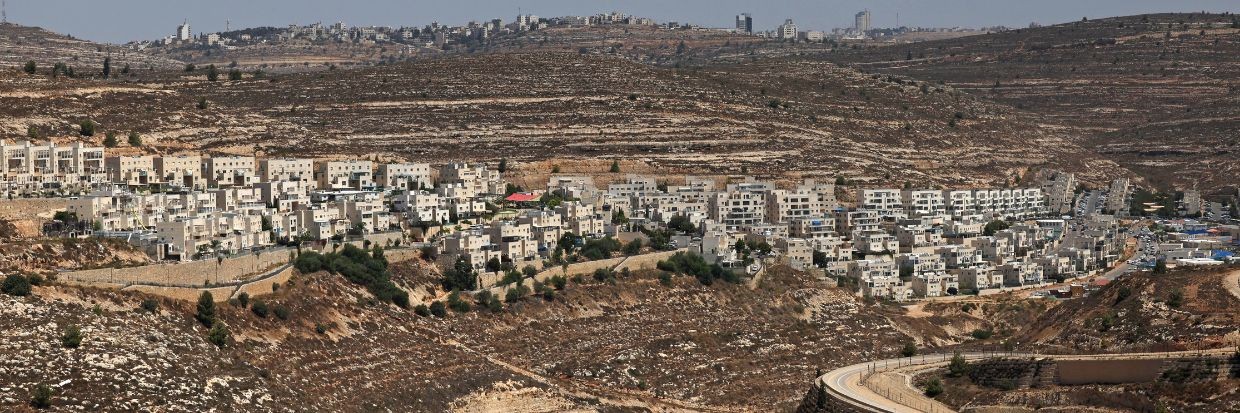
File photo of an Israeli settlement in West Bank. Photo source: OHCHR
Gaza Ceasefire Holds, But West Bank Settler Violence Escalates—UN Demands Enforcement
In Gaza, where a fragile ceasefire between Hamas fighters and Israel has held for nearly a month, the sight of thousands of schoolchildren streaming back to in-person classes in renovated facilities marks a tentative return to routine amid the rubble. Yet this fragile normalcy is undercut by the ongoing military activity there.
The “daily detonations” of residential buildings continue in areas where Israeli forces remain deployed—eastern Khan Younis, eastern Gaza City, and Rafah—erasing homes even as aid trucks deliver 5,000 tents and 85,000 tarpaulins to shield families from winter.
The juxtaposition is jarring, as the Office for the Coordination of Humanitarian Affairs (OCHA) observes starkly – children reciting lessons under patched roofs while, blocks away, explosives level what little shelter remains, a reminder that the truce has paused open combat but not the systematic dismantling of civilian life.
This duality defines Gaza’s post-truce reality. Since October 2025, over 680,000 people have moved south to north, 113,000 within Khan Younis, chasing safety and scraps of normalcy. Two hundred truckloads of essentials have crossed since the truce—bringing multi-purpose cash to 55,000 households ($378 each) for food, hygiene, and debt relief. Malnutrition treatment operates at 133 sites, including 20 in Gaza City, where famine was confirmed in August; 90,000 women and girls received reproductive health kits. Yet the United Nations Secretary-General warns that despite improved aid access, “[the UN is] far from [having] what is necessary to eliminate famine quickly and to create the conditions for the people in Gaza to have the very, very minimum that is necessary for dignity in life.”
Fuel shortages force 60 per cent of residents to cook over burning trash; food prices have spiked up to 9,900 per cent. Since October 2023, 66,148 have been killed and 168,716 wounded, per Gaza health ministry figures cited by the office; 123,000 buildings are destroyed, 50,000 severely damaged, and 5,700 northern structures newly hit since July.
Israeli authorities rejected 107 aid requests, 90 per cent from NGOs, citing security risks for items like generators and solar panels. The Office of the United Nations High Commissioner for Human Rights (OHCHR) spokesperson Thameen Al-Keetan, asked about plans for an international stabilisation force in Gaza, insisted that any such force “must respect international law and international humanitarian law.” The right to Palestinian self-determination throughout the Occupied Palestinian Territories must also be respected, he continued: “Whether there is a ceasefire or not, international humanitarian law, and international human rights law must be respected and civilians must be protected and human rights of people, of Palestinians in Gaza, do not change, whether there is a ceasefire or not.”
Across the separation barrier, in the occupied West Bank, a parallel crisis of displacement and violence unfolds with equal impunity. Since war erupted in Gaza following Hamas-led terror attacks in Israel, Israeli security forces and settlers have killed 1,010 Palestinians in the West Bank, including East Jerusalem—and this figure includes 215 children—the office stated. “When it comes to the West Bank, attacks by settlers are continuing,” Al-Keetan said, with the olive harvest season seeing the highest violence in five years—farmers assaulted, groves torched, trees chainsawed, often in view of soldiers who shield attackers rather than intervene. Israel maintains these are isolated acts by extremists and that forces enforce law and order, though the arming of 8,000 settler “defence squads” since October 2023 raises questions of state involvement.
A new report from the UN human rights office on settlement expansion in the West Bank highlights how new demolition orders impacting longstanding Palestinian communities there threaten more with forced displacement. The office’s report spotlights Umm al-Khair residents, a community of 35 extended families living there since their expulsion from their lands in Negev during the mass forcible displacement of Palestinians in 1948 to 1949, which is known as the Nakba, OHCHR said. The small Bedouin community of 200–250 residents in the South Hebron Hills’ Masafer Yatta region, near the illegal Carmel settlement, has sustained a shepherding lifestyle that once supported 5,000 goats and sheep—now reduced to about 1,000 due to land loss and restricted grazing. The village lacks basic infrastructure: no centralised water or electricity, while Carmel settlers enjoy both.
Residents of Umm al-Khair have long faced “discriminatory” land regulations and demolitions imposed by Israel, which regards their housing as illegal because they lack building permits, which are “almost impossible” for them to obtain, OHCHR alleged. Approval rates for Palestinians in Area C hover below 1 per cent. Umm al-Khair has endured over 20 demolition waves since the 1990s, with the latest on October 28, 2025, issuing mass orders for 11 homes and community infrastructure, threatening to displace 50 residents, including 30 children. In June 2024, forces razed 11 structures—homes, tents, a generator, solar panels, and water tanks—leaving 38 homeless. The area falls within Firing Zone 918, designated in the 1980s for military training; Israel’s Supreme Court upheld it in 2022, enabling evictions, though the zone is deemed illegal under international law for facilitating forced displacement.
According to the UN Human Rights Office, Israeli settlers have built new outposts connected to the nearby Carmel settlement and expanded their footprint in the occupied territories. In September, they allegedly erected an outpost in the centre of Umm al-Khair, and “intensified harassment” of Palestinian residents to force them to leave. Settler violence has intensified since October 7, 2023: daily harassment includes stalking, threats of sexual violence, livestock theft, and arson. A
Jerusalem court issued a temporary injunction stopping construction and barring settlers from entering the outpost, but “authorities have taken no action to enforce the court order, in stark contrast to the frequent and swift demolitions of Palestinian structures,” OHCHR maintained (over 1,000 structures in 2024). On July 28, 2025, activist Awdah Hathaleen, 31, was shot dead by a settler during a protest against a new settlement road; his body was withheld for weeks, prompting a women-led hunger strike demanding its return for traditional burial. Over a dozen men were arrested afterwards, some for alleged rock-throwing.
“The attacks have been increasing, and we have seen that recently, especially with the olive harvest season. These must stop, and there must be accountability,” Al-Keetan told journalists. “There must be accountability for settlers and for members of Israeli security forces who are involved in these attacks. And of course, we refer back to the ruling by the International Court of Justice that it’s very crucial for the unlawful Israeli presence in the Occupied Palestinian Territory to end.”
Community leader Eid Hathaleen describes Umm al-Khair as “an example for Palestinian communities in Area C,” resisting nonviolently through documentation and groups like the ‘Good Shepherd Collective’. The village gained global attention via the Oscar-winning film No Other Land (2024), co-directed by residents. Settlement expansion added 49 outposts and nine settlements in the past year, including East Jerusalem. Economic damage: 96,000 dunums of olive groves unharvested in 2023 ($10 million loss); total agricultural harm since October 2023 exceeds $76 million.
The office documented 7,500 Israeli raids in the West Bank this year—up 37 per cent—with 612 Palestinians killed in 2025 alone (24 Israelis in clashes). Data sources include Palestinian health records, field monitors, and verified incidents; Israel disputes casualty counts and settler complicity.
As 150 businesses sustain settlements and 90 Silwan families face eviction risk, the office’s 238,591 psychosocial support cases since 2023—including 2,769 gender-based violence survivors—underscore lingering trauma. With 660,000 children out of school for a third year, the divide between documented violations and tangible remedies persists.
– global bihari bureau